


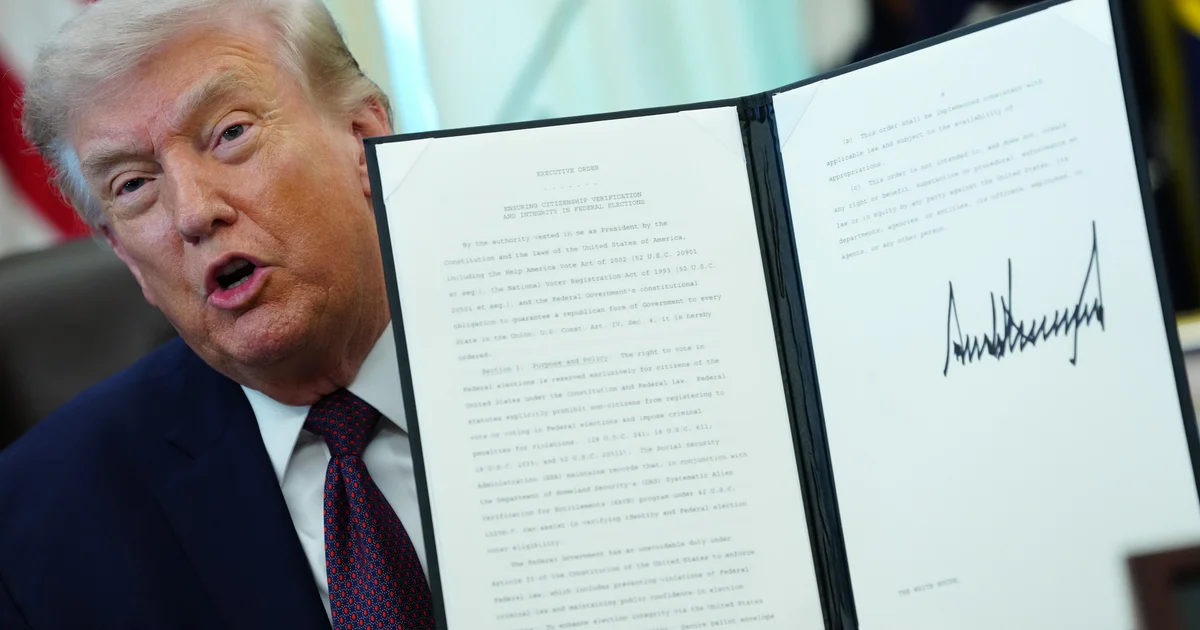
Washington — Officials from 23 Democratic states and the District of Columbia filed a lawsuit Friday seeking to block President Trump’s latest executive order that aims to restrict mail voting, arguing the directive unconstitutionally attempts to interfere with states’ administration of elections.
The lawsuit, led by California, was filed with the U.S. district court in Massachusetts. It asserts that neither the Constitution nor any federal law gives the president the power to mandate widespread changes to states’ electoral systems or voting procedures.
The measure, they said, “transgress Plaintiff States’ constitutional power to prescribe the time, place, and manner of federal elections” and seeks to “amend and dictate election law by fiat based on the President’s whims.”
The executive order at the center of the challenge was signed by Mr. Trump on Tuesday, months before the November midterm elections, and lays out new requirements related to mail voting. The directive calls for the Department of Homeland Security to compile “State Citizenship Lists” of U.S. citizens who are eligible to vote in federal elections and requires the U.S. Postal Service to send mail or absentee ballots only to voters on each state’s list.
Mr. Trump’s measure also lays out specific requirements for mail ballot envelopes, including requiring them to bear a unique barcode for tracking. States and localities that don’t comply with the executive order are at risk of losing federal funding.
The directive has already been challenged by a coalition of major Democratic groups, which accused Mr. Trump of attempting to rewrite election rules for partisan gain.
In the lawsuit, the states warned that the president’s order “violates bedrock principles of federalism and separation of powers.”
“Each Plaintiff State has duly enacted laws governing voter rolls and mail voting that are, where applicable, consistent with statutory requirements set forth by Congress,” they wrote. “The EO disregards States’ inherent sovereignty and attempts to arrogate to the President the States’ and Congress’s constitutional power to regulate federal elections.”
Mr. Trump has long railed against mail voting, claiming that the method is “cheating” and compromises election integrity. But instances of mail-voting fraud are rare, and there is no evidence of widespread voter fraud.
The president himself has taken advantage of voting by mail, casting a mail ballot in a special election last month for a Florida state House seat. First lady Melania Trump and his son Barron Trump also voted by mail, according to records from the Palm Beach County Supervisor of Elections.
The Constitution’s Elections Clause gives states the power to set the “times, places and manner” of federal elections, and Congress also has the authority to pass election regulations. While Mr. Trump often accuses Democratic states of allowing noncitizens to cast ballots in federal elections, it is a federal crime to do so. Instances of noncitizen voting are rare.
The president’s executive order comes as he has pressured the Senate to pass the SAVE America Actwhich would require Americans to show proof of citizenship in person to register to vote in federal elections and implement photo ID requirements for voting. The House approved the measure in February, but it’s unlikely to clear the GOP-led Senate, where most legislation requires 60 votes to advance.
Mr. Trump signed another election-related executive order last year, which sought to overhaul U.S. elections and require documentary proof of citizenship to register to vote, but key provisions have been blocked in court.