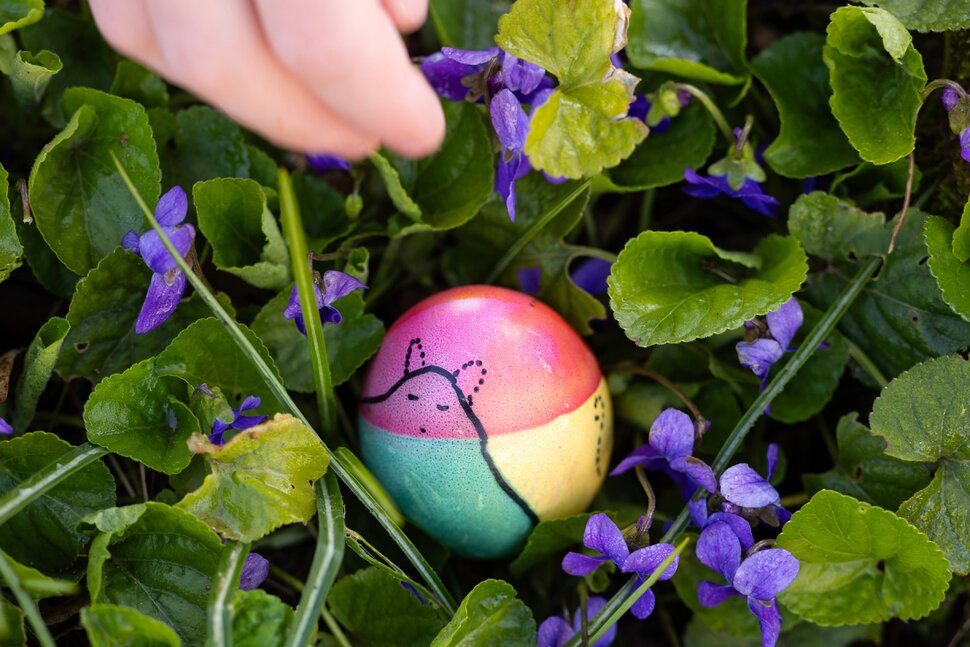
The Lenten season comes to an end on April 5 this year for Easter Sunday, the Christian celebration of the resurrection of Jesus Christ three days after his crucifixion.
From sawdust carpets to exploding doves, Easter is celebrated differently in countries around the world. Here are a few of the unique Easter traditions that remain prevalent today.
Italy (Florence): The Exploding Dove

Stefano Cellai|REDA|Universal Images Group via Getty Images
Italy. Tuscany. Florence. Easter Sunday. The Explosion of the Chariot.
On Easter Sunday, Florentines and crowds of tourists can be found heading toward the Piazza del Duomo. Some wait along the streets outside and some head in to celebrate morning Mass. At around 11 a.m., all people present can witness the explosion of the cart, or “the explosion of the wagon.”
The cart, named “Brindellone,” is a tall wooden structure covered in Florentine coats of arms and symbols. On Easter morning, it is pulled through the streets of Florence escorted by the Historic Procession of the Florentine Republic. The cart is placed outside the duomo to begin the ceremony.
Simultaneously, a rocket shaped like a dove, the “colombina,” is placed on a wire and shot down from the church’s highest altar. The dove soars through the church and outside, where it hits the cart and triggers fireworks. The dove is then shot back up to its starting point – a successful flight is known as good fortune for an abundant harvest.
The tradition revolves around Pazzino de’ Pazzi, a Florentine captain and the first to climb the walls of Jerusalem. He received three splinters or pieces of wood that are kept in the church of Santi Apostoli. The wood is used to light the holy fire that is carried through a procession on Holy Saturday. The modern rendition includes fireworks instead of fire.
France (Bessiéres): The Giant Omelet

REMY GABALDA|AFP via Getty Images
Members of the brotherhood of the Bessieres’ giant Easter omelette prepare a giant omelette with thousands of eggs, on April 21, 2014, in Bessieres, southwestern France.
The use of eggs is common in Easter traditions, but the residents of Bessiéres in southwest France take it to the next level. The final event of a three-day celebration is the creation of a 15,000 egg omelet large enough to feed over 2,000 people.
Hundreds of volunteers gather to help crack and whisk eggs to be poured in a 13-foot pan over a bonfire in the city’s center. Chives, salt, pepper and mild chili pepper are added to the egg mixture. The Bessiéres Chevaliers, or knights, are in charge of stirring the mixture with wooden paddles. Around 30 minutes later, the omelet is then distributed among the members of the community.
The story of the festival’s origin is a tall tale of Napoleon Bonaparte, who was said to have enjoyed the omelet at a local hotel so much that he had one ordered large enough to feed his entire army.
Greece (Corfu): Smashing Pots

SAKIS MITROLIDIS|AFP via Getty Images
People throw clay pots filled with water off balconies as they take part in a custom at Corfu island that takes place on Holy Saturday morning, on April 7, 2018.
On the morning of Holy Saturday at 11 a.m., the bells of all the churches in Greece are rung. This signals the Easter custom of “botides.” Locals throw botides, or large clay pots decorated with red ribbons and filled with water, from their windows and balconies.
After the pots are smashed, the feast begins. Orchestras walk the streets playing the song “Greeks Do Not Fear.” The tradition is said to have originated during the time of Venetian rule in Greece. Locals and tourists collect the shards of broken jugs as they are said to bring good luck.
Guatemala (Antigua): Sawdust Carpets

JOHAN ORDONEZ | AFP via Getty Images
Catholic faithful create sawdust carpets in Antigua, Guatemala, on March 1, 2026, ahead of the procession of Jesus Nazareno on the second Sunday of Lent.
Each carpet is made by a community or church group. Many spend months developing their designs. On the day of the event, anywhere between four and 10 people start to decorate in their assigned area, volunteers spray water to keep the sawdust from blowing away throughout the process. It takes around five to six hours to complete the design.
The tradition dates back to around 500 years ago, during the Spanish conquest of Guatemala. Alfombras were originally made to educate people about Bible stories.
Czech Republic: Easter Whip

RADEK MICA|AFP via Getty Images
Boys in traditional dresses symbolically beat a girl with small whips during a traditional Easter festivity on Easter Monday, April 6, 2015, in the village of Vlcnov in the southeastern region of the Czech Republic.
An unusual tradition in the Czech Republic stems from the word “pomladit,” which means “to make younger.”. On Easter Monday, the men go around and “whip” the women in their lives to give them good luck and fertility. The men use a “Pomlázka,” a whip made of fresh willow branches and decorated with ribbons.
The whip is usually not harsh but rather a tap or pet on their legs or backside. In some places, dousing women with water is another fertility ritual. In return, the women are supposed to give men painted eggs or chocolate.
While people still partake, many are opposed to violence against women. The whips are commonly used for decorations now.