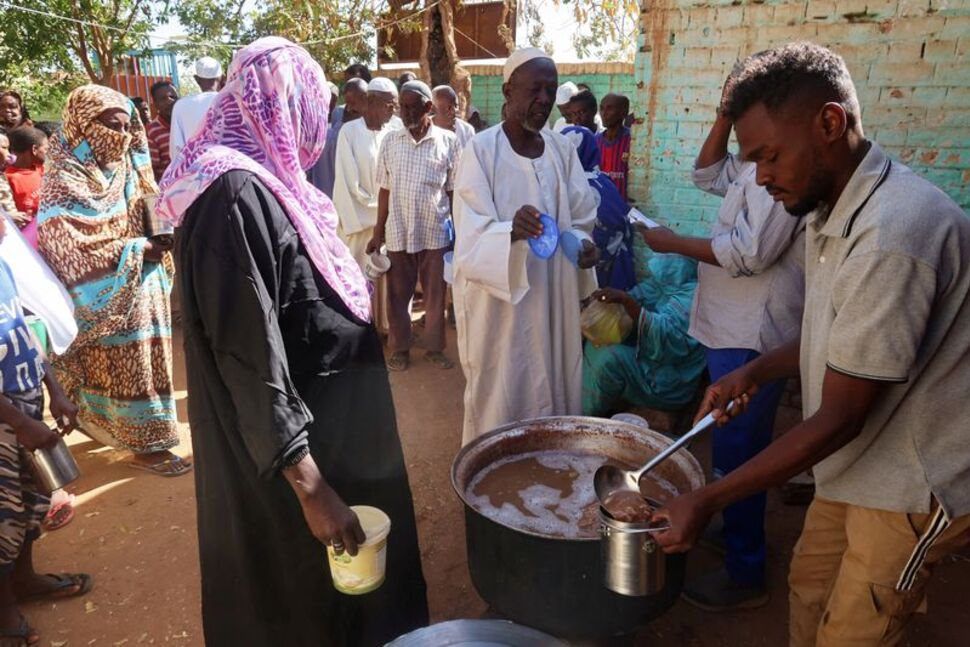
GENEVA, April 13 (Reuters) – Millions of people in Sudan are surviving on just one meal a day, as the country’s food crisis deepens and threatens to spread, according to a report published on Monday by a group of non-governmental organisations.
Sudan’s war https://www.reuters.com/world/sudan/ between the Sudanese army and the paramilitary Rapid Support Forces, which enters its third year on Wednesday, has caused widespread hunger and displaced millions of people amid one of the world’s largest humanitarian crises.
“In the two areas worst hit by the conflict – North Darfur and South Kordofan – millions of families can only access one meal a day,” the report by Action Against Hunger, CARE International, International Rescue Committee, Mercy Corps, and the Norwegian Refugee Council found.
“Often, they miss meals for entire days,” the report stated, adding that many people have resorted to eating leaves and animal feed to survive.
GOVERNMENT DENIES FAMINE
The army-aligned Sudanese government denies the existence of famine, while the RSF denies responsibility for such conditions in areas under its control.
Some 61.7% of Sudan’s population – 28.9 million people – is acutely food-insecure, according to the 2026 Humanitarian Needs and Response Plan.
The United Nations has reported widespread atrocities and waves of ethnically charged violence. In November, the global hunger monitor confirmed, for the first time, famine conditions nL1N3WF0K3 in al-Fashir, as well as Kadugli.
In February, the U.N.-backed Integrated Food Security Phase Classification found that famine thresholds nL8N3Z10OY for acute malnutrition have been surpassed in Um Baru, where the rate of acutely malnourished children under 5 was nearly double the famine threshold, and Kernoi.
The report, based on interviews with farmers, traders, and humanitarian actors in Sudan, details how the war in Sudan is driving communities towards famine conditions – due to disruptions to farming as well as the use of starvation as a weapon of war – including deliberate destruction of farms and markets.
Communal kitchens are increasingly unable to meet rising needs, while major donor funding cuts nL6N3WU0OY are impeding aid agencies’ abilities to respond, the report said.
Women and girls have been disproportionately affected, as they face a high risk of rape and harassment when going to fields, visiting markets or collecting water, the report said. Female-headed households are three times more likely to experience food insecurity than male-headed households, it added.
(Reporting by Olivia Le Poidevin; additional reporting by Nafisa Eltahir in Cairo; Editing by Rod Nickel)
Copyright 2026 Thomson Reuters.
Photos You Should See – April 2026
