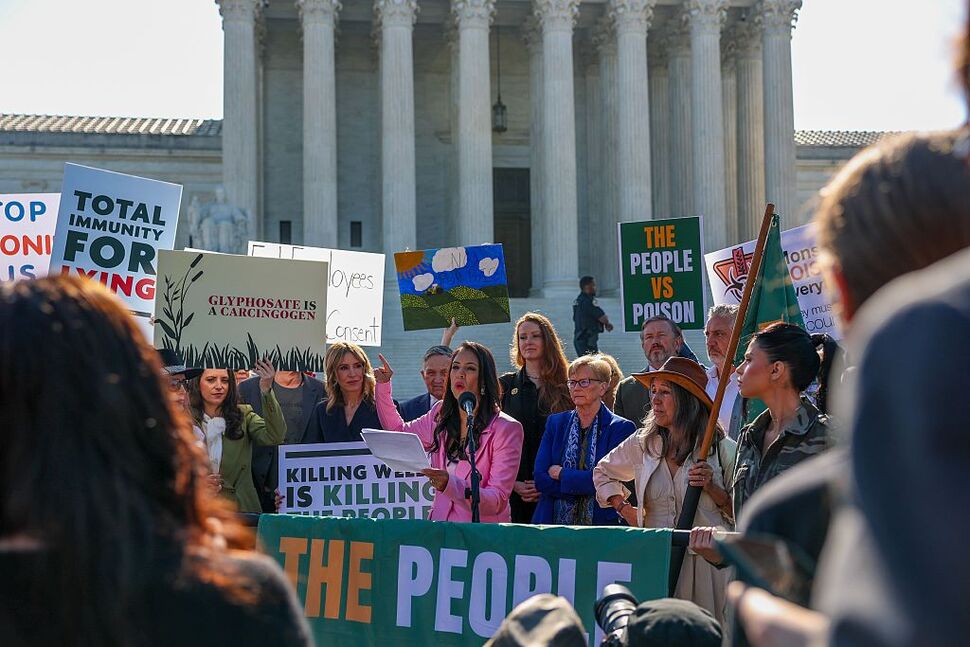
The Supreme Court on Monday heard oral arguments over an effort from agrochemical company Bayer to shut down thousands of lawsuits alleging the company failed to warn users of its popular weed killer Roundup that the product poses a cancer risk.
It was unclear Monday which way the justices would fall, though several appeared receptive to the argument that Bayer can be sued for damages under state laws despite conclusions from federal regulators that the product is safe.
Bayer has been defending against litigation over Roundup since its $63 billion purchase in 2018 of Monsanto, the company that introduced the herbicide.
What’s the Supreme Court Bayer Case About?
John Durnell alleged that he developed non-Hodgkin lymphoma because of his exposure to Roundup. His case argued that Monsanto had a responsibility to tell Roundup users that the weed killer was a cancer risk. A jury in a Missouri state court awarded him $1.25 million in damages, and Bayer appealed.
The Environmental Protection Agency, however, does not require a cancer warning label on products that use glyphosate.
Paul Clement, who argued for Bayer on Monday, said that federal law should prevent claims like Durnell’s from being brought under state laws. He also warned against a patchwork of standards implemented across the U.S., an argument that some justices were receptive to.
But Durnell’s lawyer, Ashley Keller, pushed back, saying that both state and federal law must be followed.
Why the Supreme Court Decision Matters
The justices will decide whether thousands of lawsuits against Roundup’s maker, Monsanto, are allowed under federal law. A decision in Bayer’s favor would largely bring that litigation to an end, and billions of dollars are at stake.
Bayer in February proposed a $7.25 billion legal settlement to address current and future lawsuits, but that settlement wouldn’t affect claims that stem from pending appeals or fall outside the deal, which the company estimates amount to nearly $1 billion.
Beyond the legal scope, the Supreme Court case has the attention of the Make America Healthy Again movement, which has been hoping to see changes to how the U.S. handles pesticides under Health and Human Services Secretary Robert F. Kennedy Jr.
But many vocal MAHA members are upset with the Trump administration’s steps on glyphosate, including an executive order that called glyphosate “critical to the national defense” and granted limited legal immunity to manufacturers if they’re complying with federal directives.
Additionally, the Trump administration backed Bayer in the Supreme Court case, arguing that the EPA’s determination that glyphosate does not cause cancer preempts any state laws or lawsuits.
When Will the Supreme Court Rule on Roundup Lawsuits?
The Supreme Court is expected to rule by July.
What Is Glyphosate and Is It Safe?
Glyphosate is the most widely used herbicide in the country. Before 2023, it was an ingredient in the most famous glyphosate product, Roundup. But Bayer has issued a new formula for the weed killer since then amid thousands of lawsuits claiming glyphosate causes cancer.

Sign Up for U.S. News Healthcare of Tomorrow Bulletin
Your trusted source for critical insights and solutions-focused analysis.
By clicking “Sign Up”, you will receive the latest updates, including emails, from U.S. News & World Report and our trusted partners and sponsors, and you agree to our Terms and Conditions & Privacy Policy.
The World Health Organization’s cancer agency in 2015 said that glyphosate is “probably carcinogenic to humans.” But the Environmental Protection Agency under Trump in 2019 said that glyphosate does not cause cancer – a determination the Trump administration stands by.