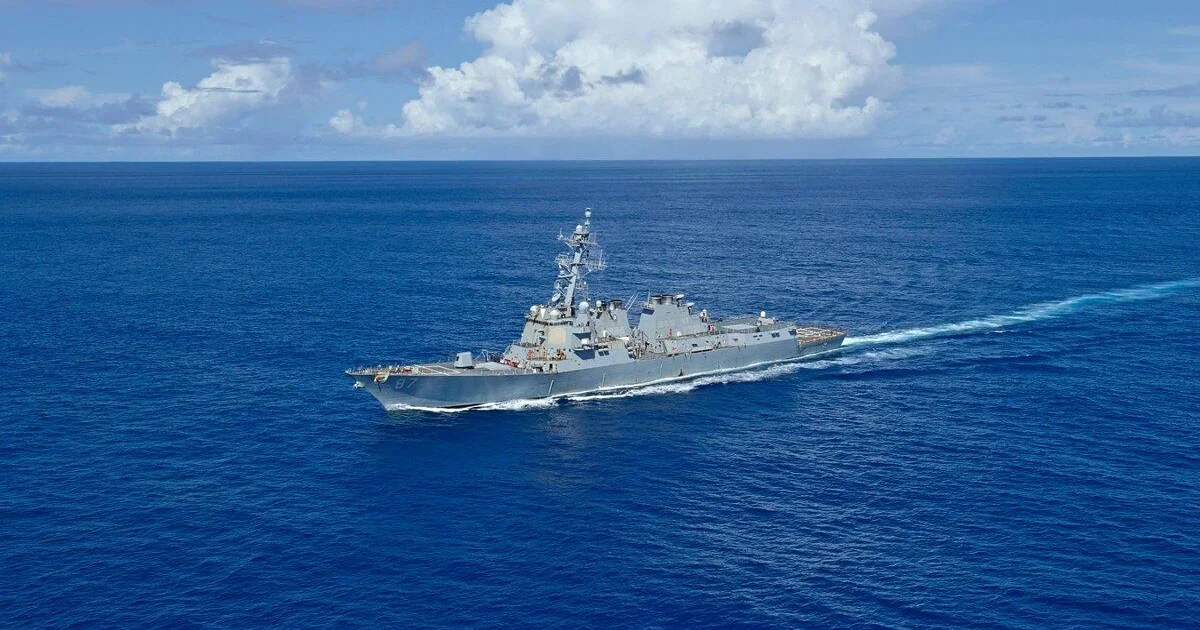
Macron calls on U.S., Iran to coordinate to open Strait of Hormuz, says France won’t join “unclear” military operation
French President Emmanuel Macron has called on the U.S. and Iran to reopen the Strait of Hormuz in a “coordinated” way, indicating that his country won’t join an effort announced by President Trump to “guide” commercial vessels out of the Persian Gulf under the threat of Iranian attack.
“What we want above all is a coordinated reopening by the United States and Iran — that is the only solution for reopening the Strait of Hormuz,” Macron told fellow European leaders during a meeting on Monday in Armenia.
“We are not going to take part in any military operation in a framework that to me seems unclear,” he said.
France and the U.K. have led efforts to build a coalition of nations to deploy military assets to the region to ensure the strait remains open and safe for shipping once peace is secured, but European countries have declined to take up those efforts until a deal is reached to end the war.
Iran’s Revolutionary Guard warns ships trying to transit Strait of Hormuz without permission “will be stopped with force”
Brigadier General Mohbi, a spokesman for Iran’s powerful Islamic Revolutionary Guard Corps, warned Monday that any vessel trying to transit the Strait of Hormuz without adhering to the regime’s “transit protocols,” which require coordination for passage “through designated routes with coordination,” will “face serious risks.”
“Violating vessels will be stopped with force,” said Mohbi in a message shared by Iranian state media.
It was the latest direct challenge from the Iranian regime to a plan announced by President Trump for a “humanitarian” military operation for American warships to “guide” commercial vessels out of the Persian Gulf via the Strait of Hormuz.
Dozens of tankers and cargo ships have been stuck in the Gulf for months as Tehran, in retaliation for the joint U.S.-Israeli war against Iran, has declared the strait — long an open international waterway vital to the transport of gas and oil — under its control, and attacked ships that don’t get its permission to use it.
U.S. Central Command 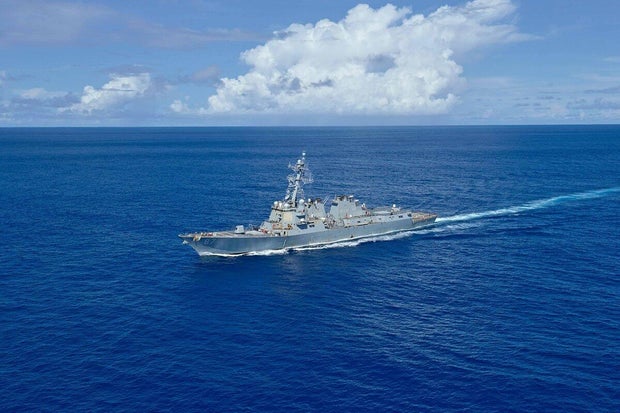
While an ongoing ceasefire between the U.S. and Iran has ended American strikes on the country, the U.S. has imposed a naval blockade of Iranian ports and vessels, which Tehran considers a breach of the truce. Iran has responded by maintaining its threat to commercial shipping, which has kept oil and gas prices high and fueled inflation around the globe.
U.S. military tells ships safe corridor established to transit Strait of Hormuz, with “high traffic volume” expected
The United States kicked off an effort to “guide” stranded ships from the Iran-gripped Strait of Hormuz, as it tries to counter economic disruptions that outlasted the peak of fighting with no peace deal in sight.
A day after President Trump announced what he called “Project Freedom,” the Joint Maritime Information Center said Monday that the U.S. had set up an “enhanced security area” south of typical shipping routes and urged mariners to coordinate closely with Omani authorities “due to anticipated high traffic volume.” The strait sits between Iranian and Omani territory.
The center warned that passing close to the usual routes, known as the traffic separation scheme, “should be considered extremely hazardous due the presence of mines that have not been fully surveyed and mitigated.”
The U.S.-led maritime task force’s announcement marked the start of the effort to revive traffic and restore confidence among commercial vessels transiting the strait.
The disruption of the waterway through which roughly one‑fifth of the world’s oil typically passes has become one of the most enduring consequences of the war that the U.S. and Israel launched Feb. 28. It has squeezed countries in Europe and Asia that depend on Persian Gulf supplies and added new volatility to energy prices for households and businesses worldwide.
Iran military says U.S. forces will be attacked if they enter Strait of Hormuz
Iran’s military said Monday that U.S. forces would be attacked if they entered the Strait of Hormuz, after President Trump announced Washington would begin escorting ships through the blocked waterway.
“We warn that any foreign armed force — especially the aggressive U.S. military — if they intend to approach or enter the Strait of Hormuz, will be targeted and attacked,” said Major General Ali Abdollahi of the Iranian military’s central command, in a statement carried by state broadcaster IRIB.
“We have repeatedly stated that the security of the Strait of Hormuz is under the control of the armed forces of the Islamic Republic of Iran, and under all circumstances, any safe passage must be coordinated with these forces,” he added.
Iran’s Revolutionary Guards say U.S. faces stark choice
Iran’s Revolutionary Guards said Sunday the United States faced a choice between an “impossible” military operation or a deal with Tehran, after President Trump disparaged Iran’s latest peace proposal.
Iran’s foreign ministry said Tehran had submitted a 14-point plan “focused on ending the war” and that Washington had already responded to it in a message to Pakistani mediators, which Iran was reviewing.
Project Freedom to include guided-missile destroyers, 15,000 service members, CENTCOM says
Project Freedom, the effort announced by President Trump to help merchant vessels get through the Strait of Hormuz, will include “guided-missile destroyers, over 100 land and sea-based aircraft, multi-domain unmanned platforms, and 15,000 service members,” U.S. Central Command said Sunday night.
Further details on what the operation would involve were not provided.
Trump announces effort to guide ships out of Strait of Hormuz
President Trump on Sunday said an effort to guide ships from countries not involved in the war with Iran safely out of the Strait of Hormuz, dubbed Project Freedom, will begin Monday.
“For the good of Iran, the Middle East, and the United States, we have told these Countries that we will guide their Ships safely out of these restricted Waterways, so that they can freely and ably get on with their business,” Mr. Trump wrote on Truth Social.
“In all cases, they said they will not be returning until the area becomes safe for navigation, and everything else,” Mr. Trump wrote.
The president said the effort is a “Humanitarian gesture on behalf of the United States, Middle Eastern Countries but, in particular, the Country of Iran,” noting that the ships are “running low on food, and everything else necessary for largescale crews to stay on board in a healthy and sanitary manner.”
“If, in any way, this Humanitarian process is interfered with, that interference will, unfortunately, have to be dealt with forcefully,” Mr. Trump concluded.