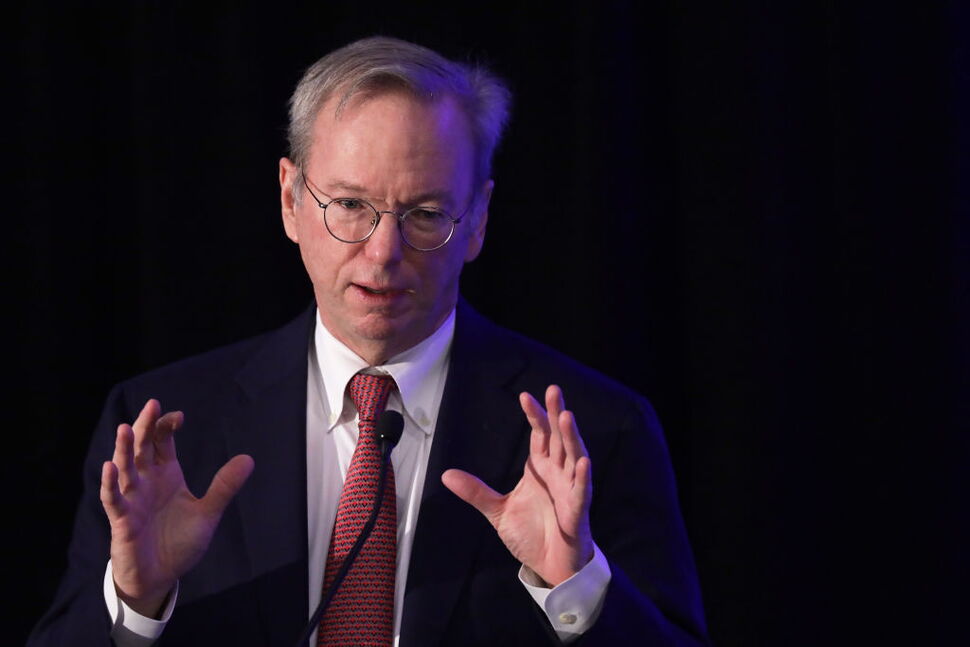
Former Google CEO Eric Schmidt was almost apologetic as he addressed the transformative impact of artificial intelligence in front of the University of Arizona’s graduating class.
“There is a fear in your generation that … you are inheriting a mess that you did not create, and I understand that fear,” he said.
Schmidt’s digression came after students booed him for raising the topic during his commencement address. He was one of several 2026 speakers who encountered dissent from students for similar reasons – a powerful, if subjective, example of the wariness with which young people see the technology.
Gen Z is increasingly skeptical of AI: A Gallup report from last month showed that excitement and hopefulness about the tool are dwindling, while anger is rising. In school and in the workplace, young people hesitate to trust AI, even though their use of it has remained consistent.
This year’s graduates have been more vocal than ever about their feelings toward AI. The University of Central Florida’s commencement speech went viral after the crowd loudly booed real estate executive Gloria Caulfield for characterizing the rise of artificial intelligence as the “next industrial revolution.”
The ceremony was for graduates of the university’s College of Arts and Humanities and Nicholson School of Communication and Media, further fueling students’ frustration with the technology that threatens to eliminate careers in the arts.

Get Higher Ground in your inbox each week!
The must-read newsletter for leaders shaping higher education’s future.
By clicking “Sign Up”, you will receive the latest updates, including emails, from U.S. News & World Report and our trusted partners and sponsors, and you agree to our Terms and Conditions & Privacy Policy.
“OK, I struck a chord! May I finish?” asked Caulfield. “Only a few years ago, AI was not a factor in our lives,” she continued. She was met with cheers for referencing the pre-AI age. “And now, AI capabilities are in the palm of our hands.” Students resumed their booing.
This generation’s fear about AI’s impact on the job market is more than hypothetical. Graduates are entering the toughest job market in years. AI may not be the main culprit, but it is one of many reasons why recent graduates are applying for hundreds of jobs and only hearing back from a handful.
Scott Borchetta, CEO of Big Machine Records, was also booed during his speech at Middle Tennessee State University’s commencement ceremony. Referring to AI, he said, “Deal with it. Like I said, it’s a tool.”
Naysayers at NYU
New York University’s commencement speech was controversial for a different reason. Jonathan Haidt, social psychologist and bestselling author of “The Anxious Generation,” received backlash before he set foot on the graduation stage.
The student government association wrote a letter expressing its “profound disappointment” in NYU’s choice of Haidt as the speaker and asking the school to reconsider. The students cited past instances in which Haidt was accused of homophobic comments and other “disturbing rhetoric” surrounding social justice and diversity, equity and inclusion.
They call NYU’s choice “underwhelming” in comparison to the school’s past commencement speakers, who included Taylor Swift and Justice Sonia Sotomayor among others.
Also a professor at NYU’s business school, Haidt is known for criticizing the overprotectiveness of today’s parents, leaving Gen Z “coddled”: a major trigger for the student dissenters.
The New York Times highlights the irony of NYU students trying to “cancel an outspoken critic of cancel culture.”
The students were unsuccessful in their endeavor to replace Haidt as the speaker, and some booed him as he took the stage. About three dozen students walked out of Yankee Stadium in the middle of Haidt’s speech, according to NYU’s student newspaper, Washington Square News.
While other commencement speakers were booed for their praise of AI, Haidt was booed despite his criticism of Big Tech: “Some of the biggest corporations in human history, they’re not trying to earn your attention. They’re not trying to deserve your attention – they’re trying to take it from you,” he warned in his speech.
More 2026 Commencement Controversies
Students at South Carolina State University, a historically Black university, protested the selection of the state’s lieutenant governor, Pamela Evette, as the commencement speaker, citing her opposition to DEI programs and her strong support for President Donald Trump.
The students were successful in convincing university administration to cancel Evette’s speech. In a video response she posted on social media, Evette called the student protestors “woke mobs” and praised the Trump administration for supporting HBCUs.
“Just like President Trump, I’ll never back down or bend a knee to the woke radicals,” Evette said.
Rutgers University also canceled a planned graduation speech by Rami Elghandour, CEO of a biotech company, following student concerns about his criticism of Israel on social media.
Elghandour was set to address graduates at the Rutgers School of Engineering, his alma mater, but his invitation was rescinded when the university heard that some graduates were planning not to attend.
In his social media posts, Elghandour has accused Israel of committing war crimes and upholding a system of apartheid.
Meanwhile, the University of Michigan issued a public apology after a history professor praised pro-Palestinian student protesters in his commencement speech. Jewish groups argued that campus protests against Israel have fostered a hostile environment for some students.
Collectively, the demonstrations suggest that, while the future for today’s graduates remains uncharted, one thing is certain: This generation will make their voices heard.