By Nicoco Chan and Casey Hall
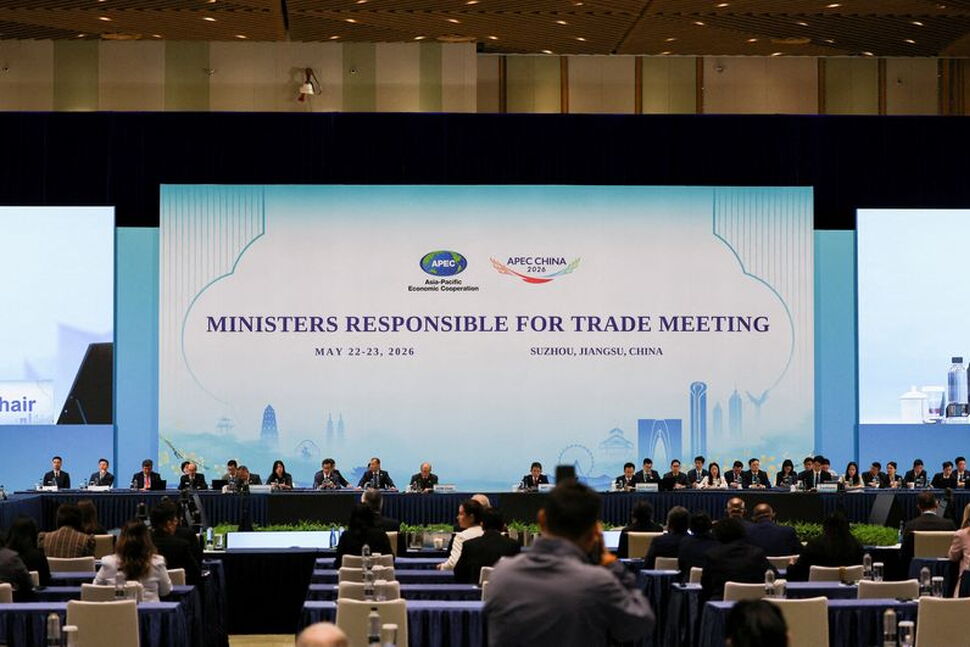
SUZHOU, China, May 22 (Reuters) – Asia-Pacific trade envoys gathered in China are expected to discuss multilateral cooperation, trade imbalances and supply chain resilience in the face of global shocks, including the U.S.-Israeli war on Iran.
Trade representatives from members of the Asia-Pacific Economic Cooperation (APEC) grouping, which together account for nearly half of global trade, will attend two days of meetings starting Friday in the eastern Chinese city of Suzhou.
“The more turbulent the times, the more we must adhere to seeking common ground while reserving differences, working together to overcome difficulties, striving to reach more consensus, leading the Asia-Pacific economy through the crisis and injecting confidence into the global economy,” said Li Chenggang, China’s international trade representative and vice commerce minister, in an address during the opening ceremony on Friday.
The event is part of several rounds of meetings ahead of an annual APEC leaders summit later this year in Shenzhen. Officials in attendance are also expected to discuss advancing the free-trade area of the Asia-Pacific region, boosting digital trade, ramping up artificial intelligence readiness and driving sustainable, inclusive growth.
The priorities of this year’s meeting, Li said, were “optimising institutional arrangements, cultivating momentum in emerging fields, jointly expanding the Asia-Pacific economic pie and ensuring fair distribution of that pie to achieve inclusive, mutually beneficial, and win-win outcomes.”
Last year, China posted a record trade surplus of nearly $1.2 trillion and the gathering in Suzhou comes days after Group of Seven finance ministers agreed on the need for action to tackle trade imbalances, saying the current situation was unsustainable. U.S. Treasury Secretary Scott Bessent, ahead of that meeting, argued for more protections against a flood of cheap Chinese imports.
The APEC trade ministers meeting also closely follows back-to-back visits from U.S. President Donald Trump and Russian President Vladimir Putin to Beijing in recent weeks. China, Russia and the U.S. are all APEC members.
Also speaking on Friday, APEC Business Advisory Council chair Li Fanrong said the global economy was under significant pressure and on behalf of the business community he urged a pause on new trade restrictions to prevent further uncertainty.
“The stakes could not be higher for business confidence, jobs, living standards and long-term prosperity in our region,” he said.
Among the attendees representing APEC’s 21 members are Rick Switzer, the deputy U.S. trade representative; Don Farrell, Australia’s trade minister; Kao Kim Hourn, ASEAN’s secretary general; and Taiwan’s top trade negotiator, Yang Jen-ni.
Japanese trade minister Ryosei Akazawa, also in attendance, is the most senior Japanese official to visit China since a diplomatic dispute between the two countries erupted in November.
A meeting between Akazawa and a senior Chinese official would mark the highest-level engagement since Japanese Prime Minister Sanae Takaichi triggered the row by saying a hypothetical Chinese attack on Taiwan could trigger a response from Tokyo.
Since then, Beijing has adopted a raft of retaliatory measures, urging its citizens not to travel to Japan and choking off shipments of some rare earths, which are vital in making electric cars, weapons and other products.
(Reporting by Nicoco Chan and Casey Hall; Additional reporting by John Geddie; Editing by Thomas Derpinghaus)
Copyright 2026 Thomson Reuters.