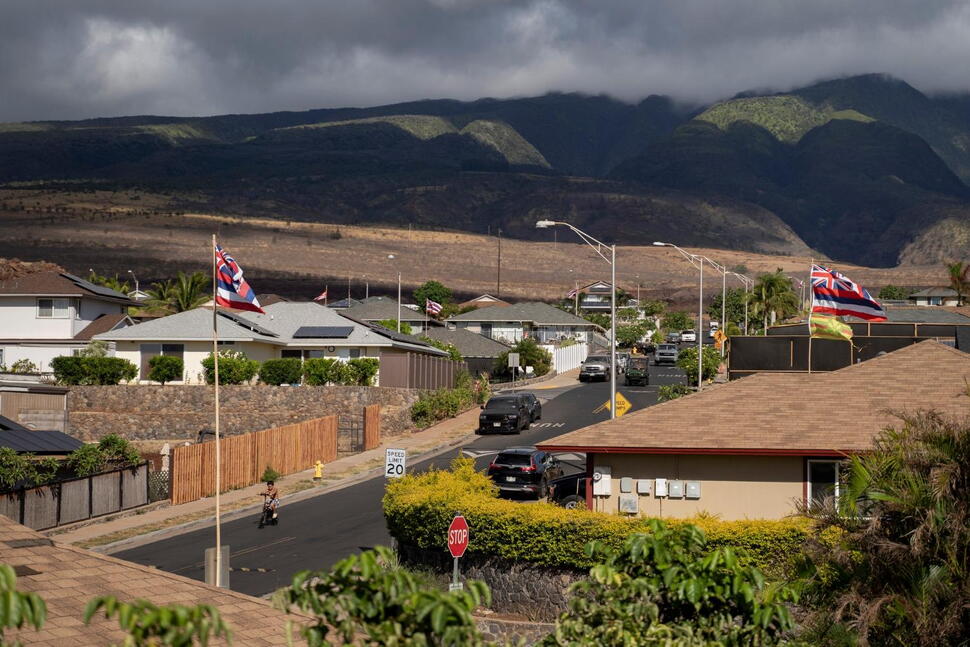
HONOLULU (AP) — A lawsuit filed this week in U.S. court in Honolulu challenges a century-old system that provides one of the most valuable benefits for Native Hawaiians: land at almost no cost.
The lawsuit says the Hawaiian Homes Commission Act, which sets aside land for those who have at least 50% Hawaiian blood quantum, is unconstitutional. It was filed Monday by the Pacific Legal Foundation on behalf of a man who is not Hawaiian but is described in the lawsuit as a lifelong Hawaii resident. It’s the latest challenge to Native Hawaiian entitlements amid the Trump administration’s pushback against diversity, equity and inclusion policies.
Homestead communities across the state have been key to economic self-sufficiency and strongholds of Hawaiian culture and traditions. Those with at least 50% Hawaiian blood can apply for a 99-year lease for $1 a year. There are about 29,000 people on a waitlist for residential or agricultural land leases.
Land for Hawaii’s Indigenous people
As a delegate to U.S. Congress for the Territory of Hawaii, Prince Jonah Kūhiō Kalaniana‘ole in 1920 pushed for a way to give Hawaii’s Indigenous people land to live on to help Hawaiians who were “landless and dying” as a result of disease, intermarriage and loss of lands since the 1893 overthrow of the Hawaiian Kingdom by American business owners.
Plantation owners opposed the idea and wanted to include only full-blooded Hawaiians, with the expectation that there would come a time when there would be none left, said Robin Puanani Danner, senior adviser to the Sovereign Council of Hawaiian Homestead Associations. The organization aims to protect the act passed by Congress in 1921. Congress settled on the eligibility requirement of 50% Hawaiian blood, she said.
It’s generally the only circumstance where Hawaiians care about blood-quantum, which is a way to calculate the percentage of someone’s ancestry.
“That was not our measurement,” said Danner, a homesteader on the island of Kauai who is also on the waitlist for a farm lot. “That was the white man’s measurement.”
Native Hawaiians have a different relationship with the federal government than Native American and Alaska Native tribes. There are no tribal nations in Hawaii. Outside Hawaii, the 575 tribal nations across the U.S. use a mix of blood quantum, ancestral lineage and other criteria to determine who is eligible to enroll as a tribal citizen.
There’s also a separate lawsuit by Students for Fair Admissions — led by Edward Blum, a leading opponent of affirmative action — against Kamehameha Schools, a competitive private school system that gives admissions preference to Native Hawaiian applicants.
The lawsuit could reach the Supreme Court
Hawaii’s governor and attorney general vowed to fight the lawsuit against Hawaiian homelands eligibility.
The U.S. Department of Interior, which is a defendant in the suit, declined to comment on litigation, as did the Department of Hawaiian Home Lands, the state agency responsible for managing the trust of approximately 200,000 acres (81,000 hectares) of land.
“We do not seek to take anything from anyone,” said Caleb Trotter, a lawyer for Pacific Legal Foundation. “All we seek to do is to make sure that this program is available to everyone on equal footing, regardless of their blood quantum. So whether you are 100% Native Hawaiian or zero percent, a successful lawsuit would result in everyone having the same chance of qualifying.”
They don’t expect a favorable ruling from a U.S. district judge in Hawaii, but it might be likelier with the 9th U.S. Circuit Court of Appeals.
Trotter said they’re confident the U.S. Supreme Court will agree government classifications based on ancestry or race are unconstitutional.
Plaintiff Eric Ryan attempted to apply for a lease online but was barred from pre-qualification when he answered “no” to the question asking if he’s at least 50% Hawaiian, the lawsuit said.
“This explicitly ancestry-based requirement establishes a permanent government mandate for state officials to engage in outright racial discrimination, perpetuates stereotypes, and limits housing opportunities for most Hawai‘i residents,” the lawsuit said.
The amount of people waiting for a lease shows the resilience of Native Hawaiians, said Sanoe Marfil, who grew up on a homestead in Nanakuli in west Oahu: “Our people are still here.”
It also gives some hope that Hawaiians who have left Hawaii because of the state’s crushingly high cost of living can return someday when they are awarded a lease, she said.
Marfil, who meets the blood-quantum threshold, now has her own lease nearby. Hawaiians have a duty to fight the lawsuit, she said, so their descendants can continue to thrive on Hawaiian lands.
“We don’t have any plans to go anywhere,” she said. ____
Associated Press reporter Savannah Peters in Edgewood, New Mexico, contributed to this story.
Copyright 2026 The Associated Press. All rights reserved. This material may not be published, broadcast, rewritten or redistributed.
Photos You Should See – April 2026
