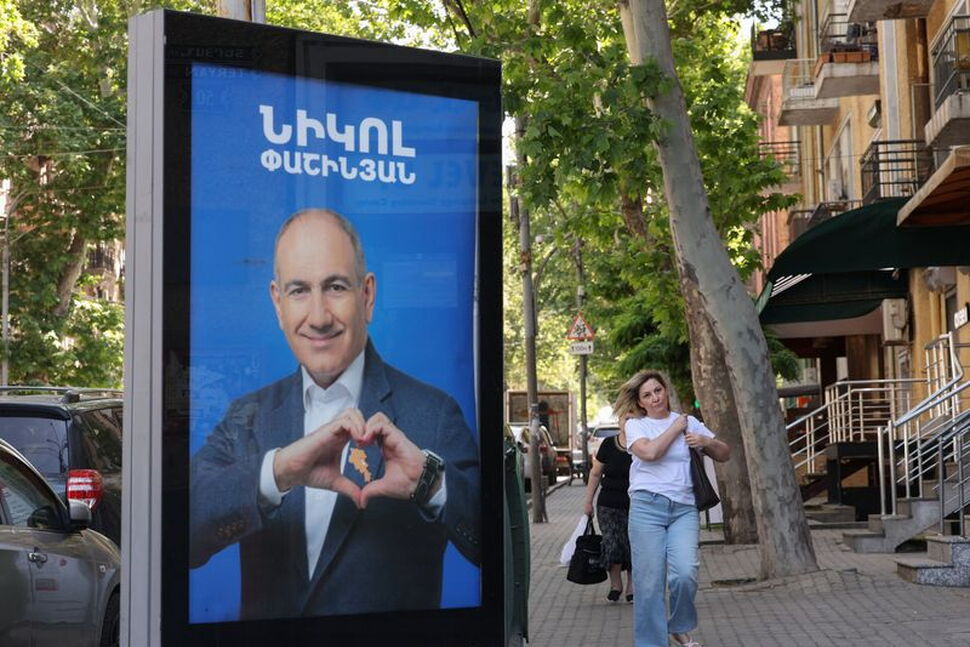
IJEVAN, Armenia, June 4 (Reuters) – When Anna Yegoyan first moved from the Armenian capital to the northern mountain town of Ijevan, she had to reach it along bumpy, potholed roads.
Years later, she points to newly paved streets and highways as proof of change under Prime Minister Nikol Pashinyan, who grew up there, and says she will back him in Sunday’s election.
Armenia has become “a proper country,” said the 40-year-old, who attended a rally for Pashinyan in the town of about 20,000 people. “Our place in the world is more recognisable.”
Armenians vote in a parliamentary election on June 7 in a test of Pashinyan’s efforts to forge peace with longtime foe Azerbaijan, and deepen ties with Western countries, moving away from traditional patron Russia. He says he wants to turn the landlocked nation of 3 million into a “crossroads of peace”, re-opening long-closed borders with Azerbaijan and its ally Turkey.
Polls show Pashinyan’s Civil Contract leading with roughly 30% support, while his main rival, Russian-Armenian billionaire Samvel Karapetyan, who is advocating for closer ties with Moscow, trailing at between 6 and 11%.
The pivot away from Russia is a delicate one. Armenia sends around a third of its exports there and has long been dependent on Moscow for energy. In recent weeks, Russia – which maintains a large military base in Armenia – has stepped up pressure, restricting a wide range of Armenian exports and threatening to cut off cheap gas and oil.
The government in Yerevan has largely played down the risks, but surveys show a third of Armenians now view Russia as a threat, behind only Azerbaijan and Turkey.
PROGRESS TOWARDS PEACE DEAL
Pashinyan has won a resounding endorsement from U.S. President Donald Trump, who helped broker a meeting between him and Azerbaijani President Ilham Aliyev and is pushing a transit corridor across southern Armenia as part of a peace deal.
Europe, too, is watching closely. Anxious for a foothold in a region sandwiched between Russia and Iran, it has a clear interest in Armenia “being more sovereign, more autonomous, and more able to trade westwards,” said Thomas de Waal, a senior fellow at Carnegie Europe.
Sunday’s vote is the first since Armenia’s 2023 military defeat, when Azerbaijan retook the breakaway region of Nagorno-Karabakh, prompting the exodus of around 100,000 ethnic Armenians.
Pashinyan is keen to trumpet his progress towards peace and the re-opening of the frontier with Turkey, shut since 1993. But no deal with Baku has been signed, and critics say he has conceded too much.
“The ruling party says peace has arrived, (but this) diverts the responsibility for all the security failures we’ve had throughout the years,” said Tigran Grigoryan, director of the Regional Centre for Democracy and Security think-tank in Yerevan.
Should Pashinyan fail to secure a two-thirds majority in parliament, a pledge to Azerbaijan to call a referendum to change Armenia’s constitution would be difficult for him to fulfill, and peace efforts could stall.
He also faces allegations of authoritarianism from the opposition and international rights groups. Dozens of opponents have been detained, including allies of his main challenger Karapetyan, who is under house arrest for calls to usurp power.
Karapetyan and another contender, former President Robert Kocharyan, want to maintain friendly relations with Russia, and warn Pashinyan is getting too close to Azerbaijan.
KARABAKH EXODUS LEAVES SCARS
In the 2021 election, Pashinyan drew support from voters far from the centres of power, while underperforming in the wealthier capital.
“Pashinyan is able to talk the language of the common people, the language people understand,” said Mikayel Zolyan, a political analyst and former member of parliament.
Since coming to power in the 2018 Velvet Revolution, he has overseen a doubling of GDP per capita, opened hundreds of kindergartens and paved thousands of kilometres of road.
That progress means little to Anahit Grigoryan, who fled Nagorno-Karabakh with her young son after her husband was killed in an explosion at a military fuel depot during the chaotic one-day war.
Now 26, she lives with four generations of her family in a village outside Yerevan, surviving on a small refugee allowance and selling cakes made with eggs from her backyard chickens.
As a former Karabakh resident, Grigoryan would need Armenian citizenship documents to vote, but said she was not interested.
“I feel like my voice will not be heard,” said the mother of four-year-old Karen. “Justice, for me is not realistic…It’s very hard for me to look my mother, my grandmother, and other women who lost their kids in the eyes.”
(Reporting by Lucy PapachristouEditing by Ros Russell)
Copyright 2026 Thomson Reuters.
Photos You Should See – April 2026
