In a move that will place hundreds of thousands of green card applicants under broader scrutiny each year, the Trump administration is allowing immigration officers to consider whether some applicants have used taxpayer-funded benefits — including Medicaidfood stamps and housing assistance — when determining whether they qualify for permanent legal status.
The Department of Homeland Security is poised to rescind a 2022 Biden-era regulation narrowing how officers apply a long-standing “public charge” test — an immigration screening tool used to determine whether applicants are likely to rely on government support — according to U.S. Citizenship and Immigration Services officials.
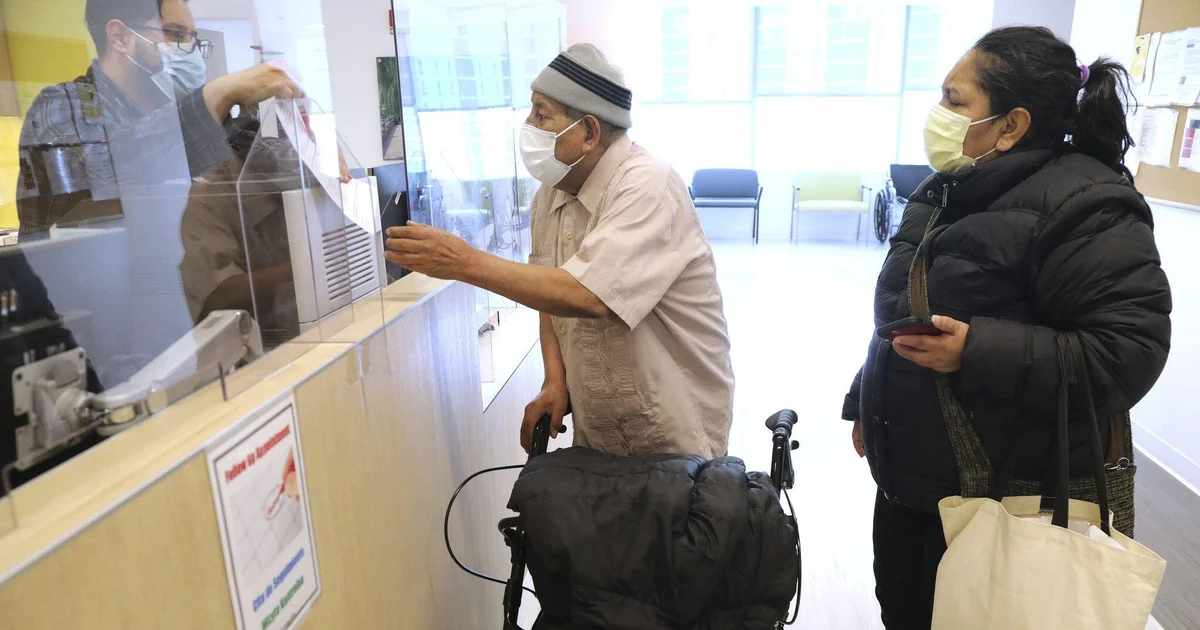
The change may directly affect hundreds of thousands of people applying for green cards from inside the U.S. each year. It could trigger a broader ripple effect if immigrant families avoid health care, food, or housing assistance — even when they or their U.S.-citizen children legally qualify — out of fear that tapping into those benefits could ultimately hurt their immigration cases.
What does the final rule change?
Under existing federal immigration law, some individuals applying for a visa, admission to the U.S. or green cards can be deemed inadmissible if the government determines they are likely “at any time” to become a public charge.
The Biden-era rule, issued in 2022, limited the benefits DHS could consider to primarily cash welfare payments meant to cover basic living expenses and long-term institutional care paid for by the federal government.
The new final rule restores the broader discretion USCIS had during the first Trump administration, so that officers can conduct case-by-case reviews that consider an applicant’s age, health, family status, assets, financial resources, education, skills and whether the person has received means-tested taxpayer-funded benefits.
Those benefits can include food stamps, Medicaid and even housing assistance, according to USCIS officials.
The federal government “is reaffirming the requirement of self-reliance, protecting public resources and ending policies that encouraged dependency on the backs of hard-working American taxpayers,” USCIS Director Joseph B. Edlow told CBS News in a statement. “Under President Trump, USCIS is restoring the basic principle that immigrants must be able to support themselves.”
Who could be impacted?
The rule applies to noncitizens inside the U.S. applying to adjust their status to lawful permanent residence, plus noncitizens seeking admission to the United States as immigrants or nonimmigrants, unless they fall into categories exempted by Congress. Historically, the public charge test exempts some refugees, asylees and those in humanitarian categories, including Special Immigrant Juveniles, certain trafficking and crime victims, and Violence Against Women Act (VAWA) self-petitioners.
In its November 2025 proposal, DHS estimated that roughly 588,000 adjustment-of-status applicants each year would be subject to public-charge review — a figure that does not include all people applying for visas abroad or seeking admission at the border.
Still, the department assessed that the broader impact could exceed formal assessments or practical denial. In that same proposal, DHS determined that changes to the public charge policy could create a “chilling effect,” leading about 950,000 people in immigrant households to disenroll from or forgo public benefits altogether.
USCIS officials told CBS News that benefits received by an applicant’s family members will not be treated as the applicant’s own, though officers may still consider them when assessing the applicant’s finances. For instance, those benefits may factor in if they suggest the applicant cannot financially support the household or if the benefits are helping to support the applicant.
When will the rule take effect?
The rule is expected to be filed for public inspection Thursday, with its effective date slated for early next week. But USCIS will not begin applying the new public-charge framework for 60 days, giving the agency time to update forms, guidance and internal procedures, and pushing the operational date into September.
For applications filed before the rule becomes operational, USCIS officials say they will only assess means-tested public benefits received on or after that date. In other words, benefits received before the program is operational will generally only be considered only if they included public cash assistance for income maintenance or long-term institutionalization at the government’s expense.
Along with the final rule, USCIS plans to publish a revised Form I-485, the application used by people seeking to register permanent residence or adjust status. Older versions of the form postmarked or submitted electronically on or after the rule is operational will no longer be accepted.
How did we get here?
The public charge test has been enshrined in U.S. immigration law for generations, but the high-profile battle over which benefits should be considered has bubbled over in recent years.
Prior to the first Trump administration, DHS followed 1999 guidance that defined a public charge as someone “primarily dependent on the government for subsistence,” and officers generally focused on cash welfare and long-term government-funded institutional care instead of benefits like Medicaid, food stamps, or housing aid.
Under a 2019 final rule, the Trump administration moved to broaden the test, allowing officers to consider a wider range of public benefits – including SNAP, most Medicaid, and certain housing programs — to create a more detailed review of applicants’ income, health, credit, education, and household circumstances.
The 2019 filing prompted a wave of lawsuits, but the Supreme Court allowed the rule to take effect while litigation continued and DHS began applying the rule in February 2020. After President Biden took office, DHS stopped defending the rule, and ultimately, the Biden administration issued a new 2022 rule that largely returned DHS to its narrower 1999-style approach.
Despite drawn-out legal fights, formal public charge denials have been very rare. For instance, between fiscal years 2020 and 2024, DHS reported that public charge denials of adjustment-of-status applications ranged from 41 to 95 total, annually.
During the period when the 2019 Trump rule was in effect, DHS identified just five cases of denials or notices of intent to deny based on the full public charge analysis, and those cases were later reopened or rescinded.
Based on these numbers alone, the chilling effect of the final rule on risk-averse families applying for status is very likely to outweigh any actual practical effect.
What happens next?
The Trump administration has previously defended proposals for the new rule as a return to a stricter interpretation of self-sufficiency that has always been present in immigration law. Still, the latest step taken by the Trump administration is likely to draw scrutiny from immigration attorneys, state benefit agencies, health providers, and immigrant-rights groups.
While the rule does not change exemptions established by Congress — USCIS says those categories will continue to be listed on Form I-485 and in updated Policy Manual guidance – questions remain about exactly which benefits will count and what data-sharing agreements the agency might use to verify benefits. It also remains to be seen how the agency will train officers nationwide to apply the updated rule in a consistent fashion.
Still, for immigrant and mixed-status families, there’s perhaps a more pressing calculation. The final rule could simply make food, health and housing assistance feel too risky on the tenuous path to permanent legal status in the United States.
Editor’s note: This article has been updated to reflect that although the new rule is expected to take effect early next week, USCIS will not begin applying the new public-charge framework for 60 days, giving the agency time to update forms, guidance and internal procedures, and pushing the operational date into September.