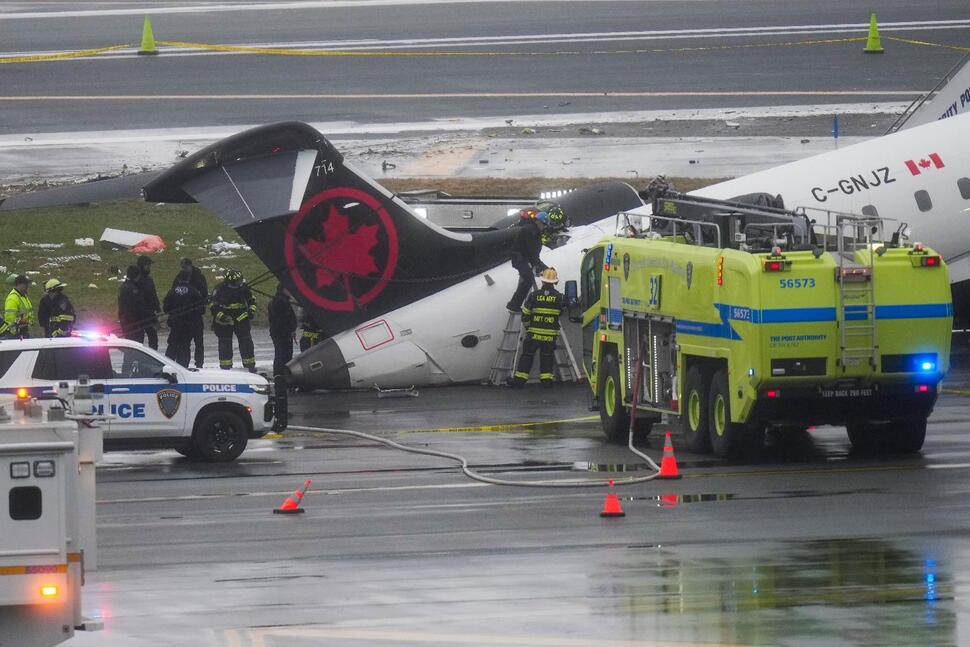
A United Airlines flight had twice aborted takeoff and reported an odor coming from the back of the plane. But with no gate immediately available, the pilot and controllers went back and forth over the radio as controllers tried to reach the airline and find a safe spot to put the plane. Audio recordings captured the chaotic conversation as the cockpit conveyed growing urgency.
“Flight attendants in the back are feeling ill because of the odor,” the pilot can be heard saying. “We will need to go into any available gate at this time.”
With no place to park the aircraft, air traffic control dispatched fire trucks to go to the plane instead and offered stairs to evacuate passengers, all while continuing to manage other traffic. Then a frantic warning cut across the radio: “Stop, stop, stop, Truck 1. Stop, stop, stop.”
Moments later, the Air Canada flight landed and crashed into one of the fire trucks as it crossed the runway. The pilot and co-pilot of the regional jet flying from Montreal were killed, while dozens of passengers and crew members on the flight and the two police officers in the fire truck were taken to hospitals, some with serious injuries.
The collision late Sunday is putting a renewed focus on the pressures facing air traffic controllers in the United States, a workforce that has long grappled with staffing shortages, demanding schedules, outdated equipment and the effects of repeated government shutdowns.
While investigators work to determine what led to the runway crash, aviation experts say the collision highlights the demanding environment controllers navigate every day — managing planes landing and taking off, aircraft moving between gates and runways, and service vehicles ranging from emergency responders to maintenance trucks.
“In the best of times, air traffic controls and air traffic controllers are under a great deal of stress,” said Alan Diehl, a former federal crash investigator. “These are people with very high cognitive levels. They’re carefully selected, extensively trained. And one of the problems is there is a shortage of 3,000 of them in this country right now.”
In a statement Monday, the National Air Traffic Controllers Association emphasized the heavy demands and weight of the job.
“Air traffic controllers work every day to keep passengers and cargo moving safely and efficiently,” the statement said. “We serve quietly, but moments like this remind us of the responsibility we carry — and how deeply it stays with us when tragedy occurs.”
Roughly 20 minutes after the crash, a controller appeared to blame himself: “We were dealing with an emergency,” he said in a radio transmission, “and I messed up.”
Officials have not yet disclosed how many controllers were on duty at LaGuardia when the Canadian plane and the fire truck carrying Port Authority of New York and New Jersey firefighters crossed paths. But Transportation Secretary Sean Duffy, whose department oversees the FAA, described the airport’s tower as generally “well staffed” and just short of its target of 37 controllers, with 33 controllers currently assigned to it and seven more who are in training.
Duffy was confirmed as President Donald Trump’s transportation secretary the day before an Army helicopter and a passenger plane collided over the Potomac River near Ronald Reagan Washington National Airport, killing 67 people. Since taking office, he has pledged to improve air controller staffing and to upgrade traffic control equipment.
Former FAA air traffic control chief Mike McCormick said the overnight shift — when the crash occurred — would typically be staffed more lightly. He said investigators are likely to examine how much overtime local controllers were working and how many consecutive days they had been on duty.
Those questions are standard after crashes. John Cox, CEO of aviation consulting firm Safety Operating Systems, said National Transportation Safety Board investigators would closely examine the human factors surrounding the tower’s operations.
“The staffing issue and the controller’s work schedule will certainly be something that they look at and only then can we determine if it’s a staffing or fatigue issue,” Cox said.
The strain on the workforce has been building for years. During a record U.S. government shutdown last fall that lasted 43 days, and a 35-day shutdown that spanned December 2018 and January 2019, controllers were required to continue working without pay, pushing some to quit or retire early. At the same time, training and hiring for new recruits was halted or slowed.
Because certification can take years, experts, union leaders and agency officials have warned that the effects would linger long after funding resumed, compounding attrition and making recruitment more difficult.
Still, industry leaders and officials emphasize that moves to modernize the technology and equipment air traffic controllers use underway. Chris Sununu, CEO of airline trade group Airlines for America, said Congress has invested billions of dollars to upgrade aging technology and improve the system.
“I think the air traffic control system has been under a lot of strain for 30 years,” Sununu said. “And that’s why Congress has put billions of dollars behind rebuilding the entire system. And we’ve already seen some pretty good successes.”
He pointed to the transition away from paper flight progress strips to digital tools at many airports, along with the purchase of hundreds of new radar systems nationwide. A new traffic flow system with upgraded back-end technology is expected to roll out later this year, he said.
“By and large, the air traffic controllers work really, really well with a very antiquated system and every day that goes by the system is now getting upgraded,” Sununu said.
Associated Press reporters Mae Anderson in New York, Holly Ramer in Concord, New Hampshire, and Josh Funk in Omaha, Nebraska, contributed to this report.
Copyright 2026 The Associated Press. All rights reserved. This material may not be published, broadcast, rewritten or redistributed.
Photos You Should See – March 2026
