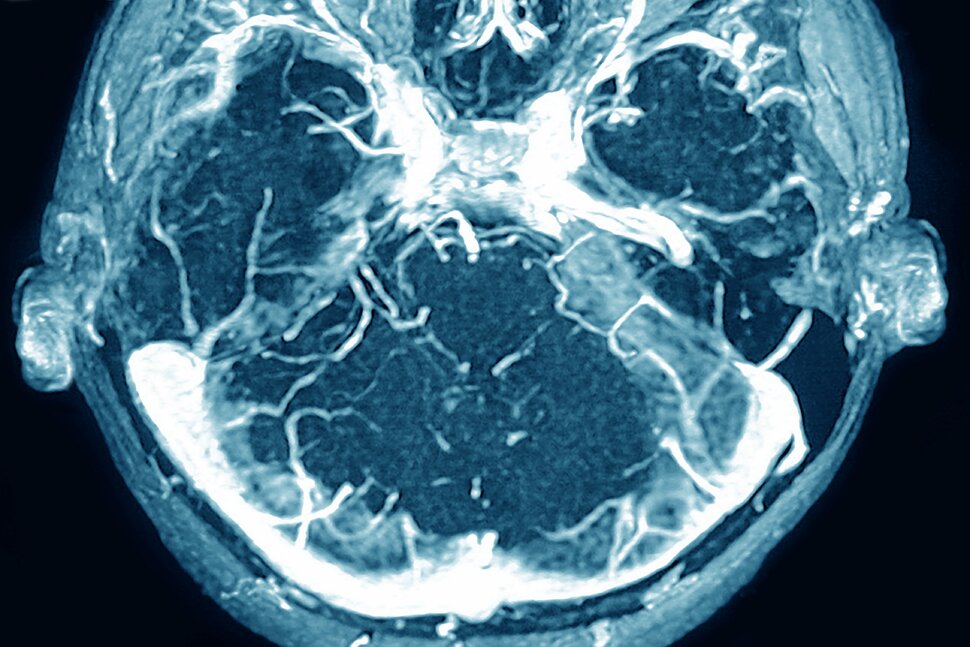
Timing and accuracy are vitally important when it comes to a brain bleed.
Viz.aithe company behind an artificial intelligence platform for disease detection and workflow optimization used in about 2,000 U.S. hospitals, wanted to streamline the process of identifying hemorrhages.
Their solution, called Viz Hemorrhage, uses AI algorithms to detect suspected brain bleeds in the hopes of reducing human error and helping institutions assess severity, monitor progression and plan treatment.
It automatically reviews non-contrast CT images and typically alerts clinicians within two-five minutes from the time the scan is completed. That earlier awareness has led to earlier action, says Chelsea Summerour, associate director of product at Viz.ai.
Viz Hemorrhage is a recipient of the Edison Awardsestablished in 1987 to honor “excellence in new product and service development, marketing, design and innovation.” U.S. News is a media partner for the Edison Awards.
Summerour talked to U.S. News about how Viz Hemorrhage works. The interview has been edited for length and clarity.
How did you come up with the concept for Viz Hemorrhage? What need did you see there that you were trying to fill?
I’m a neurological nurse by training, so one of my core beliefs is that there should be a real clinical gap for anything that we build. It was really evident in this space that there was a need for faster identification and bringing order to the chaos of hemorrhage triage from a very early point.
For us, Viz Hemorrhage really evolved in stages driven by what we were hearing from the field and what clinicians actually needed.
In practice, we started with intracranial hemorrhage detection – detecting acute bleeding inside of the skull – and those are cases where you almost always want to be informed immediately because they have the potential to become life threatening really quickly.
The real questions that our users were still asking is, “What does this mean for this specific patient?” Because the same bleed can have a completely different impact on a person depending on how it occurred or what their anatomy looks like. And that’s what first pushed us into the quantification, providing consistent and objective measurements like bleed volume or maximum thickness, so that our users could better assess the severity of the bleed and make decisions about treatment.
We were very, very aware that if we weren’t careful, we could actually introduce more noise, more alerts, more fragmentation – making things harder in an already high-pressure moment and making the alerts less meaningful.
Alert noise is one of the main reasons that clinicians stop paying attention to digital health tools, so we wanted to be really careful there. We’ve been really intentional about designing it in a way that brings everything together in a streamlined and actionable experience, so that we’re bringing clarity in that moment instead of more chaos.
Could you discuss the process of using Viz Hemorrhage from the perspective of a clinician?
From a clinician’s perspective, this is really designed to fit within their workflow and not disrupt it. So let’s say that a patient presents to the emergency department and gets a CT scan. As soon as that scan is completed, it’s sent to the cloud and our system analyzes it automatically. If we detect a hemorrhage, you’ll receive the alert.
You can open it up, and you’ll have access to the imaging as well as those quantified outputs. Because we provide those measurements, the users can also customize which notifications they actually receive. An emergency department provider might want to receive a notification for every single bleed that walks through the door, because they’re in charge of triaging the care of that patient. But a neurosurgeon might only be interested in patients that are more likely to go for intervention.
After you’ve received the notification, you reviewed the findings, you can communicate with the rest of the care team within the same platform and decide what the next best step is for that patient.
What kind of feedback or data do you have from the hospitals and other places that are using this product?
Typically, you’re receiving these alerts in two-five minutes from the time the scan is completed, and that earlier awareness has pretty significantly contributed to earlier action. We’re seeing things like reduction in time to neurosurgical evaluation by almost an hour in several settings, and then we’re also seeing a system-level impact with transfers.
Another study showed that we could reduce transfer time from over 200 minutes to just around 100 minutes, so cutting it almost in half, which is pretty significant with an acute bleed, getting the patient to the center where they’re going to have the neurosurgical care quickly to preserve brain function.

Sign Up for U.S. News Healthcare of Tomorrow Bulletin
Your trusted source for critical insights and solutions-focused analysis.
By clicking “Sign Up”, you will receive the latest updates, including emails, from U.S. News & World Report and our trusted partners and sponsors, and you agree to our Terms and Conditions & Privacy Policy.
What do the Edison Awards mean to you? And what do you think it was about your product that caught the eye of the Edison Awards?
The Edison Awards really recognize innovation, but innovation that delivers real and meaningful impact, and that’s what I think our team has been focused on from the beginning – not just with this product, but in general. It’s not just about building advanced AI, which we’re doing, but we’re all really driven by solving real world problems that clinicians face.
I think that this award reflects the combination of strong technology, really deep clinical integration and our focus on improving how care is actually delivered. For our team, it’s both a validation of that work and a motivator to keep pushing forward.