By Timothy Aeppel and Jarrett Renshaw
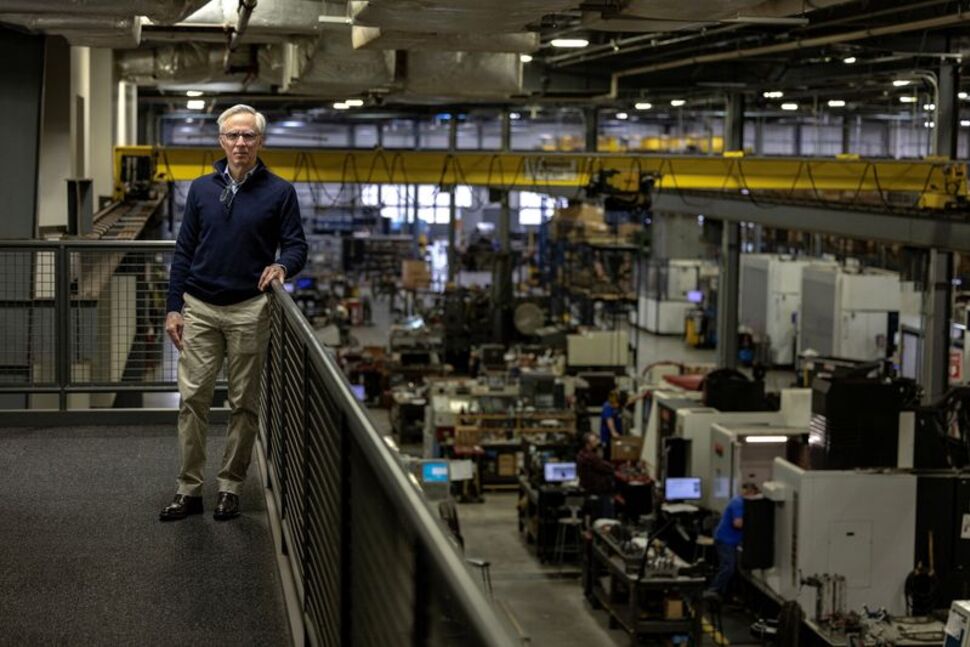
SOUTH BEND, Indiana, March 26 (Reuters) – One of his best customers recently asked John Axelberg to invest $800,000 to double the output of the tubular frames his factory here churns out for large-scale solar energy farms.
Although the solar side of Axelberg’s small metal forming business fueled all of his company’s nearly 30% revenue growth last year, bolstered by tax incentives in the Inflation Reduction Act passed under President Joe Biden, all the other industries he serves – including farm equipment and heavy trucks – were off a collective 20%. And he worries about solar.
President Donald Trump often says his policies are unleashing a new American factory boom. Yet in industrial communities like South Bend, the reality is more nuanced: government policies are lifting some sectors while clouding the outlook for others, leaving many manufacturers navigating a patchwork of incentives, tariffs and shifting signals from Washington.
Trump’s stewardship of the economy has emerged as a political pain point for him and Republicans in recent polling with critical midterm elections just over seven months away. Just 29% of respondents in a Reuters/Ipsos poll approve of his economic leadership, the lowest of either of Trump’s presidential administrations and lower than any economic approval rating of his predecessor, Democrat Joe Biden.
Case in point: Axelberg faces far higher costs for the metal and imported parts he uses because of tariffs, while one of the current administration’s first acts was curbing construction of solar farms on federal lands.
“I have no confidence that he won’t just pass another executive order and start coming after the (solar) credits we’ve received and try to claw them back,” said the CEO of General Stamping & Metalworks, a family-owned business with sales of $130 million that’s been bending metal since 1922.
Pierre Yared, acting chair of President Trump’s Council of Economic Advisers, pointed to improved manufacturing productivity, increases in new plant and equipment investment activity and a slowing of the pace of manufacturing job losses as early signs that administration policies will pay off.
“However, given the nature of these investments, it takes time to get production online, and therefore it will be some more time before we fully materialize the benefits of the President’s policies,” Yared said.
MANUFACTURING RENAISSANCE ELUSIVE
Few places better illustrate the sharp divide between a few booming niches and a lingering malaise in manufacturing than South Bend, a once thriving industrial hub that has struggled for six decades to regain its economic footing after the closure of Studebaker’s sprawling auto plant here in 1964. Many established manufacturers here are treading water–or facing erosion in key sectors, including businesses that boomed as a result of the last administration’s policies, like electric vehicles.
Michael Hicks, an economist at Ball State University who studies the factory sector, said “there’s no evidence of a manufacturing renaissance.” Instead, it looks like the sector has been in decline for the last 10 to 11 months.
Defense is one business that is doing well. Humvee maker AM General, based here, recently built a new plant to serve a $8.7 billion U.S. defense contract to build a new generation of military vehicles.
And Cleveland-Cliffs operates a steel processing complex that should benefit from tariffs, which have pushed up domestic steel prices. CEO Lourenco Goncalves said in a release announcing the company’s earnings last February that the taxes will bring about “a new golden era and a manufacturing renaissance that will make America strong again.”
Up the road from the steel plant, there’s a surge of construction where Amazon is building an $11 billion data center that will eventually have 30 buildings. Data centers aren’t manufacturing plants, but they need vast amounts of machinery and raw materials that fuel other goods producers. Once built, they don’t create many permanent jobs. Spending on data centers was over an estimated half a trillion dollars last year, according to the Federal Reserve, and the splurge is expected to “increase dramatically” through 2030.
Across the street from Amazon, there’s a $3.5 billion GM-Samsung joint venture under construction to make electric car batteries.
But the data center frenzy has sparked a fierce backlash and made land prices around the new developments “nutso,” according to South Bend Regional Chamber CEO Jeff Rea.
Skilled labor has grown scarce, and the big developments have driven up taxes and utilities for many long-time producers. The GM plant, meanwhile, faces headwinds from Trump’s anti-EV push. The automaker said it has slowed construction and no longer has a target date for opening.
Stuart Fowle, a GM spokesman, said “current market conditions give us more time to observe EV demand and plan for our future needs.”
The White House keeps a running list of new U.S. investments in manufacturing and innovation on its website, which includes Apple’s announcement of a $600 billion investment in factories and workforce training and Meta’s plan to spend the same amount by 2028 to support AI technology and infrastructure in the U.S.
And yet South Bend has seen factory jobs drift downward since the end of 2020–shedding over 1,000 workers, 265 of those since President Trump took office. The same pattern holds across the country. U.S. manufacturing jobs have declined by 100,000 since Trump’s inauguration, according to the Bureau of Labor Statistics.
To be sure, there are big projects underway across the industrial heartland. But the boom began during the Biden administration, including massive new investments in semiconductor plants and electric car and battery projects like the one GM and Samsung are building. Total construction spending on manufacturing plants grew from $5.9 billion in February 2021 to a peak of $20.8 billion in October of 2024, according to the Bureau of Labor Statistics, but fell to $17 billion by December of 2025.
“I don’t know if I’d call it a revival,” said Jon Ferguson, CFO of Master Roll Manufacturing, which operates a plant that overlooks Amazon’s massive data center site outside South Bend. Even though the company makes and reconditions steel processing equipment parts, Ferguson said sales are steady, not booming.
Meanwhile having so much development nearby is a headache. The surge in land prices has pushed up property taxes, he said, while electricity and water costs have increased. It’s nice for land to appreciate, he said, but it doesn’t mean much if they’re not looking to sell.
“A lot of companies in the area are upset with how (the data center boom) is falling out,” he said.
Some companies have struggled to find skilled workers to install or repair new production lines at existing facilities, since so much labor has been soaked up by construction.
Daniel Adams, CEO of Manufacturing Technology Inc., also sees a mixed bag for manufacturers. His great-grandfather started the business as a tool and die shop in 1926 and the company more recently carved a profitable niche in friction welding, a process used to make everything from golf putters to jet engines. He said since Trump came in, it’s become clear that EVs will be less important, which has cut into his auto-related business. “There’s an investment pause by car companies and tier-one (auto suppliers),” he said.
Adams said his aerospace customers are doing well—but that’s not enough to push the whole business forward.
Bringing new industry into the area is good for his business in the long term, Adams said, but is causing short-term tension with some other local businesses, for instance with regard to labor. “People go to the shiny place and maybe make two dollars (an hour) more,” he said.
Back at General Stamping & Metalworks, CEO Axelberg remains cautious. He has 25 acres adjacent to his plant that he planned to use to expand finishing and assembly work. But that’s on hold as he’s lost confidence in the current business climate.
“It’s almost like there is no policy,” he said. “It’s like the whims of a king.”
(Reporting by Timothy Aeppel in South Bend, Indiana, and Jarrett Renshaw in Washington. Additional reporting by Kalea Hall in Detroit. Editing by Anna Driver and Dan Burns)
Copyright 2026 Thomson Reuters.