The Iran was raises the risk that the U.S. will tumble into a recession within the next 12 months, according to economists and Wall Street analysts.
Goldman Sachs analysts this week estimated that higher global energy prices would boost U.S. inflation by 0.2 percentage points to 3.1% by the end of the year, putting a drag on consumer spending and economic growth. The investment bank increased the probability of a recession over the next year to 30%.
Economists with consulting and research firm EY-Parthenon see a 40% chance of a severe downturn over the 12 months, up from 35% before the U.S. and Israel attacked Iran on Feb. 28, citing persistent inflation due to the conflict’s disruption of global oil supply. Roughly 20% of crude and natural gas normally flows through the Strait of Hormuzwhich remains all but closed to oil tankers and other shipping traffic because of the war.
“The combination of tighter financial conditions, more uncertainty and higher inflation is going to erode growth,” EY-Parthenon chief economist Gregory Daco told CBS News. “We’ve curbed our growth forecast down and increased the odds of recession on the basis that if this conflict becomes more severe or prolonged, then you would see a more visible risk of a downturn in the economy.”
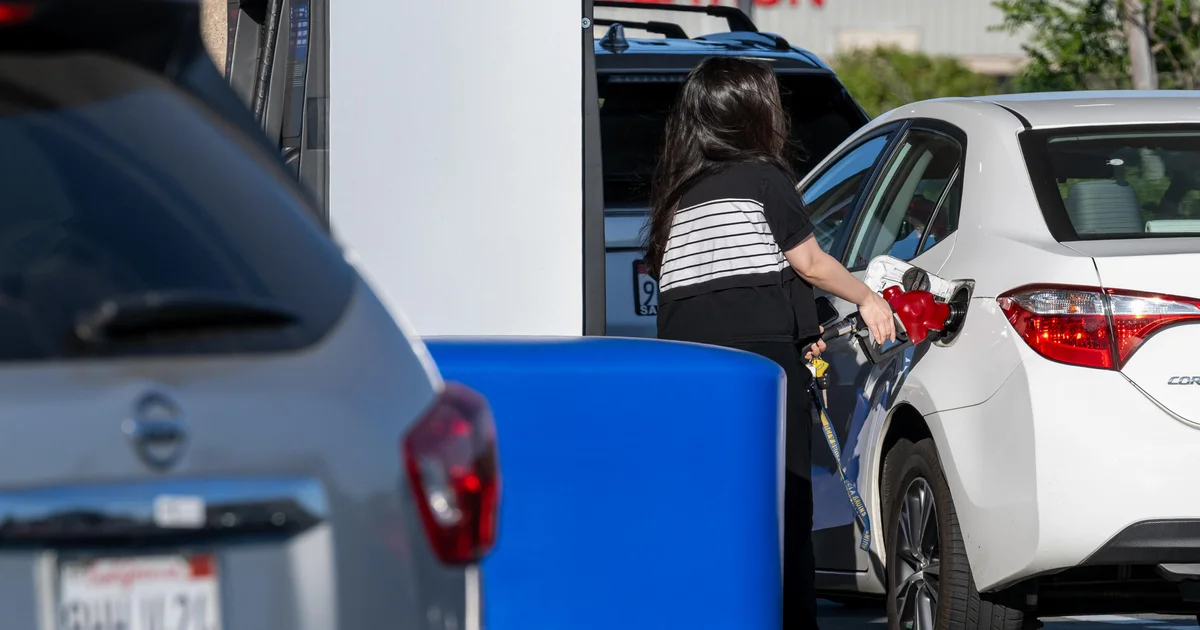
At the same time, “we have seen an increase in gasoline prices that’s been quite significant,” he added, hitting many households as they continue to recover from the soaring inflation and other economic disruptions caused by the pandemic.
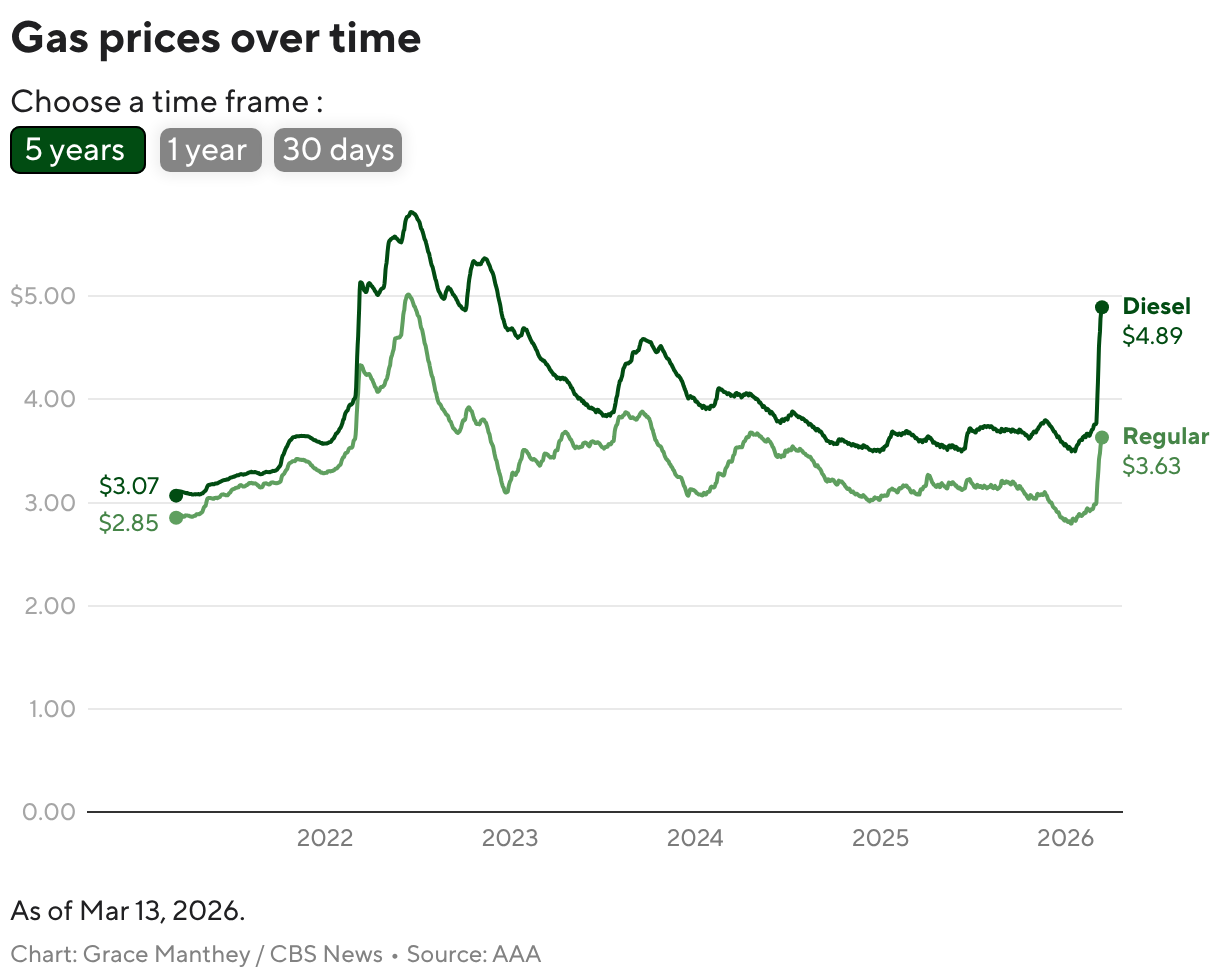
The national average gas price in the U.S. on Friday was $3.98 a gallon, up a dollar from a month ago, according to AAA. The cost of diesel, which is widely used in farming, trucking and construction, among other industries, has leaped even more and now stands at $5.37 a gallon, versus $3.75 a month ago.
Other prices set to rise
The Iran war is also adversely affecting other key sectors of the economy.
Goldman Sachs economists expect that a disruption in fertilizer supplies due to turmoil in the Middle East is likely to drive up U.S. food prices by roughly 1.5% this year. Key fertilizer products like urea and ammonia have risen in price since the war began. That means higher input costs for U.S. farmers, and higher food inflation for consumers.
The transportation industry is also taking a hit. Airlines have announced surcharges and hiked ticket prices to account for rising jet fuel costs. The U.S. Postal Service on Wednesday announced a temporary 8% postage surcharge to offset growing transportation costs.
“And that higher inflation will curtail economic activity, so you’re going to see less growth than previously anticipated,” Daco said.
PNC Financial Services Group chief economist Gus Faucher told CBS News that if oil prices rise to $150 a barrel, the odds of a recession would top 50%.
“Higher energy prices mean companies and consumers have less money to spend on other goods and services, so there is a drag on economic activity,” he explained.
For now, to be sure, oil prices remain well short of those levels. A barrel of Brent crude, the international benchmark, rose 1.4% on Thursday to $101.89 amid fresh signs of escalation in the Iran war. Benchmark U.S. crude climbed 4.5% to $94.43 per barrel. By those measures, oil prices are up roughly 40% since the outbreak of hostilities on Feb. 28.
Perhaps the biggest risk to the economy is that rising uncertainty dampens consumer spending, which accounts for roughly two-thirds of U.S. economic activity, and weighs on financial markets, hurting investors.
“If you’re a consumer, you may want to hold off on making a big purchase because you’re not sure how the economy is going to look a few months from now,” Faucher said. “The economy has been propped up by higher-income people, and if they cut back on spending, it could push the economy into a recession.”
Businesses could also curtail planned investments if high energy prices persist, he added. “If you are trying to plan, there’s a big difference if oil is at $60 a barrel versus $120, so businesses may put investment decisions on hold until the outlook becomes clear.”
Why the U.S. may avert a recession
Despite such concerns, experts underline that a slump isn’t imminent, noting that the U.S. is well-positioned to weather the conflict.
For one, the economy has largely shrugged off other recent economic shockwaves, including the Trump administration’s move to impose steep tariffs on dozens of U.S. trading partners. Daco also noted that the U.S. is less vulnerable to economic fallout from the conflict than other regions. Most of the crude from the Middle East is destined for Asia and Europe, while the U.S. is today the world’s largest oil producer.
“That insulates to some extent the U.S. from the shock we’re seeing in the Middle East,” Daco said.
Consumers today also spend a smaller share of their incomes on energy goods and services than they did in the past, according to the American Petroleum Institute.
Relatedly, automobiles are more fuel-efficient, so motorists don’t have to fill up as frequently, ClearBridge Investments analyst Josh Jamner points out. He also thinks that larger tax refunds related to provisions in Republicans’ “One Big Beautiful Bill Act” will also help offset higher prices at the pump.
Apollo Global Management chief economist Torsten Slok also underscores the strength of the U.S. economy before the Iran war, boosted by spending on AI data centers and increased investment in domestic manufacturing.
“Before Iran, the tailwinds to growth were strong,” he told CBS News.
Slok is forecasting inflation to rise by 0.1%, for GDP to dip 0.1%, and for unemployment to rise 0.1%.
“The impact of what’s happening in the Middle East is quite limited,” he said, adding that he puts the probability of a recession in the U.S. at just 10%.