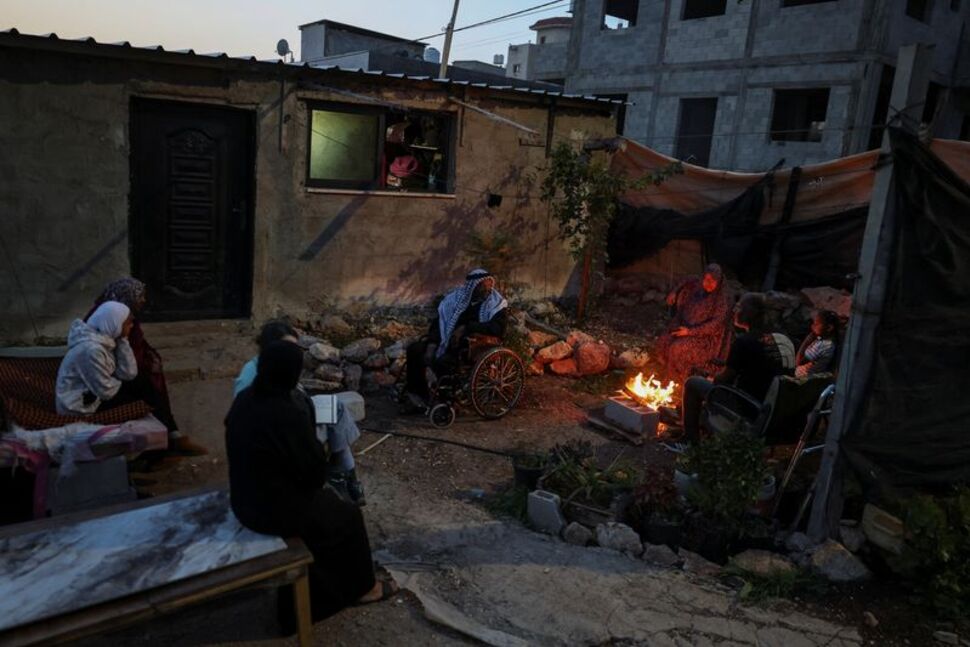
TULKARM, West Bank, April 2 (Reuters) – The sight and sound of Iranian rockets arcing overhead have become near-daily for the Palestinian Ghanem family, expelled by the Israeli military from a refugee camp and now living in a rickety shack with a thin metal roof offering little protection.
The family are among an estimated 32,000 people who Israel’s military forced last year from homes in three longstanding camps housing Palestinian refugees and their descendants in the occupied West Bank.
Their situation has become even more precarious since the U.S. and Israel attacked Iran on February 28, exposing the West Bank to falling debris from Iranian missiles taken out by Israeli interceptors.
“The children were terrified by the sound of the rockets,” said Madleen Ghanem, who has children aged three, eight, 11 and 14 living with her in a one-room shack, while her older children live elsewhere.
More than 270 pieces of missile debris have fallen on the West Bank since the start of the war, according to the Palestinian Civil Defence rescue service.
Unlike in Israel, where bomb shelters are widely available, the West Bank has virtually no shelters, giving the Ghanem family nowhere to hide.
While Iran has not been reported to deliberately target Palestinian territories, four Palestinian women were killed last month when an Iranian missile hit the West Bank town of Hebron.
“We don’t have shelters, the space where we stay is the same space we hide in. There are no shelters and no place to run to,” said Madleen.
Israel’s military did not immediately respond to a request for comment.
In early 2025, during a brief truce in fighting with Hamas in Gaza, Israel’s military began demolishing homes and destroying roadways in Tulkarm camp, the nearby Nur Shams camp, and the Jenin refugee camp in the northern West Bank.
Israel said its operations in the camps were necessary to demolish civilian infrastructure so that it could not be exploited by militants. Human Rights Watch called the expulsions war crimes and crimes against humanity, in a report on the displacements published last year.
Some leaders from Israel’s ruling coalition have called repeatedly for Israel to annex the West Bank, an area around 100 km (60 miles) long that Palestinians see as the core of a future independent state, along with Gaza.
Israel cites historical and biblical ties to the West Bank, which it captured during a 1967 war.
‘CAN’T EVEN PROVIDE BASIC FOOD’
The Ghanems had lived in a three-storey house in the crowded Tulkarm camp, where the women of the family had spent decades growing trees, flowers and vines that hugged their verandas.
Areej Ghanem, Madleen’s sister-in-law, says Israeli soldiers broke into their family’s home without warning in the middle of the night last year.
“We didn’t take clothes, nothing at all. They made us leave. Our father can’t get up or down…He’s an old man, he can’t walk. We left, dragging him,” Areej said.
The Israeli military did not respond to a request for comment on the Ghanems’ case.
After their house was destroyed, like many others in the camp, Areej, her sister and her niece moved with their father, Mahmoud Ghanem, 89, to a small rented room in the nearby town of Tulkarm.
Areej is the only one in the family earning money, working as a maid. The room they rented is small with no kitchen, so Areej washes dishes in the bathroom. With little money, they have not been able to afford meat for more than a year.
“Honestly I have no hope for the future. We can’t even provide basic food,” Areej said.
Meanwhile Madleen, her husband Ibrahim – Areej’s brother – and their children, who had also lived in the family house, moved to a different part of Tulkarm, where they had bought a small plot in 2023, just before the Gaza war broke out.
Ibrahim had been working as a construction worker, one of thousands of Palestinians permitted to cross into Israel for work. But after the Hamas-led attacks in 2023, which sparked the Gaza war, Israel pulled work permits from most Palestinians. Ibrahim has been unemployed since.
Ibrahim says he and his wife sometimes cannot afford gas and instead do their cooking over a fire outdoors.
Though they now live about an hour’s walk apart, the family tries to gather each week to create a semblance of normality.
At a dusty, roadside playground on a recent Friday, Areej and Madleen spread a picnic blanket over a faded patch of synthetic turf as their children played.
Madleen said she dreams of finishing the house they started building and hopes one day the family can reunite under one roof. Areej said the important thing is that they find a way to remain together.
“Either we die together or we live joyfully together,” she said.
(Reporting by Pesha Magid; Editing by Alex Richardson)
Copyright 2026 Thomson Reuters.