


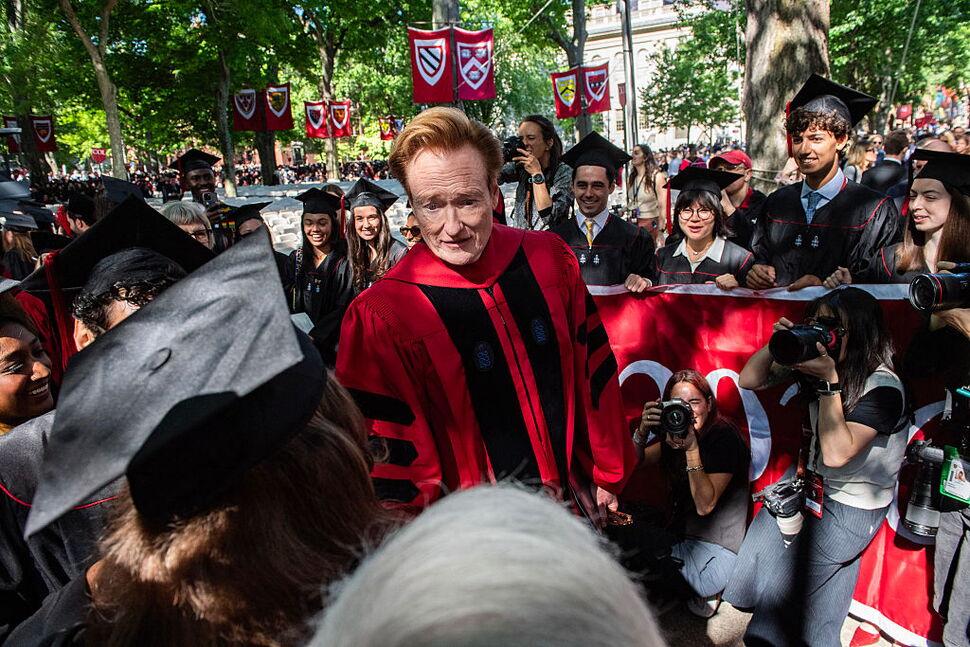
The main commencement speaker at America’s oldest institution of higher learning painted artificial intelligence in a different – and less serious – light on Thursday after several 2026 graduation ceremonies saw students boo addresses that praised the technology.
“Luckily, AI is not a problem at Harvard,” remarked comedian and TV host Conan O’Brien to Harvard University’s 375th graduating class. “Here, professors have been able to quickly flag students’ use of AI, thanks to the sophisticated AI software they use to grade papers.”
But O’Brien, who graduated from Harvard in 1985 with a degree in history and literature, also acknowledged the anxiety that AI has sparked among young job-seekers.
“Despite your fears, trust me when I say AI cannot replace you,” he said. “It’ll be too busy replacing those creeps from Princeton.”
The theme was a recurring one through the graduation festivities, after speakers ranging from former Google CEO Eric Schmidt to Scott Borchetta, head of Big Machine Records, drew scorn from skeptical audiences this season when touching on the future of AI while delivering commencement addresses.
On Wednesday, “The Daily Show” host Ronny Chieng spoke to Harvard’s graduating class at the Class Day celebration and repeatedly cursed AI.
“A lot of other respected graduation speakers at colleges around America are talking about you guys needing to master AI for the future. I’m here to tell you the mission of your generation is to destroy AI, kill it,” the comedian said.
Acknowledging today’s exceptionally competitive job market for recent graduates, O’Brien promised: “I will keep my remarks short, because MIT’s graduation is also today and I want to give you a 15-minute head start on your job hunt.”
O’Brien also did not hesitate to call out President Donald Trump’s administration for its lawsuit against Harvard in March that argued the university failed to protect Jewish and Israeli students from antisemitism on campus. Harvard earlier this month asked a federal judge to dismiss what it called the “unconstitutional” lawsuit.
Keeping the tone light, O’Brien joked that he too is suing Harvard “for the cast iron bunk bed that greeted me upon my arrival” and other humorous gripes. “Harvard, I’ll see your ass in court!” he said. “I’m confident that my claims will have more merit than those filed by the president of the United States.”
O’Brien also received cheers for his mention of the government’s attempt to block Harvard from accepting international students as part of the administration’s broader immigration crackdown.
“After all, what has any foreigner added to our American culture?” asked O’Brien before listing: “Music, literature, art, cuisine, fashion, architecture, dance, scientific breakthroughs and the core of our moral codes and ethical beliefs.”
O’Brien touched on another new development at Harvard: its controversial cap on A’s to counter grade inflation. After thanking Harvard President Alan Garber, he joked: “Normally I would give you an A-plus, but in keeping with upcoming Harvard policy, I’m adjusting your grade to a C-minus.” Students burst into laughs and applause.
An Emmy Award-winner for his comedy writing on “Saturday Night Live,” O’Brien worked on the long-running animated comedy “The Simpsons” before hosting his own show on NBC, “Late Night With Conan O’Brien,” which ran from 1993 to 2009 and totaled more than 2,700 episodes. He is also famous for his travel comedy shows, and his latest endeavor is a popular interview podcast called “Conan O’Brien Needs a Friend.”
But during his remarks, he leaned into his time at Harvard, where he served two terms as president of the Harvard Lampoon – a semisecret undergraduate humor society that is known for producing several successful comedians, including Greg Daniels, creator of “The Office” and “Parks and Rec”; B.J. Novak, an actor, writer and producer for “The Office”; and a host of other writers, commentators and satirists dating back a century and a half.
O’Brien spoke about the principles he learned during his college experience. He emphasized the importance of community, humility and the ability to pivot, while acknowledging the role of luck in his life.
“We are living through a period of extreme narcissism,” O’Brien said. “Our current leadership in Washington believes that empathy is a weakness and that our nation stands supreme and alone.”
He continued: “Everyone here today has a phone in their pocket that is algorithmically programmed to celebrate you and you alone by making you the ‘protein-maxxing’ hero of your own special journey.”
O’Brien said in his closing remarks, “My wish for you is not that Harvard becomes the last thing people know about you, but instead that Harvard becomes the least important thing people know about you.”
“Your greatness comes from the mess around you, not despite it.”


Get Higher Ground in your inbox each week!
The must-read newsletter for leaders shaping higher education’s future.
By clicking “Sign Up”, you will receive the latest updates, including emails, from U.S. News & World Report and our trusted partners and sponsors, and you agree to our Terms and Conditions & Privacy Policy.