


OTTAWA, May 15 (Reuters) – Alberta separatists have been dealt their first major setback in their campaign for a referendum on seceding from Canada, after a provincial court ruled this week in favor of a First Nations bid to halt the referendum petition.
The ruling, which the oil-rich province’s populist leader has promised to appeal, further complicates the uphill campaign for an independent Alberta that separatists have hoped will go before voters in an October referendum.
But reactions so far from separatist leaders and Alberta’s conservative premier, Danielle Smith, indicate the campaign will remain a major challenge for Prime Minister Mark Carney, who hopes for a united Canadian front as he grapples with U.S. tariffs and diplomatic tensions.
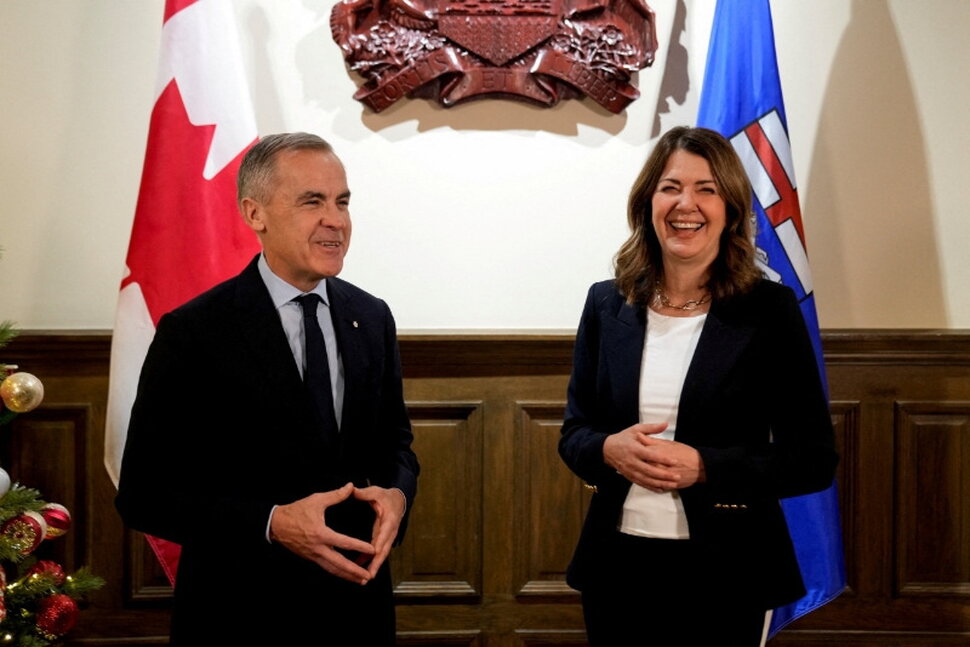
Carney’s next test on finessing the issue will come on Friday, when he visits Alberta to finalize parts of an energy deal with Smith.
“It could be dangerous for Carney if he steps into the conversation about Alberta and tries to dismiss the sovereignty idea,” said Adrienne Davidson, a political science professor at McMaster University in Ontario. “It could be seen as Ottawa just trying to run the show and could absolutely backfire for him.”
LONG-RUNNING RESENTMENT OF OTTAWA
Alberta separatists have aimed to tap into long-running resentment towards successive Liberal governments in Ottawa, which they believe have undermined the province’s oil and gas industry with onerous environmental regulations. Polling has consistently shown, however, that separation is supported by only about one-third of the province’s voters.
On Wednesday, Justice Shaina Leonard ruled that the province’s chief electoral officer was wrong to allow separatists to collect signatures requesting a referendum, because the process should have triggered a consultation with Indigenous peoples whose rights might be violated by Alberta’s separation from Canada.
“Alberta independence would fundamentally contravene” the land treaties Indigenous peoples signed with Canada, Leonard said.
Smith, who pushed through several legislative changes last year making it easier for separatists to trigger a referendum, said the court decision was “incorrect in law.”
Smith has stopped short of publicly supporting independence, but some factions of the movement back her leadership. She said that her government would appeal against Leonard’s ruling and that her caucus would meet “to discuss the full context and make some decisions after we’ve had a chance to talk it through.”
Earlier this month, the separatist group Stay Free Alberta said it delivered a petition to Elections Alberta with more than 300,000 signatures, which have yet to be validated but would be more than enough to trigger a referendum. Smith had reduced the number of signatures required by half.
The separatist campaign has also had to grapple in recent weeks with a data breach and a backlash over meetings with U.S. President Donald Trump’s administration.
Elections Alberta said it was investigating the unauthorized use of a list of voters by the Centurion Project, a separatist group that received a database with personal information on hundreds of voters. That database had been legally provided to the Republican Party of Alberta, another separatist group.
Both the Republican Party of Alberta and the Centurion Project have denied any wrongdoing.
The movement also gained international attention when the U.S. State Department confirmed in February that staff-level meetings were held with members of Alberta’s separatist movement. While the department said there would be no future meetings, Leonard’s ruling this week noted a significant risk of foreign interference in the matter.
Grace Skogstad, a professor emerita of political science at the University of Toronto, said the Alberta data breach and claims of foreign interference were “a very bad look” and might hurt the separatists’ cause.
“People aren’t going to like that voter lists are being mishandled,” she said.
McMaster University’s Davidson added that, while Alberta intends to appeal Wednesday’s decision to a higher court, the First Nations’ argument against the referendum might legally block separation altogether.
“The treaties in question actually predate the creation of Alberta as a province,” she said.
First Nations have underscored that their treaties are with Canada, not with the provinces.
“Our treaties are embedded into the constitution and we as First Nations people are always going to be recognized,” said Chief Allan Adam of the Athabasca Chipewyan First Nation. “The land belongs to us.”
Jeff Rath, a spokesman for Stay Free Alberta, told Reuters that regardless of what the courts say about the merits of the petition, Alberta’s premier should put separation on the ballot because “301,620 members of Danielle’s base expect her to call the question.”
Carney, who spent much of his childhood in Edmonton, said Thursday he was working to make Alberta and all of Canada stronger.
“As someone who was raised in Alberta … I view that very much the best place for Alberta is in Canada.”
(Reporting by Maria Cheng; Additional reporting by Ryan Patrick Jones in Toronto, Amanda Stephenson in Calgary and David Ljunggren in Ottawa; Editing by Caroline Stauffer and Edmund Klamann)
Copyright 2026 Thomson Reuters.