



Cutting oil consumption may help combat soaring energy prices caused by the Iran wasbut convincing Americans to burn less gasoline could prove difficult, according to economists.
The International Energy Agency (IEA) last week released a list of energy-conserving measures for consumers, including working from home, driving more slowly and carpooling. Because two-thirds of oil is consumed by vehicles, many of its suggestions relate to driving less, improving fuel economy or using public transportation.
“Supply-side measures alone cannot fully offset the scale of the disruption,” the IEA wrote in a March 20 report. “Addressing demand is a critical and immediate tool to reduce pressure on consumers.”
The recommendations may have a familiar ring to Americans who experienced the 1970s oil crisis, when an embargo by Middle East producers caused gas prices to surge and prompted many U.S. workers to carpool to save money. But convincing people to change their habits can be difficult — especially in the U.S., where public transportation is unavailable in many regions and electric vehicles remain generally pricier than fuel-powered cars.
The Strait of Hormuza narrow waterway in the Persian Gulf that carries roughly 20% of the world’s oil, remains blocked to most tankers. Unless the U.S. brokers a diplomatic agreement with Iran ending the war, global oil supply will be depleted for months, according to many experts.
“The single most important solution to this problem is opening up the Hormuz Strait,” IEA director Fatih Birol said when the intergovernmental agency released its recommendations.
The conduit in the Gulf could remain impassable until May, economists with Oxford Economics estimated. At that point, about half of the pre-conflict volume of oil could start shipping again.
The Trump administration has also taken steps to try to boost oil suppliesincluding by releasing 172 million barrels of oil from the U.S. Strategic Petroleum Reserve (SPR). But experts said such efforts alone won’t rebalance the market enough for prices to drop to pre-war levels.
Easier said than done
Yet while reducing energy usage can save money as fuel prices soar, for many consumers that’s often easier said than done. Nobel Prize-winning economist Paul Krugman told CBS News that the most effective way to reduce oil consumption is for people to change their driving habits — primarily by driving less — while acknowledging that engineering such a shift isn’t easy.
For many Americans, transportation options such as taking the bus aren’t feasible, given that many regions lack mass transit. Gas prices might need to rise even further to push workers to carpool, Krugman said. The upshot: It’s hard to quickly reduce the nation’s oil demand because there are few immediate substitutes, analysts said.
“Oil demand is, on average, highly inelastic in the short run because most end uses have few immediate substitutes — factory boilers rely on fuel oil, aircraft require jet fuel and most cars still run on gasoline,” JPMorgan global energy analyst Natasha Kaneva noted in a report.
Skip the commute?
While it may be unrealistic to expect people to stop driving, consumers can change their driving habits to save fuel, such as reducing driving speeds to improve fuel efficiency. Reducing highway speeds by 5 to 10 mph can improve mileage by up to 14%, according to AAA.
Krugman also pointed to a phenomenon that unfolded in 2020 during the COVID pandemic, when work-from-home mandates caused oil consumption to fall to a 25-year low, according to the U.S. Energy Information Administration.
“Look at how much oil consumption fell in 2020, and a lot of it had to do with remote work, which we could do now. A lot of commuting can be saved by having people spend one less day commuting in per week,” he said.
For the 4.8 million households that use heating oil, another way to reduce oil consumption is to fill up their tanks only halfway, said Mark Wolfe, an energy economist and executive director of the National Energy Assistance Directors Association, an energy policy group. That would help avoid drawing down the nation’s oil supplies,
“Just buy as much as you need. Typically in March, people might fill it up to get ready for next winter, but I wouldn’t do that now,” Wolfe said.
When is demand “destroyed”?
The reality, however, is that consumer demand for oil typically doesn’t budge unless downstream prices shoot to painfully high levels. Typically, those upstream oil costs range between $120 to $130 a barrel, said Rystad Energy oil and gas analyst Matthew Bernstein.

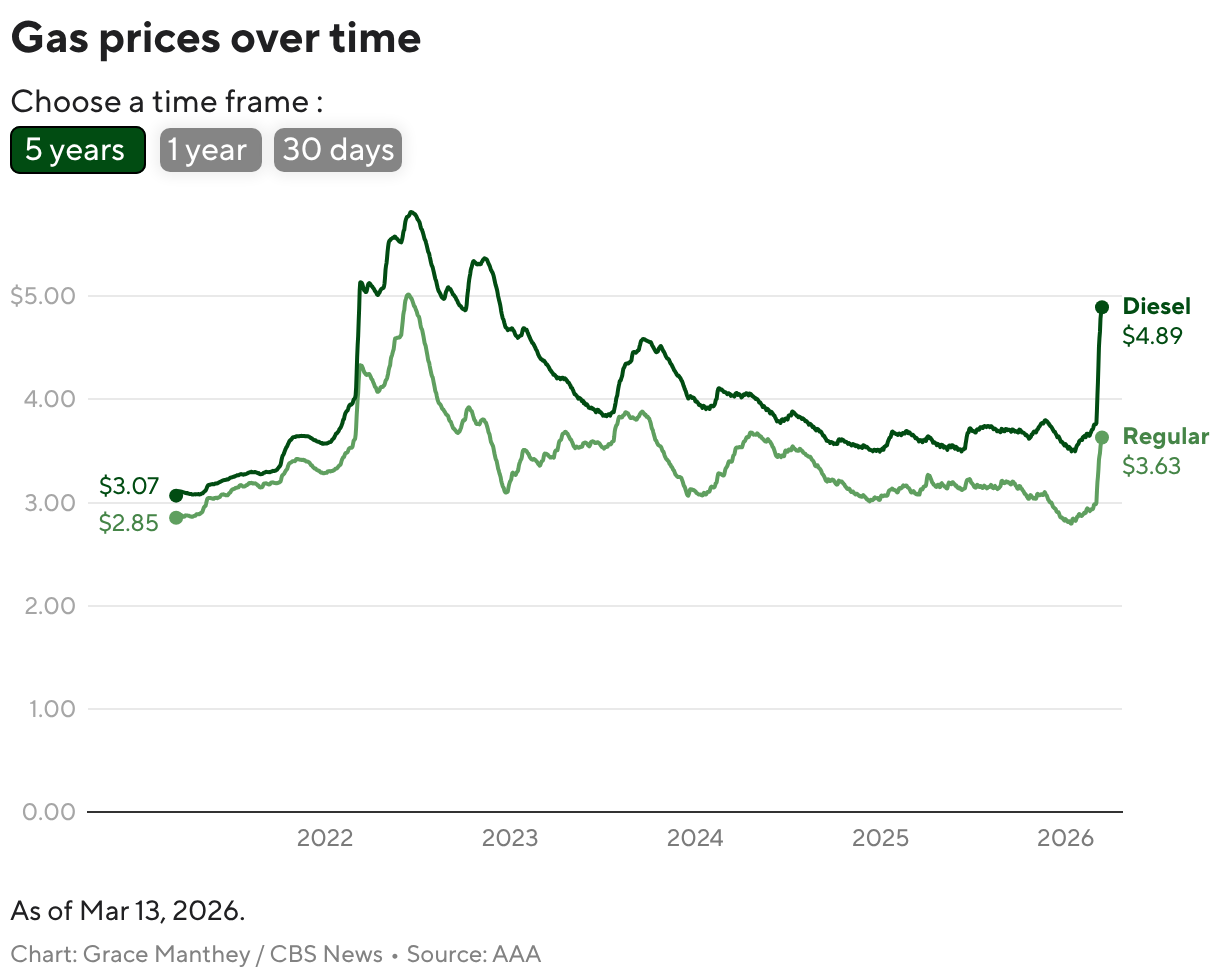
A barrel of Brent crude, the international benchmark, rose 3.8% on Thursday to $100.93 amid fresh signs of escalation in the Iran war. Benchmark U.S. crude climbed 3% to $93.05 per barrel. By those benchmarks, oil prices are up roughly 40% since the outbreak of hostilities on Feb. 28.
“If prices get so high that there’s less economic activity, less travel, that’s when you get demand destruction,” Bernstein said. “But we’d need to see that for a sustained period of time before it makes a difference.”