


Human rights around the world are under severe attack, creating a “global environment where primitive ferocity could flourish,” warns Amnesty International in its annual report released Monday, “The State of the World’s Human Rights.”
The current “predatory world order,” says Amnesty International, normalizes and fosters social injustice, suppression of free speech, unprecedented military investment, cuts to international aid and withdrawal from multilateral organizations, resulting in millions of preventable deaths.
“This is a direct assault on the foundations of human rights and the international rules-based order by the most powerful actors for the purpose of control, impunity and profit,” said Amnesty International Secretary-General Agnès Callamard.
Technology played a significant role in the past year’s human rights violations, as surveillance and censorship tools became more accessible to governments and artificial intelligence continued to pose threats to the natural environment and labor rights while remaining insufficiently regulated.
The human rights organization has published a comprehensive analysis of the circumstances in a growing number of countries every year since 1962. Its newest report assesses the state of human rights in 2025 across 144 countries and reveals intensifying threats to multilateralism and international law around the world.
Here’s a look at the state of human rights in select countries that have dominated global discourse over the past year.
United States
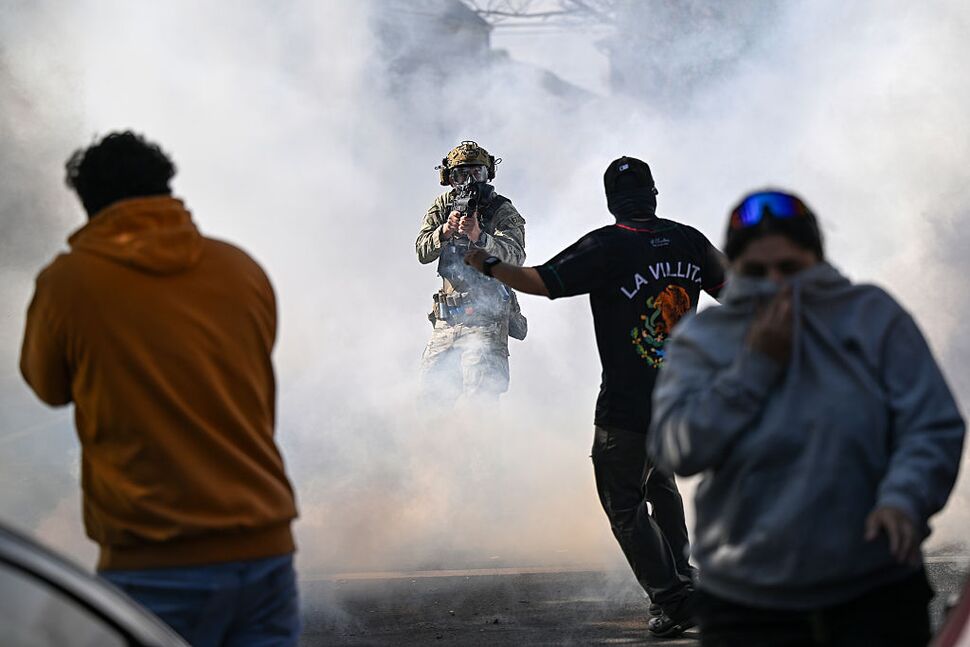
The beginning of President Donald Trump’s second term set the stage for radical changes in the country’s observance of human rights, according to the report. Increased immigration enforcement, gun violence and crackdown on protests, as well as the rollback of protections for marginalized groups and the environment were among the actions that defined Americans’ human rights in 2025.
In keeping with its anti-immigration agenda, the Trump administration threatened the safety of refugees, migrants and civilians who spoke up to defend them.
The government also reversed its progress in LGBTQ+ and reproductive rights, introducing hundreds of anti-LGBTQ+ bills and upholding state bans of gender-affirming care, in addition to supporting abortion bans in 41 states.
The report notes the nation’s increasing and controversial involvement in foreign conflicts, most notably the ongoing war in Gaza. Sharply critical of Israel’s conduct in the war, Amnesty points out that the alliance between the U.S. and Israel has strengthened during Trump’s presidency. Many blame the U.S. for supporting Israel as violence continues to plague people in the region.
Iran
Iran’s entanglement in international conflict and oppressive regime created a hostile environment for ethnic and religious minorities, women and LGBTQ+ people in 2025. The country saw its highest number of executions since 1989 amid some of the most intense protests against the regime in the Islamic republic’s history.
While the report does not cover the current war in Iran, it highlights the Iranian government’s persistent human rights violations, including using arbitrary detention, enforced disappearance and the death penalty against anyone belonging to a targeted group.
The country continues to enforce bans on social media platforms, independent political parties, trade unions and newspapers.
Callamard warns that Iran’s failure to uphold international laws will “intensify an already devastating human toll and push the region even further towards another humanitarian and human rights catastrophe.”
Russia
As Russia’s war against Ukraine grinds on, bringing an escalating casualty count and a flagging economy, censorship and restriction of free expression prevail. Corruption in the legal system put innocent people at risk of torture and detention in subhuman conditions. Amnesty International considers some of Russia’s acts against Ukrainian prisoners to be war crimes and crimes against humanity.
Most migrant children in Russia could not enroll in school because of restrictions imposed by the government, and LGBTQ+ people remained marginalized and criminalized. The internet was increasingly controlled by authorities, who blocked public access to websites and platforms deemed dangerous or extreme.
Venezuela
U.S. involvement with Venezuela, most notably the capturing of its president in January, pushed the country into the global spotlight. Any real or perceived dissent against Nicolás Maduro led to punishment, often severe enough to be considered crimes against humanity, according to the report. Human rights defenders and journalists in particular were targeted by the oppressive regime.
Political, social and economic conditions in Venezuela continued to worsen and drive people out of the country. Between 2015 and 2025, about 7.9 million Venezuelan refugees fled the country, according to the report.
“Impunity for crimes against humanity committed by Venezuelan authorities for more than a decade is so far continuing,” said Amnesty International Senior Director Erika Guevara-Rosas. “No meaningful steps toward justice have been taken.”
China
The past year in China has been characterized by increasing government imposition of strict laws and policies against suspected anti-communists. Authorities used surveillance and raids to persecute people engaging in religious activities or defending human rights.
Advanced technology allowed Chinese leaders to further control information and public discourse. “In China, we are seeing the refinement of a techno-authoritarian model where generative AI and facial recognition are not just tools of convenience, but instruments of absolute social control,” said Callamard.
Overall, Amnesty International warned that the global order that emerged nearly a century ago based on a multilateral system of equal states, universal human rights and a non-recurrence of atrocities was in jeopardy. It said 2025 was a year of “bullies and predators” and the “politics of appeasement.” The group urged resistance in 2026.
“We have a choice to make at this critical moment in history,” said Callamard in a call to action. “Continue to let authoritarian practices erode our freedoms or resist together and stand up for human rights.”