


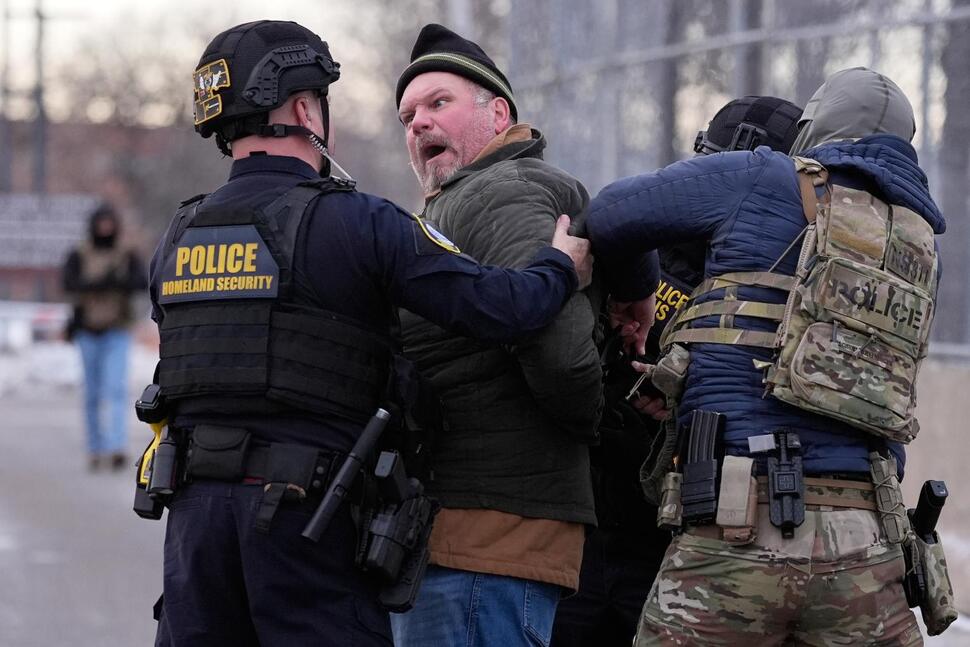
A Colorado prosecutor said Wednesday that the officer has been charged with third-degree assault and criminal mischief following an investigation into the treatment of a protester in October.
Multiple videos show a masked federal agent seizing a 57-year-old woman, who says she was put in a chokehold, during the protest in Durango.
Colorado is among several states to prohibit or severely limit the use of chokeholds and neck restraints by police officers. But immunity provisions under the U.S. Constitution and federal law limit the reach of local authorities in prosecuting federal agents.
Investigations underway in
Minnesota and Chicago
The Trump administration’s immigration enforcement tactics have spurred an array of investigations by state and local authorities.
Immigration and Customs Enforcement officer Gregory Donnell Morgan Jr. is accused of pointing his gun at occupants of a car after pulling alongside them on a Minneapolis-area highway. Investigators say Morgan said he feared for his safety after the vehicle swerved in front of him.
Outside Chicago, an off-duty ICE agent has been charged with misdemeanor battery for throwing to the ground a 68-year-old protester who was filming him at a gas station in December. The Homeland Security Department that oversees ICE says the agent acted in self-defense.
In California, the shooting death of 43-year-old Keith Porter by an off-duty ICE agent on New Year’s Eve has prompted protests and calls for an independent investigation.
Federal officers and the supremacy clause
Federal law enforcement officers have broad legal protections when acting in the course of their official duties, and the Justice Department has taken a hard line against state efforts to arrest or prosecute federal agents.
Late last year, U.S. Deputy Attorney General Todd Blanche said arrests of federal officers performing their duties would be “illegal and futile,” citing the Constitution’s supremacy clause and federal law.
Legal experts say those protections are significant but not absolute and that the supremacy clause does not provide blanket immunity.
Flashpoint in Colorado mountain town
The altercation in Colorado arose from demonstrations over the detention on Oct. 27 of three Colombian asylum-seekers — a man and two children — while they were on their way to school in the morning. In late October, protesters gathered outside an ICE facility in Durango, a college town and destination for outdoor recreation in the San Juan Mountains of southwestern Colorado.
Multiple videos show a masked federal agent placing Franci Stagi in what she described as a chokehold. Chokeholds have been at the center of public discourse and state legislative initiatives about what constitutes an unreasonable use of force since Eric Garner died in New York in 2014 after he was put in a chokehold by a police officer.
Stagi, a retired hypnotherapist, said she reached for the agent’s shoulder to get his attention and that he then grabbed her by the hair, put her neck in the crook of his arm and carried her across the street by her head before throwing her down an embankment next to the street.
Court documents allege that Customs and Border Protection officer Nicholas Rice committed third-degree assault by causing bodily injury to Stagi, but the documents don’t describe how she was injured or make mention of a chokehold. Court documents didn’t list any attorney as representing the officer.
A spokesperson for U.S. Customs and Border Protection, which launched its own investigation, didn’t immediately respond to questions about the charges.
Stagi says she’s disappointed Rice was charged with less serious crimes but hopes the prosecution sends a message that immigration officers can’t tackle people indiscriminately and use excessive force.
Lee reported from Santa Fe, New Mexico, and Slevin contributed from Denver.
Copyright 2026 The Associated Press. All rights reserved. This material may not be published, broadcast, rewritten or redistributed.
Photos You Should See – April 2026

