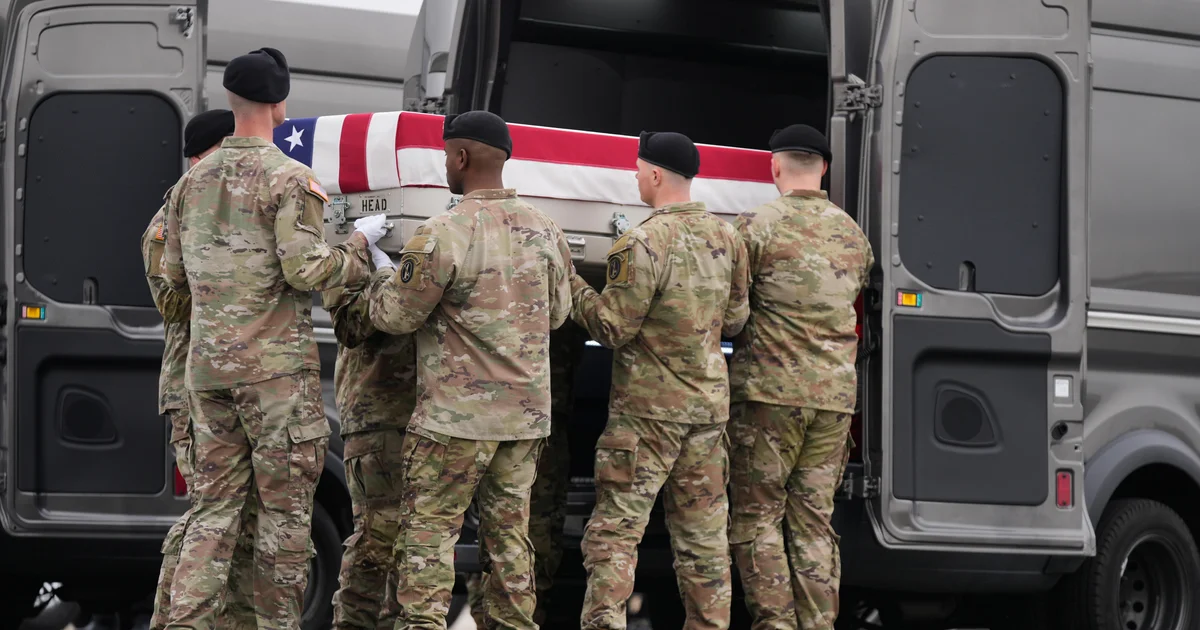
An Iranian drone attack in Kuwait that killed six U.S. service members in the early hours of the war with Iran was more severe than has previously been revealed, with dozens suffering brain injuries, shrapnel trauma and burns, multiple sources told CBS News. At least one required the amputation of a limb.
Sources described a grim and chaotic scene in the aftermath of the strike on a tactical operations center at the Shuaiba port outside Kuwait City on March 1. Smoke quickly filled the building, making it difficult to rescue those inside.
More than 30 military members remained in hospitals Tuesday night with battle injuries from the Kuwait attack — one at Brooke Army Medical Center in San Antonio, 12 at Walter Reed Medical Center in suburban Washington, D.C., and about 25 at Landstuhl Regional Medical Center in Germany, sources said.
Of those, about 20 arrived on a C-17 military transport aircraft at Landstuhl on Tuesday with injuries the military designated as “urgent” and requiring evacuation, including traumatic brain injuries, memory loss and concussions, three of the sources said.
More than 100 medical personnel were sent to Landstuhl to assist, one of the sources said.
Defense Department officials initially didn’t specify how many had been hurt in the Kuwait attack, but said on March 1 that five were seriously wounded and “several others sustained minor shrapnel injuries and concussions.”
Two of the service members were missing after the attack and were later found under the rubble, sources said.
The Pentagon has a process to notify wounded soldiers’ family members and seeks to shield them from learning from press releases about how extensive the injuries were.
The military defines a serious injury as one that “requires medical attention, and competent medical authority declares that death is possible but not likely to occur within 72 hours.”
Speaking at the Pentagon last week, Defense Secretary Pete Hegseth, described the strike: “You have air defenses, and a lot’s coming in, and you hit most of it. Every once in a while, you might have one, unfortunately, we call it a squirter, that makes its way through. And in that particular case, it happened to hit a tactical operations center that was fortified, but these are powerful weapons.”
At least one American was killed in a separate strike in Saudi Arabia March 1. It is unclear how many others may have been injured in that attack.
On Tuesday, the 11th day of the war, Pentagon spokesman Sean Parnell said about 140 American service members had been injured so far, without specifying where or when they were wounded.
“The vast majority of these injuries have been minor, and 108 service members have already returned to duty. Eight service members remain listed as severely injured and are receiving the highest level of medical care,” Parnell said in a statement.
The military has robust air defenses shielding all U.S. personnel in range of Iranian attacks, sources told CBS News.
Pentagon spokespeople did not immediately respond to questions on Tuesday about service members’ injuries or where they were sustained.