


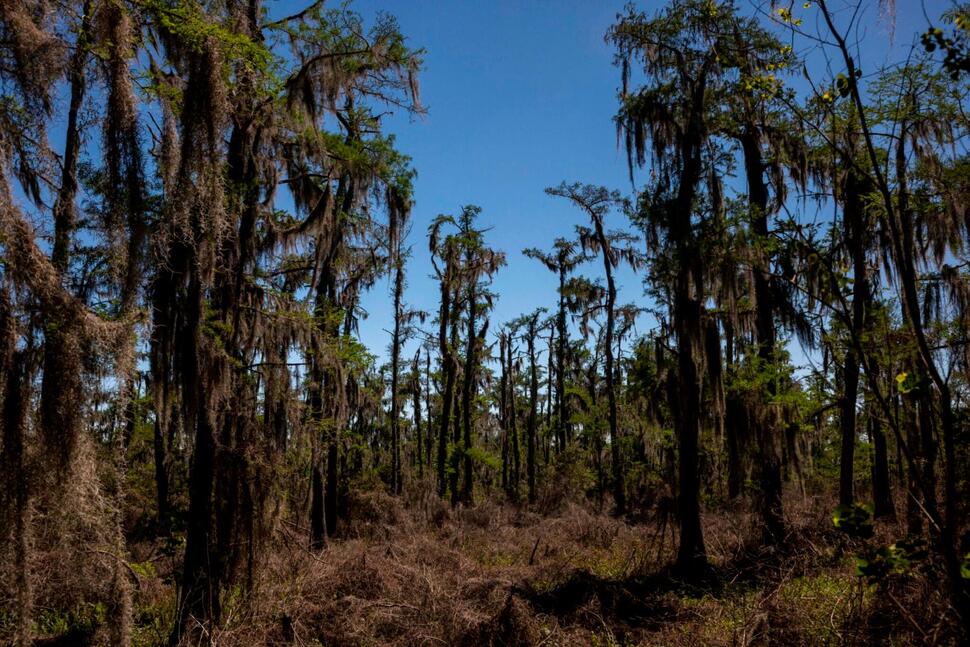
On a bright March day, Mary Maggiore led a group of mostly out-of-state tourists through the cypress swamp at Wetland Trace in Jean Lafitte, offering up facts about the town’s pirate namesake and the newly-blooming blue irises.
The trail begins by a levee, which exists to protect nearby residents from extreme weather, including hurricanes and intense winds, she explained.
“Back here we have the town of Lafitte, we have buildings, we have houses, we don’t want those things to flood,” she said, motioning to the buildings behind the group as they stood on the levee. “We don’t want the town to get flooded every single time the swamp is flooded, so that’s why you have this kind of stark separation right here.”
Hurricane damage is the reason Maggiore is leading a tour at Wetland Trace, instead of nearby Barataria Preserve, where she started leading tours three years ago. After Hurricane Ida badly damaged the preserve in 2021, it continued to remain open to visitors until closing at the start of 2026 for long-needed repairs.
A flat expanse of swampland just 20 miles south of New Orleans, Barataria Preserve possesses all the postcard characteristics of Southeastern Louisiana. Spanish moss dangles overhead, cypress tree roots push up out of the dirt, and visitors with keen eyes may be rewarded by an alligator sighting.
Barataria Preserve is also similar to the rest of the marshes that line the Gulf Coast in that it is deeply vulnerable to coastal erosion and extreme weather.
When Hurricane Ida made landfall in August of 2021, it submerged the entire preserve, which is a mostly freshwater landscape, in saltwater. It tore through Barataria, covering public areas with debris, damaging the roof of an administrative trailer, flooding the visitor center and maintenance building and shattered parts of boardwalk trails over the marsh, rendering them unusable. It was the worst storm damage the preserve had faced since Hurricane Rita hit in 2005.
“It was kind of sad for me to watch some things fall apart,” said Maggiore. “I was kind of like, what are they going to do about this? And now they’re finally doing it, but it was kind of either we repair everything at once, or we just don’t repair everything.”
Now, five years later, the National Park Service is trying to stave off future damage with a two-year rebuilding process that began in February. In a region of the country that’s regularly hit hard by hurricanes, it’s a complex task.
Each year, Louisiana loses nearly 11 square miles of coastal wetlands to erosion, often expressed in terms of football fields — one every 100 minutes on average. If erosion occurred evenly over a single year, that means that a full field would be lost in the time it would take a hiker to walk from the Barataria Preserve Visitor Center to the marsh outlook and back.
But the football field analogy actually simplifies a much more complex story of erosion. The rising sea level does not affect marshland at a constant rate. Rather, extreme weather events can often level acres of land in hours. When Hurricane Ida touched down, it destroyed over 100 square miles of marshland. It would take 32 hurricane-free years of regular erosion to see that amount of marsh loss.
The state, and the Park Services, hope to protect Louisiana’s wetlands through a number of conservation and restoration projects at marshes including Barataria. But as a recent study warns that New Orleans should begin evacuation because sea level rise will overtake the city within generations, scientists say those efforts likely won’t be enough in the long run.
“You are not gonna save the coast,” said Ehab Meselhe, who chairs Tulane University’s Department of River-Coastal Science and Engineering. “You are going to reduce the amount of loss.”
A slow moving push towards restoration
With an opportunity to rebuild, the National Park Service is trying to bolster the infrastructure in the preserve against future weather events, according to Meredith Hardy, manager of interpretation and education for the Jean Lafitte National Historical Park, which includes Barataria Preserve.
By using a 50-year projection on sea level rise and environmental factors, including salinity and projected water depth, the Park Service created a plan that will hopefully increase resilience.
Over two miles of old boardwalks will be removed, based on flooding patterns, and new boardwalks will be built out of composite materials that are more resistant to flooding. The boardwalks will also have safety railings and be 1.5 to 2 feet higher than they currently are.
Hardy told Verite News that these plans began when the park team started designing new plans for boardwalks using congressionally-allocated disaster funds in 2022. It took two more years for an environmental assessment to be conducted and signed, then needed to undergo public review before being finalized.
The slow-moving pace of bureaucracy is a stark contrast to the quick devastation of weather events. That’s one reason that Meselhe, who works on computer models of coastal wetland systems, sees a dire need for more preventative solutions to coastal wetland loss.
In the 29 years he’s lived in Louisiana, Meselhe has served as the state’s technical lead for the Mid-Barataria sediment diversion — an ambitious land rebuilding project that was recently cancelled — and helped build models that led to two of Louisiana’s Coastal Master Plans.
“Most of the protection projects are unfortunately reactionary,” Meselhe said. “This is how our country here has been operating: they wait for something to happen, then they allocate recovery money or repair money.”
The timeline for a project like Barataria Preserve repairs, Meselhe said, is not abnormally long considering the number of steps required to get funding from the federal government. Even after the funding is obtained, it often requires a huge financial investment just to get a site back to its pre-hurricane state.
“You’re basically putting out fires rather than to actually improve the resilience of the system,” he said. “Overall, restoration projects sometimes are a little better, because you see deterioration somewhere, and you try to get ahead of it.”
Such restoration projects are built into the Coastal Master Plan, a $50 billion, 50-year outline created by the state Coastal Projection and Restoration Authority that aims to fight coastal erosion through a number of smaller plans.
But it’s become increasingly unclear whether those projects will come to fruition. Gov. Jeff Landry cancelled the Mid-Barataria Sediment Diversion project last year. The plan, which had a $3 billion dollar price tag, aimed to use sediment diversions to connect the river to wetlands in order to rebuild and maintain 27 square miles of land over 50 years.
By Meselhe’s projections, the Barataria area is slated to lose 90% of its wetlands by 2100. Had the Mid-Barataria project gone forward, that number would’ve dropped to 80%.
“You can think about it as really gloomy — I was gonna lose 90% and I’m gonna only lose 80%, that’s not very good,” Meselhe said. “You can also flip it. You say you were going to have only 10% remaining, I’m going to double that. So it is significant.”
When to stay, when to move
The question hiding below the surface for many coastal scientists is the delicate conversation of relocation — is there ever an appropriate time to ask a community to uproot itself because of climate vulnerability?
The town of Jean Lafitte, with a population of just over 1,800, is home to many residents who have lived there for generations. The surrounding swampland, including Barataria Preserve, is a big part of the area’s history as a fishing village.
“It’s very delicate to tell somebody you shouldn’t rebuild because you still are very vulnerable, you need to relocate,” Meselhe said. “It’s very delicate to say that to somebody who lived there, they have a cultural connection to that land.”
Dr. Kevin Xu, director of the Coastal Studies Institute at Louisiana State University, thinks the relocation conversation is starting about three decades too late.
“I believe that it’s time to talk about retreat, and it’s time to talk about how the government would subsidize the local community and how they can even pay the relocation fee to the local community,” Xu said.
Xu believes that one path forward would see the government building increased infrastructure to allow fishermen to live inland but commute down to the coast for work.
“Without those infrastructures, the fishermen will not leave their home, right?” Xu said. “We cannot finish the retreat in just like one year or five years. It will be a gradual, slow back and forth process.”
Trenton Smith, who lives in nearby Harvey, has been visiting the Barataria Preserve since they were a teenager to spot different species of snakes. Smith, who uses they/them pronouns, is grateful to see repairs, which they noted have been slow-moving even since Hurricane Katrina hit in 2005.
“Since Katrina, they haven’t repaired a lot of city parks, walking areas that were surrounded by lakes and rivers or canals,” they said. “I’m really looking forward to the repairs they’re doing now.”
Smith works as a mechanic but moonlights as a wildlife breeder, including snakes and lizards. After hurricanes, they often notice a change in the creatures that make up the swamp ecosystem.
“All it takes is one good hurricane, ’cause Lafitte floods,” they said. “It causes a lot of migration of reptiles, and people don’t really take account how fragile the reptile ecosystem is.”
With the Barataria Preserve closed for repairs, Smith has been searching for wildlife around the Bonnet Carré Spillway.
Maggiore — the park guide — is looking forward to being able to take visitors on tours on the new boardwalks when construction is finished. She’s particularly excited about a new visitor center that will have a screened in wall that will look out at the forest, with a view of the marshlands that coastal scientists are fighting to protect.
“It’s going to be beautiful,” she said, “but we don’t really have a place to give a tour at the moment.”
This story was originally published by Verite News and distributed through a partnership with The Associated Press.
Copyright 2026 The Associated Press. All rights reserved. This material may not be published, broadcast, rewritten or redistributed.
Photos You Should See – April 2026

