By Robbie Corey-Boulet and Pulcherie Adjoha
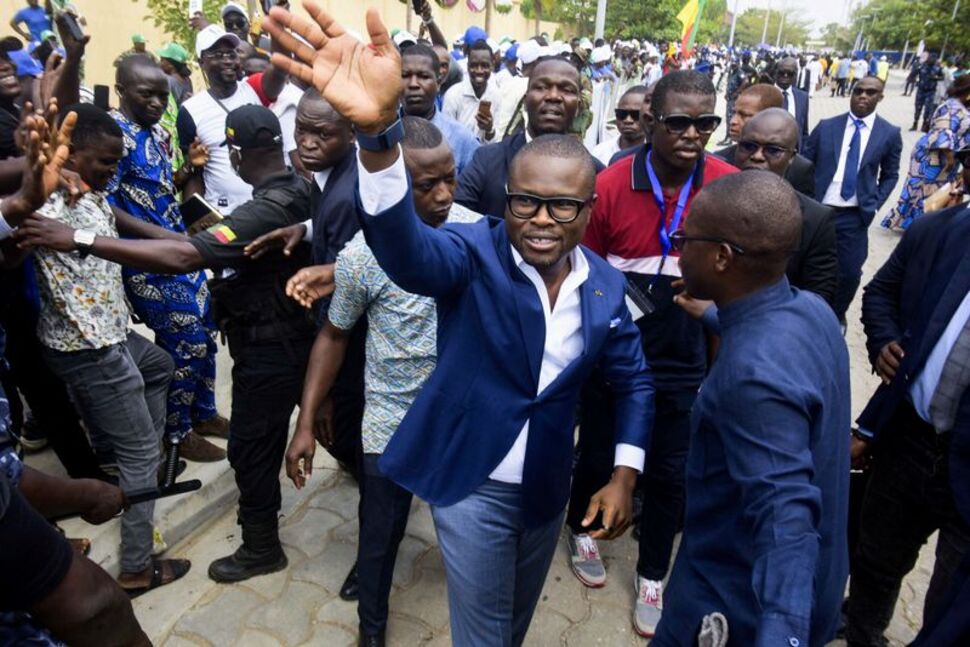
COTONOU, April 8 (Reuters) – Benin Finance Minister Romuald Wadagni is expected to make the leap from behind-the-scenes technocrat to head of state on Sunday when he runs as the strong favourite in a presidential election clouded by jihadist attacks in the north.
The 49-year-old former Deloitte executive has spent the past decade implementing the economic agenda of outgoing president Patrice Talon, who is barred by constitutional term limits from running again.
His campaign points to achievements like tripling the national budget and posting cotton-exporting Benin’s highest GDP growth rates in more than two decades.
Talon’s tenure has featured a consolidation of power within the presidency and the almost total sidelining of the political opposition, easing Wadagni’s path to power.
Since his selection as ruling party candidate last September, Wadagni has played down the idea of any major break from the man with whom he shares, as he told French magazine “Jeune Afrique” last month, “almost like a father-and-son relationship”.
He has proposed creating new development hubs across the country – to better distribute industrial and tourism investments – and expanding access to health care, while touting the benefits of continuity from one government to the next.
Under Talon “I had the honor of managing one of your most precious assets: your money,” Wadagni told supporters in March.
If elected president, “I will do the job with the same seriousness and dedication.”
GOVERNMENT SURVIVED DECEMBER COUP ATTEMPT
The election almost didn’t happen.
In the pre-dawn hours of December 7, disgruntled soldiers attempted a coup, temporarily seizing the state television network and getting close enough to Talon that he witnessed clashes firsthand.
Nigeria carried out airstrikes and the West African regional bloc ECOWAS deployed elements of its standby force to keep Talon in office. About 100 alleged coup participants are in jail awaiting trial.
The coup plotters said they were motivated in part by the government’s “neglect” of soldiers on the frontline in the north.
Benin has been the hardest hit among coastal West African states by jihadist groups that have made major gains in the central Sahel.
Fighters linked to al Qaeda and Islamic State have been rapidly increasing their attacks on the borderlands between Niger, Benin and Nigeria, turning remote transit corridors into active conflict zones.
Al Qaeda-linked Jama’at Nusrat al‑Islam wal‑Muslimin killed 54 Benin soldiers in one attack a year ago, and another 15 in an attack last month.
“Benin, historically, has never faced a situation like this, with serious threats, with these regular losses in the army,” said Gilles Yabi, founder of the West African think tank WATHI.
Wadagni has staged several campaign rallies upcountry – including in Parakou and Tanguieta – to try to demonstrate that the government controls all its territory.
He has also vowed to create municipal police forces in northern border towns to defend against attacks.
HARVARD-TRAINED CANDIDATE EMPHASISES LOCAL ROOTS
Wadagni was born on June 20, 1976, in Lokossa, in southern Benin, and studied management, financing and auditing at Grenoble School of Management in France before joining Deloitte, where he became a partner. He has also attended courses at Harvard in the U.S.
His campaign, seeking to fend off doubts about his ties to Benin after many years abroad, has emphasised his “deep roots” in the country and his “ordinary Beninese childhood”.
Under Talon, the political opposition has been steadily weakened, making Wadagni’s victory all but guaranteed.
He is facing off against just one candidate: Paul Hounkpe of the Cowry Forces for an Emerging Benin party, who maintains that most citizens are not benefiting from Talon’s high GDP growth and flashy tourism projects.
The main opposition party, The Democrats, failed to get enough lawmakers to sponsor a candidate, so it is not on the presidential ballot. It also failed to win any seats in legislative elections in January.
Talon’s supporters say a stronger presidency can be more effective in developing the country, while his critics decry the shrinking political space.
If security woes persist, the opposition could become even more constrained, said Nina Wilen, director of the Africa Programme at the Egmont Royal Institute for International Relations in Belgium.
“There is a risk that the government will be increasingly cracking down on any opposition to make sure they maintain that grip on power,” she said.
“Where there is a jihadist expansion, the rulers want to have complete control.”
(Reporting by Robbie Corey-Boulet in Dakar and Pulcherie Adjoha in Cotonou; Editing by Hugh Lawson)
Copyright 2026 Thomson Reuters.
Photos You Should See – April 2026
