Shock Books 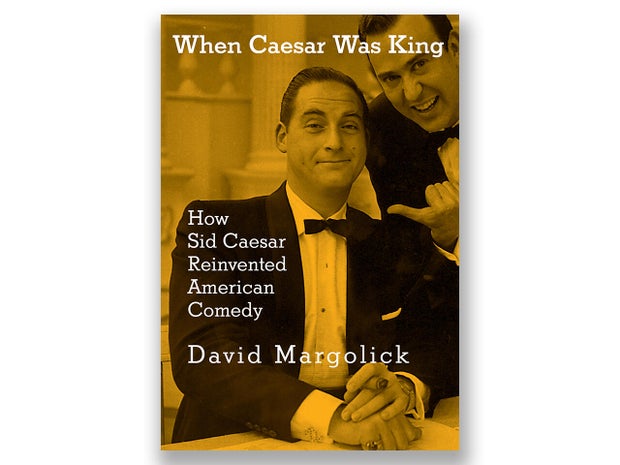
We may receive an affiliate commission from anything you buy from this article.
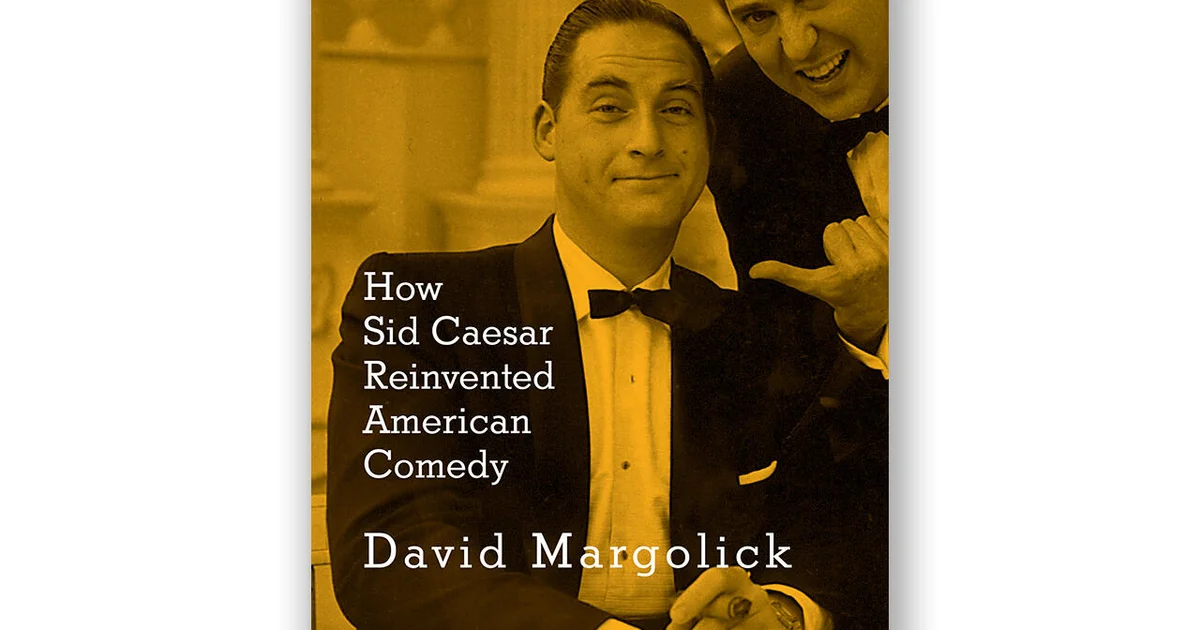
In his new biography, “When Caesar Was King” (published by Schocken Books), David Margolick explores how 1950s comic Sid Caesar reinvented the art of comedy in the new medium of television.
Read an excerpt below, and don’t miss Mo Rocca’s interview with David Margolick on “CBS Sunday Morning” March 22!
“When Caesar Was King” by David Margolick
Prefer to listen? Audible has a 30-day free trial available right now.
Television was called a “medium,” Fred Allen, the much-respected radio wit (and hero to Caesar and other thinking comics), once quipped, because nothing on it was well done. But Allen exempted Caesar from his broadsides. He lived around the corner from the International Theatre and would often drop by for dress rehearsals. “A casual observer might have assumed that Allen, the master, had come to instruct Caesar, the apprentice,” Collier’s noted. “Actually it was the other way around. Allen was embarking on his first television show and he had come to learn from Caesar.“
Before long, Caesar rued the day when he and Liebman had taken all ninety of the minutes Pat Weaver had offered them. “For the birds,” he called that last, agonizing half hour. But it was then, when he was most depleted, that he was also at his most ingenious, reflective, autobiographical, and exposed, that he bonded with his audience, and that his peculiar suitability for TV became most apparent. “Caesar seems to be the ideal comic for television,” Jeanne Loughlin noted in The Daily Compass. “His spontaneous, adroit facial expressions—wonderful in television close-up—might be lost on a theater stage. His comic material, drawn mainly from perceptive observations of everyday life, might not be broad enough buffoonery for the movies. At night clubs, perhaps much of his comic creation of the adventures of an average man might be wasted.” But “for home consumption,” she noted, his antics were “just about perfect.”
There was drama at the start of every show unmentioned on the printed program. It came when Caesar introduced the week’s guest host, or tried to. When he first appeared onstage—”Ladies and gentlemen, Sid Caesar!” the announcer would shout as the last note of “Stars over Broadway” faded— he was all business. He’d hold up his hands peremptorily, almost imperiously, to cut off the applause, not out of modesty, but because it prolonged his agony. He’d then start speaking, in an affected, actorly, slightly stilted manner. Much as he hated (and even banned) cue cards, so inimical to authenticity, spontaneity, and connectivity (to the audience as well as to the other performers), it sounded as if he were reading off one of them.
“Good evening, ladies and gentlemen, this is Sid Caesar,” he’d say, as if on radio rather than standing there for all the world to see. “Welcome to Your Show of Shows.” But only rarely was that how the words came out. Tolkin once assembled the forty or so different ways they actually did, among them “Woolkim to the shoo,” “Wilcome to the shaw,” “Wulcum to da shee.” Caesar’s stock line when presenting the evening’s guest presenter—the correct phrase was “star of the week and host for this evening”—seemed formulated to trip him up. Getting through the visitors’ latest credits also proved an ordeal. “Our star tonight has just finished a picture where he co-starred wis . . . with Miss Betty Hutton, in the Cecil B. dePicture, The Greatest Show on Earth” was how he presented Charlton Heston in October 1951. Once finished, Caesar would dash off the stage, ostensibly to prepare for the opening sketch but also to play someone besides himself. Reiner attributed it all to fear. “His feeling is, I’m just an ordinary guy whose folks ran a luncheonette in Yonkers,” he theorized. “Who am I to be up here, having all these people watching me and listening to me?” Caesar kept trying— it was, he once explained, “the way I practice being me”—but it never got any easier. Hugh Downs, brought on later to spare Caesar from such agony, likened Sid’s struggle to “the stark, evident terror of a kid in a high school play.”
Viewers actually enjoyed the “fluffs,” Caesar observed: They gave them “a sense of participating.” (A week without a flub was novel enough for Variety to note.) The sheer brinkmanship of his performances was part of the show’s power. As the critic Andrew Sarris later put it, “their opening nights were not only their closing nights, but also their eternal incarnations,” lending an “exquisitely wrought emotional tension” to the experience of watching them.
Every show was recorded, though hardly for posterity; practical concerns, rather than intimations of immortality, explained why, unlike so much of early television, Your Show of Shows was preserved: The kinescopes allowed for last-minute reprises of old sketches—say, when something else wasn’t funny or had suddenly fallen through. “Better a good old thing than a bad new thing,” Liebman liked to say. Whenever that happened, he’d ask his young assistant, Len Kanter, to fetch a particular “kinny” containing something tried and true, which the principals would then review and recommit to memory. But posterity’s hold on the show was fragile: Periodically, another of Liebman’s assistants, Natalie Goodman, would fill the metal tray beneath the reels of film with water to keep them from drying up and disintegrating.
Even without the repeats, there were complaints of predictability. As early as April 1950—barely two months into the show—Variety was calling the program “tired and pedestrian.” But with television spreading, lots of folks were still seeing Caesar for the first time. And Caesar kept collecting kudos. Groucho Marx congratulated him at Toots Shor’s. Look called him television’s best comic, TV Guide, a “clown of majesty.” Cue magazine compared him to Chaplin and W. C. Fields, and said that how good television was in any given week “depends on how funny Caesar has been.” That he was so often likened to Chaplin only made Caesar more tongue-tied the two times the two men met. (Running into Jack Benny once, Caesar hadn’t known what to say to him, either.)
For all the talk about joining “Broadway on parade,” the show brought jitters to the Great White Way. “Ticket demand is almost as hot for this one as for South Pacific,” Larry Wolters of the Chicago Tribune reported. The managers of Radio City Music Hall begged NBC to move Your Show of Shows to Thursdays. Robert Taylor complained that he could no longer get his wife (Barbara Stanwyck) to go out on Saturday nights because she was home watching Caesar, and Ida Lupino had the same beef with Howard Duff. Ordinary people had to make adjustments, too. Because foot traffic from the nearby movie theater had dried up on Saturday nights, Myron Lipsy, who owned a shoe store in Syracuse, closed up then. Caesar’s few detractors reconsidered. Philip Hamburger of The New Yorker, who had found Caesar’s portrayal of a gumball machine in Make Mine Manhattan so offensive, now hailed him as “one of the two or three funniest men on television” (and Coca as “far and away the funniest” of the comediennes).
Caesar was among the few television comics to impress Mack Sennett, the man who’d directed Chaplin, W. C. Fields, and the Keystone Cops. To those who said television comedy would come of age only once the “big boys”—Hope, Benny, and Jimmy Durante among them—came on board, TV Guide had some news: “The big boys are too late.” NBC gloated. “Now we own Saturday night,” George McGarrett, who supervised the production of the show for the network, wrote to Weaver in April 1950. Liebman took his bows. If they’d had to put out half what he did, the producers Moss Hart and Max Gordon told him, they’d “be ready for the guy with the big net.” Billboard suggested, “NBC oughtta build a statue of Max (Sat. Nite) Liebman” “smack dab in the middle of Rockefeller Plaza.”
From “When Caesar Was King.” © 2025 by David Margolick. Excerpted by permission of Alfred A. Knopf, a division of Penguin Random House LLC. All rights reserved. No part of this excerpt may be reproduced or reprinted without permission in writing from the publisher.
Get the book here:
“When Caesar Was King” by David Margolick
Buy locally from Bookshop.org
For more info: