


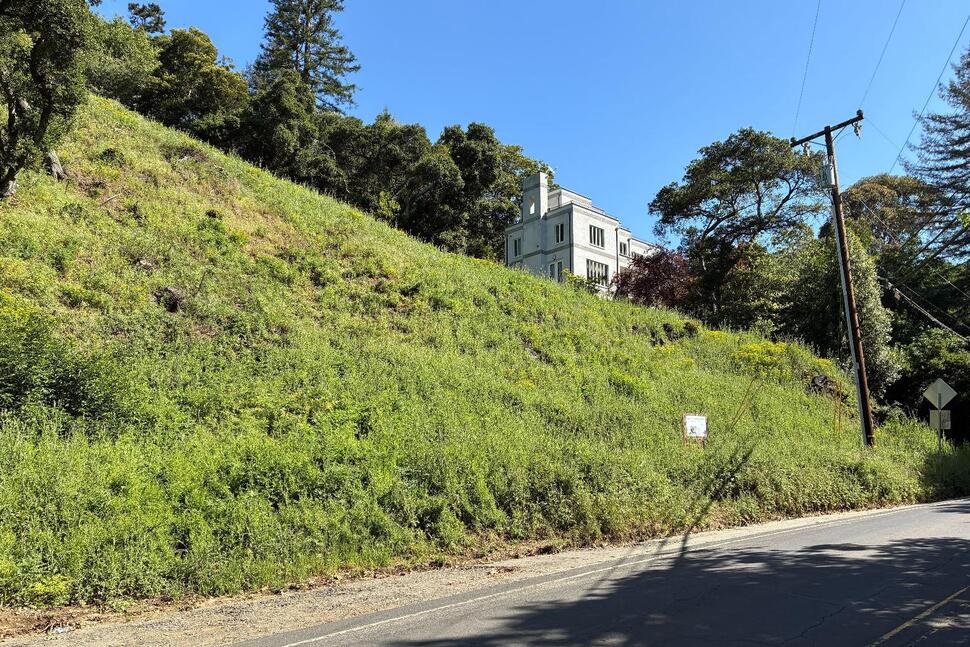
After two previous attempts to decide how to deal with a couple who chopped down 38 trees in North Oakland in violation of the city’s Protected Trees Ordinance, the Oakland City Council decided Tuesday to fine them $915,135.
The fine is perhaps the largest ever in Oakland for destroying trees.
Councilmembers Janani Ramachandran, Noel Gallo, Kevin Jenkins, Zac Unger and Charlene Wang voted for the fine. Rowena Brown, Carroll Fife and Ken Houston voted no.
Emeryville residents Matthew Bernard and Lynn Warner purchased the hillside lot behind the Claremont Hotel and Club in 2019. Two years later, city staff said the couple started felling trees without permits. The trees included native live oaks, broad-leaf maples, buckeyes and other species.
Bernard repeatedly ignored warnings that he needed permits to cut down the trees, city staff said. Some of the trees were on neighboring properties.
The couple applied for building permits to construct a single-family residence, but Oakland issued them a notice of violation of the city’s protected tree ordinance last year. When staff calculated the value of each tree — from a small plum worth $750 to a mature coast live oak valued at $95,000 — the total was nearly $1 million.
City staff say trees provide valuable ecosystem services like preventing fires, holding hillside together against erosion and debris flows, supporting biodiversity, cleaning the air and improving people’s mental health.
Bernard and Warner requested a public hearing on the matter before the City Council, an option afforded to people facing fines under the city’s tree protection law.
The council was unable to resolve the matter during its first two attempts in December and April. At its April 14 meeting, a motion to impose the maximum fine did not pass after councilmembers Fife, Brown and Houston voted no, and Gallo’s absence was recorded as a no vote.
In the run-up to today’s meeting, environmental advocates flooded the councilmembers’ inboxes with messages supporting the fine.
Some spoke at the meeting, saying they were concerned that if the city didn’t fine Bernard and Warner, it would send a message to developers and other property owners that they could chop down trees with impunity.
“This is not simply an environmental issue,” said Arash Daneshzadeh, director of programs at the Oakland Parks and Recreation Foundation. “It’s a civic, public safety and equity issue. When violations, particularly in egregious cases like this, go unpenalized, it sends a clear message that compliance is optional.”
Before today’s vote, Bernard made his case to the council, arguing he had tried in good faith to follow the city’s process. He also claimed that some of the 38 trees were already cut down or diseased and dead.
“We dispute there were 38 trees removed,” he said. “Some trees fell prior to our purchase, others fell during storms.”
City staff said they gathered extensive evidence of the violations and included in materials submitted to the council were photographs of the lot before and after the trees were cut, photos of people cutting trees on the property and detailed reports by Oakland’s arborist staff. Police also took reports when they responded to the property while Bernard and others were cutting trees.
Bernard asked the council to resolve the matter by waiving the fine and allowing him and Warner to replant new trees after they built their home.
Councilmembers Brown and Fife wanted to find a solution more favorable to Bernard. Brown called Oakland’s protected tree ordinance “outdated” and said it felt unfair to impose such a large fine on the property owners for chopping down trees the city would likely have permitted removal of anyway.
“I believe a truly equitable approach requires us to distinguish between preventable loss and inevitable removal,” she said. She tried to get her colleagues to vote for a roughly $300,000 reduction in the fine.
Fife railed against what she said were racially inequitable policies, making comparisons with the drug war, mass incarceration and colonization, while noting that Bernard is Black and his property is located in an area where people of color were prohibited from living in the early 20th century. She supported Brown’s proposal.
In the end, a majority of the council embraced the notion that laws matter and the city shouldn’t be making excuses for people who violate them.
Ramachandran said Oakland needs “to be crystal clear to anyone who wants to come into our city and trash our city, and violate our laws, and think you can get away with it: …You are going to be fined.”
Similarly, Jenkins said Oakland needs to restore the confidence among residents that it will uphold its laws. Appealing to Gallo and Houston — both of whom frequently complain during council meetings about their frustrations with the perception that Oakland is lawless — Jenkins asked them to support the fine.
“Are we going to enforce the laws? Do they mean anything?” he said.
This story was originally published by The Oaklandside and distributed through a partnership with The Associated Press.
Copyright 2026 The Associated Press. All rights reserved. This material may not be published, broadcast, rewritten or redistributed.
Photos You Should See – April 2026

