


California’s delayed release of its Baby2Baby contract is casting a shadow over the state’s new Golden State Diaper program.
Two months after Gov. Gavin Newsom announced a controversial multimillion-dollar state diaper contract with Baby2Baby, a nonprofit with existing ties to the Newsom administration and the First Partner, Californians still have not been allowed to see the contract or competitive bid records behind the deal to manufacture and deliver millions of California co-branded free diapers to new parents.
The delay comes despite repeated requests by CBS California Investigates and despite California law requiring the state to release these records.
ALSO READ: California’s “Diapergate”: Critics got free diaper math wrong, but state won’t release key Baby2Baby records
The Newsom administration waited 24 days to decide whether it would even allow the public to see the records, but continues to delay releasing the Baby2Baby contract and competitive bid records that the governor announced more than two months ago.
At the same time, California lawmakers are advancing legislation that would give state agencies additional time to respond to California Public Records Act requests, further extending how long the public must wait for records like these.
Delayed accountability
CBS California Investigates requested a copy of the Baby2Baby contract on May 12, four days after Governor Newsom announced the partnership during a high-profile press conference.
Given the controversy and misinformation surrounding the announcement, we asked the Newsom administration to forgo the formal California Public Records Act (CPRA) process and provide an expedited copy of the contract and competitive bid records.
Both are expressly identified as public records under California law, which also requires agencies to “promptly notify” requesters whether records are disclosable, allowing a maximum of ten days to let them know the estimated date that they will provide the records.
Instead, the Newsom Administration spent 24 days determining whether or not it would even allow Californians to see these public records, then said it would take another 42 days (if the state meets its latest deadline) to provide a copy of the contract and competitive bid records that the governor publicly announced two months ago.
What is AB 1821?
Even as public interest grows, California lawmakers are advancing a bill that would allow agencies to further delay responses to Public Records Act requests, extending the maximum initial 10-day determination window and 14-day extension window from calendar days to business days.
State law does not limit how long an agency can wait to actually provide the records after they provide that initial response.
ALSO READ: California State Secrets: What public officials don’t want you to know
Assemblymember Blanca Pacheco introduced Assembly Bill 1821, which originally sought to overhaul the transparency law to allow agencies to sue if they deemed a request “malicious” and charge up to $66 an hour to provide public records.
The proposal triggered fierce pushback from a broad coalition including the First Amendment Coalition, ACLU California Action, Common Cause California, the League of Women Voters, and the Howard Jarvis Taxpayers Association.
The Senate Judiciary Committee, led by Senate Judiciary Chair Tom Umberg, stripped the most controversial elements from the legislation before moving it forward.
“People shouldn’t have to tell us why they want that information. People shouldn’t have to pay to get information from public officials,” Umberg told CBS California.
Still, the amended version lengthens the legal window for officials to respond to records requests.
Pacheco maintained the necessity of the changes for burdened departments.
“Agencies across the state are experiencing a sharp increase in requests that are exceptionally broad,” she argued during testimony.
Ginny LaRoe of the First Amendment Coalition contends that essential documents, such as multimillion-dollar state contracts, should be accessible without any formal request at all.
“You should have that document in your hands. You should’ve had it in your hand the day they were talking about it,” LaRoe said.
Rather than forcing Californians to wait weeks for paper-pushing, LaRoe suggests the state should proactively upload finalized agreements online with minor necessary redactions for personal information, ensuring immediate transparency and easing the administrative burden.
Umberg signaled support for a shift toward automated disclosure.
“I think there’s a world where we make them do that,” he said. “It’s up to us to motivate them to do so.”
More than two months after Newsom’s big announcement, CBS California Investigates continues to wait for the state to release the Baby2Baby contract and the underlying bid documents.
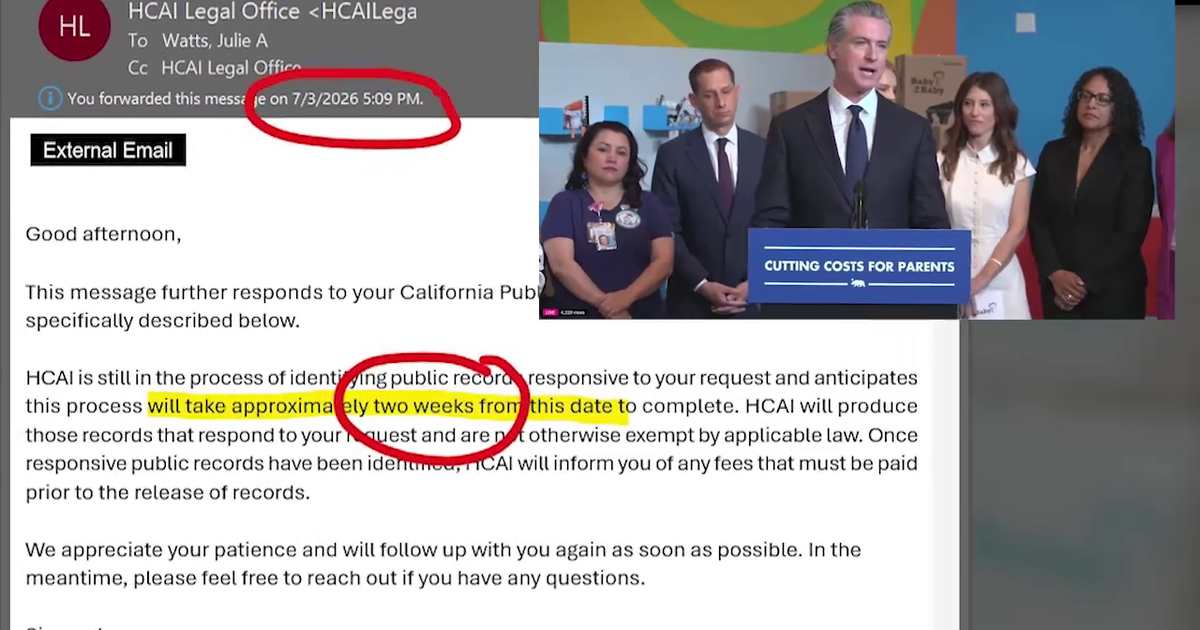
After waiting 24 days to confirm the records were, in fact, disclosable, the state said it would need an additional 28 days to provide them. At 5:09 pm on the 28th day – Friday, July 3, a state holiday – CBS California received a presumably automated email informing us the state would need another two weeks to provide the contract the governor announced two months ago.
Until these public records are actually public, questions will continue to mount about how this deal was reached and how competing proposals were scored.
Day 1 | May 12
CBS California Investigates requested a copy of the Baby2Baby contract four days after Governor Newsom announced the partnership during a high-profile Capitol press conference.
The Governor’s Office referred the request to the California Health and Human Services Agency. Because of the intense public interest following the announcement, CBS California Investigates asked Deputy Secretary of External Affairs Sami Gallegos and Assistant Secretary of External Affairs Rodger Butler to forgo the formal California Public Records Act (CPRA) process and simply provide an expedited copy of the highly publicized contract.
Instead, Butler directed us to the Department of Health Care Access and Information (HCAI), the agency handling the procurement. HCAI acknowledged receipt of the request.
Day 7 | May 19
CBS California Investigates followed up with the HCAI, again requesting an expedited copy of the contract because we were on a deadline.
The agency responded that the request was being processed through the California Public Records Act, rather than providing the contract directly.
Day 14 | May 22
Exactly 10 calendar days after the request, the HCAI invoked the CPRA’s “unusual circumstances” provision, extending the deadline another 14 days to determine whether the requested records were disclosable.
The agency wrote that it needed additional time because “two or more components of the agency have substantial subject matter interest” in the request.
Day 28 | June 5
Fourteen days later, the HCAI agreed that the records are public.
The agency determined that the Baby2Baby contract, procurement packet, scope of work, bid scoring sheets and vendor award documents are disclosable public records.
However, instead of releasing them, the HCAI said it would need another three to four weeks to identify and produce the records.
AB 1821 | While we waited
While CBS California Investigates waited for the records, lawmakers advanced AB 1821, legislation that originally proposed sweeping changes to California’s Public Records Act.
After bipartisan criticism and opposition from transparency advocates, many of the bill’s most controversial provisions were removed. However, the amended bill still gives agencies additional time to respond to public records requests.
Day 52 | July 3
Instead of receiving the records, CBS California Investigates received another email at 5:09 p.m. on the final day of the promised three-to-four-week production window.
Rather than releasing the records, the state delayed production another two weeks, pushing the expected release well past the two-month mark.
Day 56 and counting
Fifty-six days after CBS California Investigates requested the Baby2Baby contract, and 60 days after Governor Newsom publicly announced the partnership, Californians still have not been allowed to review:
- The executed contract
- The procurement packet
- The scope of work
- The competitive bid scoring sheets
- The vendor award documents
Translation: The Newsom administration spent 24 days determining whether records already identified as public under California law could be released. It then delayed producing those records for another six weeks. If the state meets its latest deadline, Californians will have waited 66 days from our request and 70 days from the governor’s announcement to see the contract.