


By Lais Morais and Adriano Machado
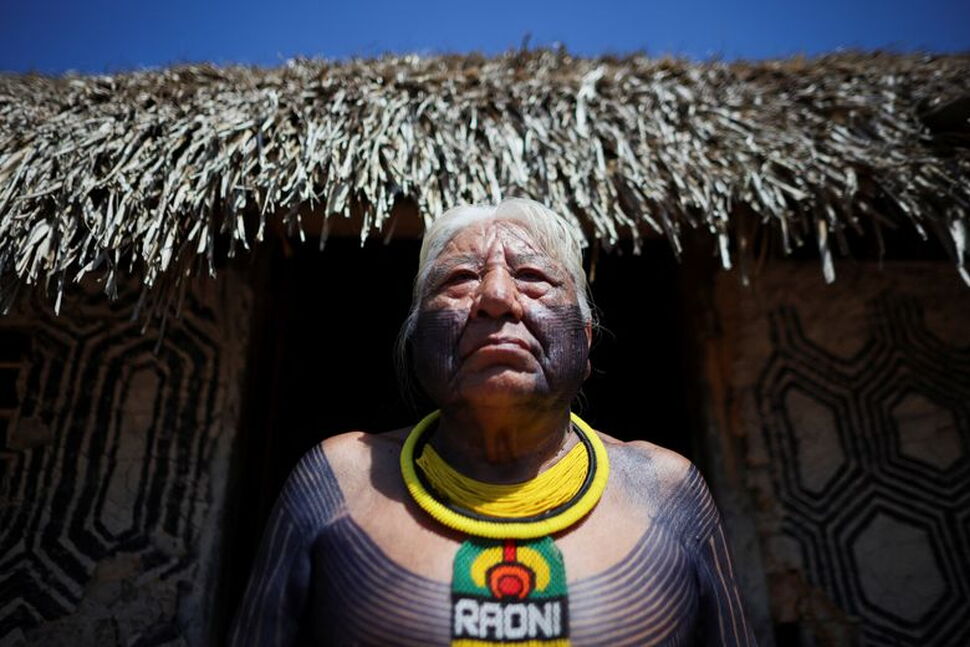
PYKANY VILLAGE, Brazil, May 28 (Reuters) – Chief Megaron Txucarramae, a 75-year-old leader of Brazil’s Indigenous Kayapo people, has spent decades defending Indigenous rights, from securing the demarcation of his people’s land in the Amazon to opposing hydropower projects and illegal mining.
Now he is preparing for a new challenge: preserving the legacy of his uncle and mentor, Chief Raoni Metuktire, a 94-year-old Indigenous leader known worldwide for his campaign to protect the world’s largest rainforest.
Chief Raoni has been hospitalized several times in recent years and last week returned home after seven days in intensive care for pneumonia. For decades, Chief Raoni has served as a global figure in the Indigenous movement, appearing alongside presidents, popes and even the musician Sting during campaigns to save the rainforest in the 1980s. He and Megaron lead Kayapo communities along the Xingu River, where the Amazon meets Brazil’s vast grasslands.
The Kayapo first came into contact with non-Indigenous Brazilians in the 1950s, when Chief Megaron was still a young child.
Not long after, he began working alongside Chief Raoni and now says he is ready to carry forward his battle for their rights.
“I have followed it closely,” he said. “And I will continue it, continue his struggle.” He spoke to Reuters in the village of Pykany during a trip organized by Greenpeace to monitor illegal mining on Kayapo land.
‘THEY CAN’T KILL US WITH WEAPONS, SO THEY PASS LAWS’
Megaron’s efforts come as the Amazon faces growing pressure. Nearly a fifth of the rainforest has been lost to crops, pasture and mining, while droughts and wildfires linked to climate change have intensified.
“The best thing is to preserve the Amazon, to preserve what is ours, what belongs to everyone,” he said. “It helps people breathe better, it holds back the winds, it keeps the heat from becoming too intense.”
He said he wants to keep fighting for the Kayapo and other Indigenous groups, as well as raising global awareness about the forest’s importance and pushing for more Indigenous representation in Brazilian politics.
Brazil’s Congress has approved several laws in recent years to curb Indigenous rights, including one that limits protections for Indigenous lands of certain communities.
Chief Megaron is especially worried, he said, that someone opposed to Indigenous rights could win general elections due in October.
Chief Raoni had supported President Luiz Inacio Lula da Silva at his 2023 inauguration after the previous administration of Jair Bolsonaro, which had pledged to halt new Indigenous land demarcations. Senator Flavio Bolsonaro, the former president’s son, is running against Lula in this year’s election.
“They can’t kill us with weapons, but they want to pass laws to exploit [our land]to destroy our culture, to put an end to our customs,” he said. “The more Indigenous people there are in Congress, the better for us.”
In 2022, seven of the 594 lawmakers elected to Congress were Indigenous.
He also wants to help his uncle stop young people from leaving their forest and their customs behind.
“You can learn, you can reach university, but you must not stop being Indigenous,” he said. “That is his struggle.”
(Reporting by Adriano Machado and Lais Morais; Writing by Manuela Andreoni; Editing by Christian Plumb and Sanjeev Miglani)
Copyright 2026 Thomson Reuters.