


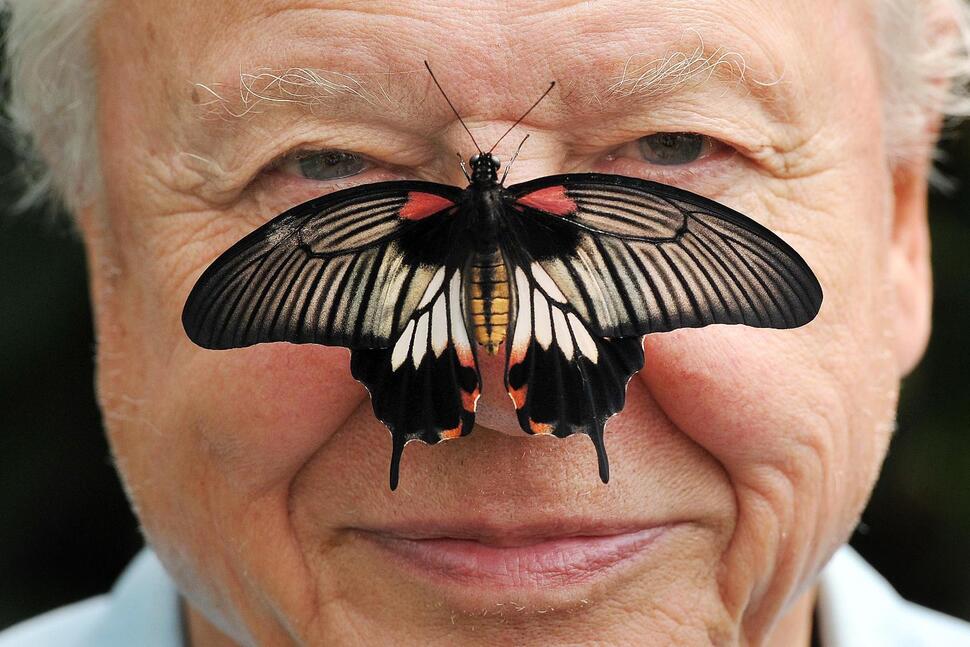
LONDON (AP) — The BBC is hosting a party for David Attenborough at the Royal Albert Hall. Cinemas are playing his nature films. Friends have spent weeks lavishing praise on the man and his work.
But the world’s most famous wildlife presenter is likely to be uncomfortable with all the attention as he celebrates his 100th birthday on Friday, said Alastair Fothergill, the producer of some of Attenborough’s most well-known documentaries.
“He’s always been very clear to all of us that work with him: ‘Remember, the animals are the stars, I’m not,’’’ Fothergill told The Associated Press. “So, yes, surprisingly for one of the most famous men on the planet, he doesn’t like being famous at all.”
But Attenborough has had to accept the accolades this week as scientists, politicians and conservationists celebrated the man who has brought frolicking gorillas, breaching whales and tiny poisonous frogs into living rooms around the world for more than 70 years.
Viewers who might never leave their hometowns were transported to the Himalayas, the Amazon and the unexplored forests of Papua New Guinea. But behind the stunning images was an attention to scientific accuracy that helped teach people about complex subjects like evolution, animal behavior and biodiversity.
And as the evidence mounted, he began to sound the alarm about climate change, ocean plastic and other human-caused threats to the planet.
That helped people understand not only how life evolved but, more importantly, why we have to protect it, said Ben Garrod, an evolutionary biologist at the University of East Anglia and himself a broadcaster who has worked alongside Attenborough.
Attenborough, Garrod believes, initially saw himself as a neutral observer but was compelled to speak out when he saw that politicians, business leaders and the public weren’t taking the emergency seriously.
“He is showing you the majesty, the ferocity, the fragility of the natural world. He shouldn’t have ever had to have turned to policymaking and advocacy,” Garrod said.
“I think it’s very easy for a lot of people to say, ‘He should have done it sooner. Why didn’t he act 20 years, 30 years, 40 years ago?’” Garrod then asked: “Why didn’t we?”
Fond of fossils from the start
Born in London on May 8, 1926, the same year as the late Queen Elizabeth II, Attenborough was raised on the grounds of what is now the University of Leicester, where his father was a senior leader.
His fascination with nature developed when he was a young boy, riding his bicycle into the surrounding countryside where he collected treasures such as abandoned birds’ nests, the shed skin of a snake and, most importantly, fossils.
“I’d find a fossil and show it to my father and he’d say ‘Good, good, tell me all about it.’ So I responded and became my own expert,” Attenborough told Smithsonian Magazine in 1981.
He went on to study geology and zoology at the University of Cambridge.
In 1952, Attenborough joined the BBC, working behind the scenes on “everything from ballet to short stories.” After he’d been there about two months, the capture of a “living fossil” off the coast of East Africa caused an international stir, and he was asked to produce a short piece about the coelacanth.
That story was told in the studio by Professor Julian Huxley, an evolutionary biologist, who used pickled wildlife specimens and a photograph of a coelacanth to explain the fish’s significance.
But Attenborough thought television could do more.
“I’d always wanted to do films on animals around the world,” he recalled in a 1985 interview with The Associated Press. “But the attitude was, ‘We’ve got TV cameras in the studio. What’s this about spending money abroad?’”
In 1954, he finally persuaded the BBC to let him accompany a London Zoo team that traveled to West Africa to collect specimens. That began a decade as host and producer of “Zoo Quest,” kick-starting his career in the field.
The privilege of his life
One of the most famous moments of that long career came during the 1979 series “Life on Earth,” when Attenborough encountered a family of mountain gorillas in a forest on the border of Rwanda and what was then Zaire (now Congo).
During that scene, voted one of Britain’s top TV moments of all time, a young gorilla lies across his body while several babies try to remove his shoes. Attenborough grins, laughs and is speechless with delight.
“I honestly don’t know how long it was,’’ Attenborough later told the BBC. “I suspect it was about 10 minutes, or even a quarter of an hour. I was simply transported.”
“Extraordinary, really,’’ he reflected. “It was one of the most privileged moments of my life.”
A character everyone could understand
Attenborough has combined his knowledge of television, an understanding of his audience and his commitment to science to create a character who could deliver complicated issues surrounding wildlife, conservation and natural history to a mass audience, said Jean-Baptiste Gouyon, a professor of science communication at University College London.
“Basically he gave wildlife television a figure, a front of the house person … which has come to embody television discourse about nature,” Gouyon said.
And on this, his centenary, his fans made a point of finding him. In a recorded audio message he said he thought he would mark the day quietly. As if.
“I’ve been completely overwhelmed by birthday greetings from preschool groups to care home residents and countless individuals and families of all ages,” he said. “I simply can’t reply to each of you all separately, but I would like to thank you all most sincerely for your kind messages.”
And he isn’t planning to stop now, Fothergill said.
“He said to me recently he feels unbelievably privileged that a man in his late 90s is still being asked to work. And, you know, he will go on forever. He will die in his safari shorts.”
Copyright 2026 The Associated Press. All rights reserved. This material may not be published, broadcast, rewritten or redistributed.
Photos You Should See – April 2026

