


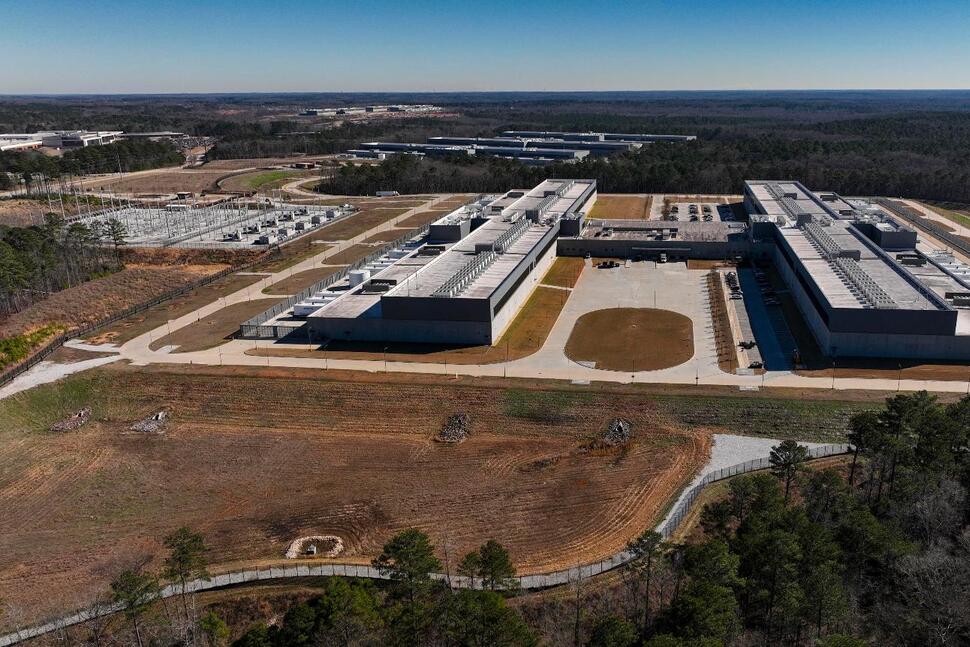
ATLANTA (AP) — Georgia state lawmakers spent months debating ideas to curb the impact of data centers. But as their annual legislative session ended Thursday, they did nothing.
Now with election season upon them, lawmakers are returning home to find local communities up in arms against the warehouses full of computers that power artificial intelligence.
“I think they failed us, that’s what I think” said Judy Mullis, an activist fighting plans for a data center near Newnan, southwest of Atlanta. “I think they had the opportunity to do the right thing, and they didn’t. I’m so tired of them prioritizing big money.”
Georgia has become one of the country’s top sites for new data centers, thanks to utilities eager to sell electricity and tax breaks estimated to cost state and local governments nearly $3 billion in the year beginning July 1.
That gold rush has inflamed opposition, even in areas where business-friendly Republicans dominate local politics. Democrats hope to harness that anger to gain ground in the battleground state, a potential model as the party plots a path back to power around the country in the midterm elections.
Last year, opposition to data centers and discontent over rising electricity rates helped Democrats win upset victories over incumbent Republicans in statewide elections for the Georgia Public Service Commission, which regulates utilities. This year, they want to win the governor’s office for the first time in 24 years and advance toward a majority in the 180-member state House.
Cyndie Hutchings, another activist, said local opposition to data centers has the potential to swing elections. She’s running as a Democrat to oust Vance Smith, a longtime Republican state representative, in a district southwest of Atlanta.
“They tell me that they are lifelong Republican voters, but this has changed the way they’re looking at everything,” Hutchings said.
Mullis said she’s one of them. She said she used to be a Republican but wants to elect officials who will act on data centers, and she voted for Democrats “for the first time ever” in the utility commission race.
Georgia lawmakers never seriously considered calls for a moratorium on new data centers. But they did debate stricter rules to protect other electricity ratepayers from shouldering costs from the developments.
The Public Service Commission passed rules last year that the five commissioners said would protect customers of Georgia Power Co., the state’s only private electric utility, from paying for generation or transmission investments needed to serve data centers. But commissioners also approved a huge expansion in electric generating capacity by Georgia Power, which is a subsidiary of Atlanta-based Southern Co.
The utility said fears of higher rates are misplaced, pointing to an electricity rate freeze and projections that revenue from data centers could help reduce future rates.
“Data center growth in our state means large energy users pay more so you pay less,” spokesperson Matthew Kent said in a statement Friday. “Georgia Power is able to leverage that growth to lower costs for everyone.”
But critics continue to warn that residential and other customers could end up on the hook, saying more action is needed
“The No. 1 concern that we heard pretty much consistently across the board was the residential ratepayers, they were concerned about costs that would be inflicted on them from the infrastructure investments and data centers and their rates going up based on the basic supply-and-demand principles,” said state Rep. Brad Thomas, a Republican who chaired a special committee looking at resource usage.
One legislative idea was to write existing commission rules into law. But Republican state Sen. Chuck Hufstetler said current language is “extremely weak and doesn’t protect the consumers,” and he teamed up with Democrats earlier in the session to try to force stronger language earlier in the session.
The move was blocked when Republican Senate leaders — including Lt. Gov. Burt Jones, who is running for governor — abruptly adjourned that day, prompting howls from Democrats.
Efforts to restrict tax breaks for data centers also fell short despite widespread interest from lawmakers.
Republican Gov. Brian Kemp vetoed a bill to end data center tax breaks in 2024, but the issue took on fresh urgency as their value has ballooned into the billions. The House, though, never took up Senate proposals to curtail tax breaks.
Jones has been accused of favoring data centers because his family owns an interest in a real estate development that’s courting the big computer centers. A spokesperson didn’t immediately respond to an email and text message seeking comment Friday.
Others see the strong political influence of Georgia Power or the big money backing the data centers, which can boost property tax revenue at a time when local governments are under pressure to cut taxes for other property owners.
“They had a choice, and they chose big business,” said Mark Woodall, a lobbyist for the Sierra Club.
Democrats see an opportunity to offer themselves as a different choice.
“We need to get people into the state legislature to undo this legislation that’s enabling all of this,” Hutchings said.
Copyright 2026 The Associated Press. All rights reserved. This material may not be published, broadcast, rewritten or redistributed.
Photos You Should See – April 2026

