


BRUSSELS (AP) — European Union leaders are holding a summit in Brussels on Thursday for talks on the Iran war, energy prices, migration and an enormous loan for war-ravaged Ukraine being held up by Hungary.
The European Commission, the EU’s executive branch, has floated the idea of a “toolbox” of measures to lower energy prices for leaders to discuss because no single policy will work across the myriad markets in the 27-nation bloc to blunt economic shocks from the war, according to a senior European diplomat who wasn’t authorized to be publicly named so spoke on condition of anonymity.
The summit will also focus on a long-brewing standoff between Hungarian Prime Minister Viktor Orbán and most other EU nations.
The last EU summit was held in December at a Belgian castle, where the leaders including Orbán agreed to a 90 billion-euro ($104 billion) loan for Ukraine for help overcoming a budget shortfall in the country as it grapples with a grinding war with Russia.
But a month later, Orbán backtracked after the Druzhba oil pipeline was disabled in January after what Ukrainian officials said was a Russian drone attack. The pro-Russia leader, who has held office in Hungary since 2010, is running an aggressive media campaign villainizing both Brussels and Kyiv as he seeks reelection next month.
“If there is no oil, there is no money,” Orbán said in a social media post on Tuesday.
To get Ukraine the much-needed loan, EU leaders and diplomats will lobby Orbán and Slovakia’s prime minister, Robert Fico, whose government has also taken pro-Russia stances.
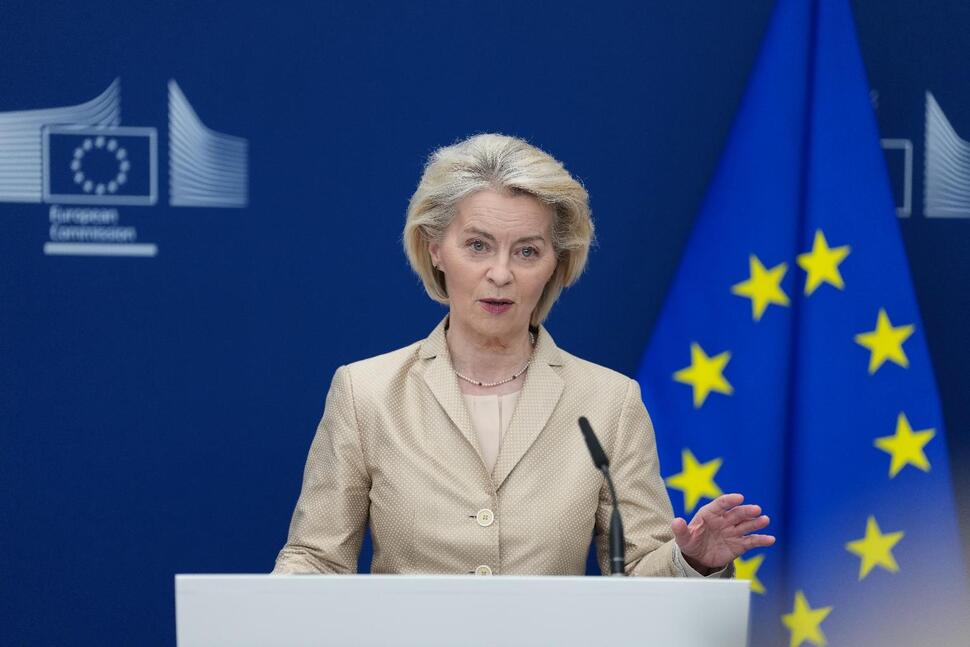
On Tuesday, European Commission President Ursula von der Leyen offered for the EU to pay to repair the Druzhba pipeline and the development of alternative fuel lines for Hungary and Slovakia.
Ukrainian President Volodymyr Zelenskyy said that any obstruction to the loan is “absolutely unfair” and that there is “no alternative” for the embattled nation than those funds as it faces a severe budget crisis because of the war, which began on Feb. 24, 2022.
“There may be alternatives in terms of financing mechanisms, but there is simply no alternative to strengthening our army,” Zelenksyy said on Wednesday.
German Chancellor Friedrich Merz told lawmakers in Berlin on Wednesday that the EU must swiftly reach an agreement on the 20th package of sanctions against Russia and the loan.
He said that he would “advocate for that emphatically” in Brussels and that “we must not take into consideration a single country in the European Union that is currently setting up this blockade in Europe now for domestic political reasons and because of an election campaign that is being conducted there.”
Merz said, in urging for more sanctions, that “the needs of the moment call for us to increase the pressure on Moscow together – the U.S. and the European partners together.”
Karel Janicek in Prague, Geir Moulson in Berlin, and Illia Novikov in Kyiv, Ukraine, contributed to this report.
Copyright 2026 The Associated Press. All rights reserved. This material may not be published, broadcast, rewritten or redistributed.
Photos You Should See – March 2026

