


The FBI has closed a politically charged voter fraud inquiry sought by Nevada’s top federal prosecutor, after finding only 38 non-citizens may have voted in the 2020 presidential election, sources with direct knowledge of the probe told CBS News.
The FBI ended the inquiry in late January, after Signal Chattahthe first assistant U.S. attorney in Nevada, had ordered the bureau in July to open a 2020 election fraud probe that she claimed could help flip a key congressional seat in Republicans’ favor. She also said it could ensnare President Trump’s Democratic opponents — state attorneys general who had gone after fake electors — sources previously told CBS News.
At that time, she provided the FBI with a thumb drive of data compiled by the Republican Party that she claimed would show that non-citizens had voted in the 2020 election and that people on Indian reservations were accepting cash for ballots, the sources previously said.
But an FBI review of Nevada voter roll data, compared against Department of Homeland Security citizenship data, only identified 38 possible non-citizen voters. In addition, FBI agents told Chattah’s office that the statute of limitations to pursue any possible case had also expired, which made bringing a case untenable, according to sources familiar with the case.
Chattah did not immediately respond to a request for comment.
The results of the inquiry were reported earlier by the Washington Post.
The lack of any basis to pursue voter fraud investigations into the 2020 election in Nevada raises further questions about why similar inquiries are being pursued in other swing states, including Georgia and Arizona, and why there is probable cause to suggest fraud occurred in those other states.
Earlier this year the FBI executed a search warrant in Fulton County, Georgiato gain access to ballots and other records that was premised in part on claims made by White House attorney Kurt Olsen, who has frequently made unproven claims about widespread election fraud in the 2020 election.
Then in Arizona, state Senate President Warren Petersen revealed that he had recently received a grand jury subpoena seeking records in connection with the Arizona state Senate’s 2020 audit of Maricopa County, and he said that he had turned them over to the FBI.
CBS News could not determine why the Fulton County, Georgia, or Arizona cases have proceeded, and what distinguishes them from the review in Nevada by the FBI.
“The Justice Department is committed to upholding the integrity of our electoral system and will continue to prioritize efforts to ensure all elections remain free, fair, and transparent,” a Justice Department spokesperson said in a statement to CBS News.
The FBI in Nevada declined to comment.
But some election experts suggest the legal system in some states is working more effectively to defend their elections amid investigations into already de-bunked claims.
“The 2020 election has been investigated robustly in Nevada and across the country,” said Dax Goldstein, the Election Protection Program Director for the States United Democracy Center.
“I think that in Nevada we saw the system work, and in Georgia, I think the system didn’t work properly.”
Mr. Trump, meanwhile, is pushing Congress to pass the Safeguard American Voter Eligibility Act, which would require Americans to show proof of citizenship in person to register to vote in federal elections and implement photo ID requirements for voting.
Democrats have warned the bill could disenfranchise millions of eligible voters.
Conflicts of interest for Chattah
The fact that the FBI in Nevada even opened a preliminary assessment into debunked claims that the 2020 presidential election was stolen from Mr. Trump — and kept Chattah looped into the findings — will likely renew fresh concerns about whether her involvement violates federal ethics rules and rules of professional conduct for attorneys.
Before she was appointed interim U.S. attorney, Chattah worked as a defense lawyer representing the National Republican Committee and the Nevada Republican Party, and she also defended one of the men accused of acting as a fake elector to try to sway the results of the 2020 election in Mr. Trump’s favor. The fake elector was criminally charged for his role by Democratic Attorney General Aaron Ford’s office.
Chattah also served as a chairwoman for the Republican National Committee in Nevada, and she previously ran for state attorney general against Ford and lost.
Chattah is currently serving as the office’s first assistant U.S. attorney, after a federal court declared her appointment as interim U.S. attorney unlawful.
“The Department follows the guidance of career ethics officials on all recusal matters,” a Justice Department spokesperson told CBS News.
George Kelesis, a defense attorney in Nevada who also represented one of the fake electors in Nevada, has since been appointed by Mr. Trump to serve as the state’s U.S. attorney.
“If we want people to trust the government and the government’s judgment, then the government has to make sure that it avoids conflicts of interest,” said Nancy Rapoport, a law professor at the University of Nevada who specializes in legal ethics.
“You just don’t want to raise a question about fairness. The government has so many resources compared to private citizens,” she said. “You don’t want people scratching their heads and asking ‘was this above board?'”
Chattah previously asked the FBI to review data compiled by the Nevada Republican Party that she alleged contained evidence showing that people living in the U.S. illegally cast ballots in the 2020 election and that members of Indian tribes allegedly received cash for ballots.
She told senior Justice Department officials that she hoped the probe would allow Republicans to win back a congressional seat held by a Democrat, and exonerate Nevada’s fake electors, one of whom she represented in private practice, sources with direct knowledge of the matter previously told CBS News.
She also suggested using the probe to investigate other state attorneys general — including Ford — to establish they and the Biden White House had unlawfully conspired against the United States.
Chattah’s decision to launch the probe came just days after the deputy attorney general’s office issued a memo ordering her to recuse herself in six other civil and criminal cases — all of which involved people who had political ties to Chattah before she joined the Justice Department, according to both documents and sources familiar with the matter.
Despite that warning, Chattah pressed ahead and requested the probe into the 2020 election and she also continued trying to reach out to other Justice Department staff who had worked on at least one of the matters from which she was explicitly recused, multiple sources tell CBS News.
Screen grab from X, March 12, 2026 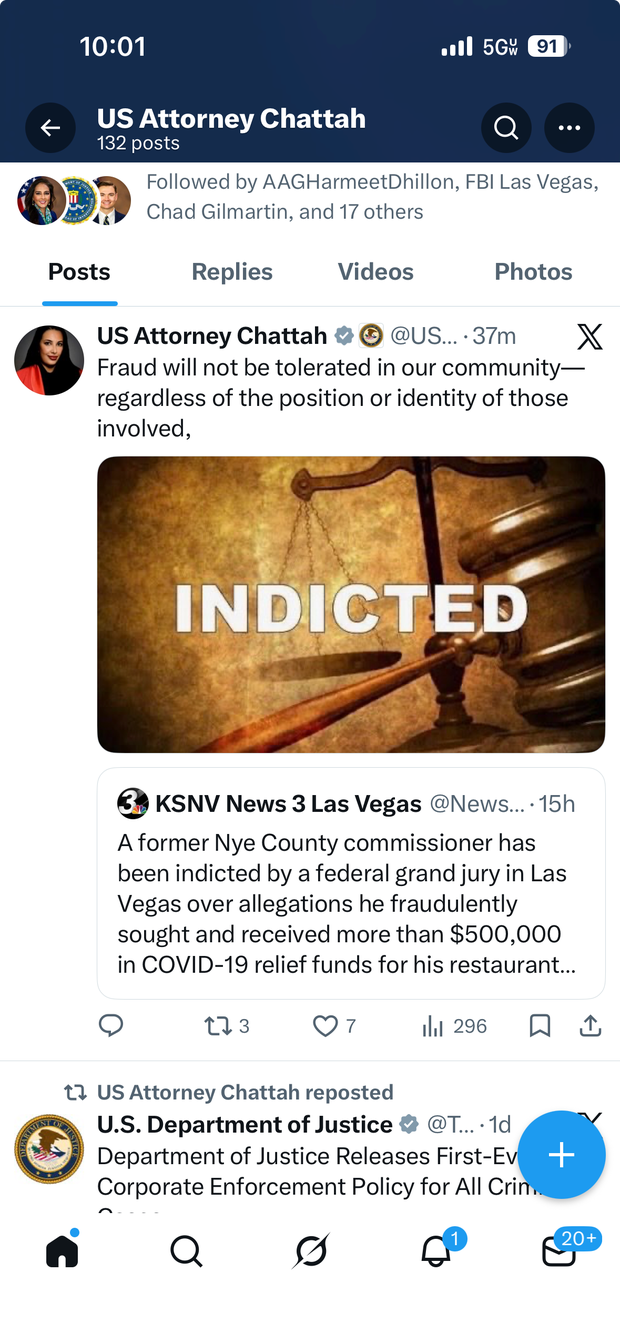

On Thursday, Chattah used her X account — which still refers to her as a U.S. attorney — to comment on one of the six cases from which she was ordered to recuse.
The case involves the recent indictment of Nye County Republican Commissioner Leonardo Blundo, who is accused of committing fraud against a government program that gave small businesses loans to keep them afloat during the COVID-19 pandemic.
Blundo previously gushed over Chattah’s initial appointment as interim U.S. attorney in a press release, referring to her as a “fierce patriot” with a “brilliant legal mind.”
On Thursday, Chattah reposted a news article on Nye’s indictment, saying, “Fraud will not be tolerated in our community — regardless of the position or identity of those involved.”
The press release issued by her office announcing the indictment contained no comment from Chattah.
Her social media post was later removed, not long after CBS News sought comment from the Justice Department.
“A lawyer who is entering the government shall not participate in the same matters that she worked on in the private sector, so if she worked on anything to do with the election in the private sector, then she shouldn’t work on it in the government,” said Richard Painter, who was the White House ethics lawyer during President George W. Bush’s tenure.
He added that while it’s possible that Attorney General Pam Bondi may have granted a waiver to allow her to participate, such an act would be highly unusual.