


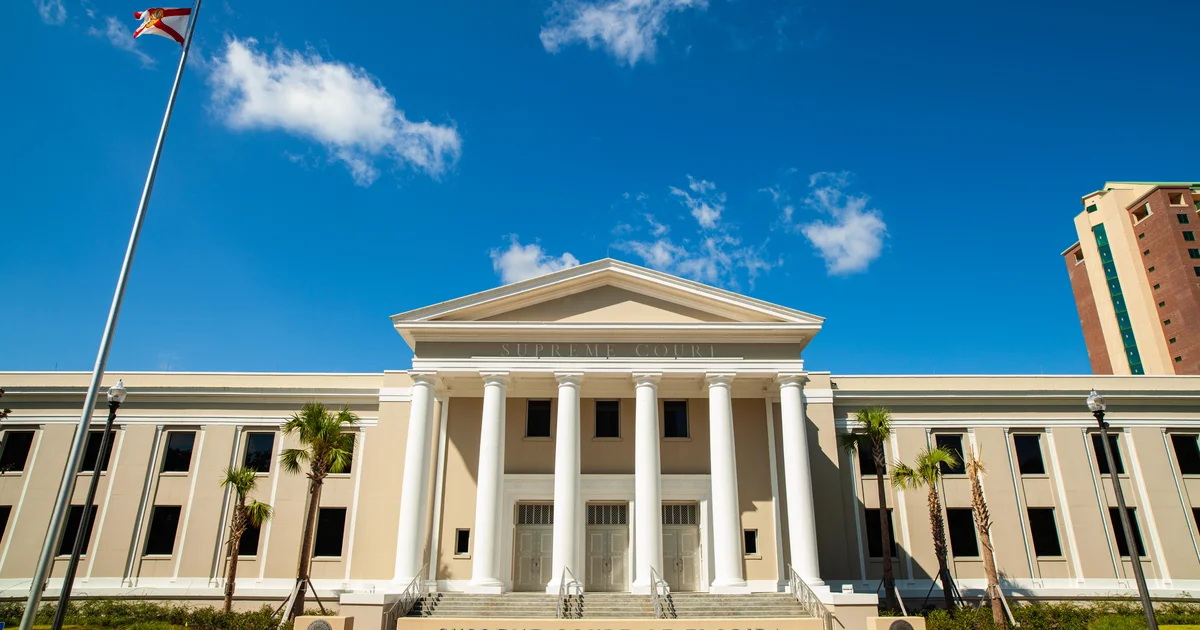
The new congressional district map will remain in effect for the midterm elections, after the Florida Supreme Court on Tuesday rejected a push to block the new configuration.
In a 6-1 ruling, the court determined the First District Court of Appeal should consider the merits of the case before it weighs in on the matter. Equal Ground Education Fund and two other voting rights groups brought the case alleging the new districts were drawn to favor the Republican Party, a violation of the state’s anti-gerrymandering law, but the First DCA didn’t grant a temporary injunction while the underlying case is pending.
“At this time, we do not have jurisdiction over that matter, and we do not simply assume that the First District’s decision will provide an appropriate basis for this Court’s review,” the court ruling states.
Justice Jorge Labarga wrote a dissent arguing the court did have jurisdiction, and chiding the 1st DCA for not expediting a review by the Florida Supreme Court. The qualifying deadline for U.S. House candidates ends Friday at noon, leaving no time for the courts to rule on the merits of the case before the elections are locked in place.
“Had the district court invoked pass-through jurisdiction here, doing so would have established an independent basis for this Court’s jurisdiction in this matter,” Labarga wrote. “Unfortunately, for now, and with a filing deadline and an election fast approaching, we will not have the opportunity to review the issues of statewide importance raised in the petitioners’ efforts to enjoin Florida’s 2026 congressional map.”
Labarga is the lone liberal left on the court, after Gov. Ron DeSantis was able to remake the bench, installing a 6-1 conservative majority after a slew of required retirements due to constitutional age limits.
DeSantis pushed for a redrawn congressional map of Florida’s 28 districts after President Donald Trump urged Republican-controlled states to pass new maps favoring the GOP ahead of the midterm elections.
An aide for DeSantis drew the new map and handed it to the Republican-led Legislature, which passed it without any changes during an April special session.
DeSantis has pointed to a U.S. Supreme Court ruling, which was released during the special session, undercutting part of the Voting Rights Act that allowed districts to be drawn to favor racial or ethnic minorities. That ruling meant District 20, specifically, had to be redrawn, he contends.
But Democrats and voting rights groups that brought the case alleged the new map is a blatant gerrymander to favor the GOP, violating a constitutional amendment passed by voters in 2010, known as the Fair District Amendment, that prohibits drawing districts to favor or disfavor political parties.
They noted DeSantis’ aide, Jason Poreda, told lawmakers he drew the new map with partisan data. And DeSantis’ office also sent the map to Fox News with partisan coloring, showing Republicans could flip up to four seats based on 2024 presidential voting patterns.
Although the underlying case will still progress through the court process, the maps will remain in place.
“The people of Florida can rest assured that elections will take place this year—under a redistricting law and an election code enacted by their Legislature, all as administered by various, capable state and local election officials—following which they will have their duly apportioned allotment of elected representatives in Congress,” Justice Adam Tanenbaum wrote in a concurrence that took issue with Labarga’s dissent.
“In the meantime, the plaintiffs will have their days in court, in due course, to be heard on the merits of their challenge to the new redistricting law—all in comportment with the reformed judicial system established by the people through their constitution,” he added.