



At an Oct. 27, 2024 campaign rally during his run for president, Donald Trump told his audience, “On Day One, I will launch the largest deportation program in American history.” And he did. President Trump began his second term by dispatching troops and armed ICE agents to carry out aggressive arrests and mass detentionsmainly in blue states.
The president appointed as his Secretary of Homeland Security Kristi Noem, whose appetite for deportation, and publicity, appeared to match (and at times eclipse) his own. That, and pinning her promotional campaign’s $220 million price tag on the boss, may have ruffled a few important feathers at the White House. Secretary Noem was fired – signaling a change in tone for the administration, but no change in mission. You have only to check out what’s happening in our immigration courts.
Former immigration judge Ryan Wood told us there is no doubt among immigration judges these days as to what the administration wants: “Zero doubt, they want numbers, they want deportations. They want to keep as many people detained as possible, and stress the system,” he said.
When Wood retired a little more than a year ago, he was an assistant chief immigration judge in the Midwest. He probably could’ve stayed on. He was appointed during President Trump’s first term, and denied many more asylum applications than he granted.
But even so, he didn’t like what he was seeing: “I have seen judges that have not made it very long in this new regime, where they’ve been walked off the bench for whatever reasons … They’re in the middle of dictating an oral decision and they get an email, or they get a tap on the shoulder, literally on the bench, saying, ‘Please come with me.'”
Asked if that had happened in years past, Wood replied, “No, never. We’ve never seen anything like this.”
CBS News 

“We’re not ‘deportation judges'”
The immigration court is not part of the judiciary; it is overseen by the Department of Justice, which is in the executive branch. And over the past 14 months, the Trump administration has fired, retired, or forced out more than 200 immigration judges.
Anam Petit was fired last September. “It was crushing,” she said. She’d given up a well-paid job as a law partner to take on a job as an immigration judge in Annandale, Virginia. “It was a dream job for me in a lot of ways. I made personal and professional sacrifices to take that job, because I believed I could be a good and fair judge.
“In my two years of being a judge, I never received any negative feedback from colleagues [or] superiors,” she said. “All my probationary reviews were positive, and no reason was given [for my dismissal].”
Asked what her gut tells her about why she was fired, Petit said, “I came from a background where I represented immigrants previously. I was a law professor at Georgetown Law, where I taught on gender-based immigration issues. I am a woman, a person of color.”
Jeremiah Johnson was an immigration judge in San Francisco for eight years. “My last words on the bench were to a family of four: ‘You’ve been granted asylum in the United States. Welcome to the United States,'” he said.
Johnson was appointed during the last Trump administration. He was caught off-guard last November when he was terminated: “I logged onto the computer and I saw the email notification with attached letter indicating that I had been fired,” he said. “Within 30 seconds, I was locked out of the computer system, unable to print that letter. And then, I was escorted out of the building.”
He said no reason was ever given for why he was fired.
A recruitment ad from the Department of Homeland Security, posted online last December, offers a pretty broad hint: It features the fictional character Judge Dredd, a futuristic hanging judge, and reads: ”Deliver justice to criminal illegal aliens. Become a deportation judge. Save your country.”
A page on the Justice Department website, headlined “You be the judge,” promises a salary up to a little more than $200,000 a year to be a “deportation judge” – and even a 25% bonus for taking a job in a “sanctuary city.”
Justice Department 

Johnson said he found the ad offensive: “When I first saw the ad, I thought it was a little bit fake. It was not real. It might be spam. We’re not ‘deportation judges’; we’re immigration judges.”
So far, the administration has recruited more than 70 “deportation judges,” most from enforcement backgrounds with little or no immigration experience. Also, to fill the gap created by the administration’s own firings, Secretary of Defense Pete Hegseth authorized sending military lawyers (known as JAGs) to serve as temporary immigration judges for six-month rotations.
Wood says that’s a problem: “I’m a former Army judge advocate. So, I have a lot of affinity and respect for those judge advocates. This is not a temporary detail. Immigration law is extremely complex. It’s only rivaled by the tax code in complexity. It takes a year or two to really get up to speed and to understand the law and how to make good, fair decisions. But we’re pulling these people out of private practice for six-month details, and truncating the training, and there’s clearly been messages out there of, ‘Read the room. If you’re not gonna make “appropriate” decisions, you won’t be here for long.'”
The Department of Justice declined our request for an interview; but in May of last year, the president succinctly summed up his approach aboard Air Force One: “We need judges that are not going to be demanding trials for every single illegal immigrant. We have millions of people that have come in here illegally, and we can’t have a trial for every single person. That would be millions of trials.”
There are more than 60 immigration courts, for an estimated 3.5 million cases. “We had around 600 immigration judges,” said Petit. “And there are about 100, 125 fewer judges now.”
Asked if she sees any legitimacy to the administration’s argument that an overwhelming number of undocumented immigrants requires mass deportation rather than trials, Petit replied, “The issue is that we also have a statute. Congress has set laws, and it has established what removal proceedings are. It has established what a right to asylum is. And an administration can’t procedurally get around that rule of law.”
Unless they ignore the law.
“I think you’re seeing chaos in the courts”
Johnson, who continues to serve as executive vice president of the National Association of Immigration Judges, said, “You’re seeing chaos in the streets; I think you’re seeing chaos in the courts. You shouldn’t have police or ICE agents arresting people who are coming into court, tasers being outside the courtroom.”
And what are the consequences of that happening? “If they’re there to send a chilling effect to the people coming to courtroom, then that person is prevented from having their day in court,” Johnson said. “If they’re arrested before they even get to the courtroom, then they have to defend their case miles away in a detention facility, perhaps away from their family, resources, lawyers.”
Michael M. Santiago/Getty Images 

There are about 60,000 such people currently being held in U.S. detention. More than 70 percent of them have no criminal record.
According to a count by the Associated Press, 30,000 immigrants have filed what’s known as a habeas corpus petition, claiming illegal detention because they haven’t been granted a bond hearing.
“These are basic due process issues,” said Wood. “American citizens are taken into custody. They’re flown across the country and held without bond. That’s extremely concerning. Even if you are wanting to deport more people, that’s fine, but we should follow the laws that are in place. And if we don’t like the laws, Congress should change them.”
Wood said it is not clear how many American citizens have been detained. “The real answer is that I don’t think we know on some of these cases. There’s such strong incentives to self-deport and to give up and to sign papers without talking to counsel or even talking to a judge. And I think we’re gonna learn, years from now, about some really egregious examples of where we didn’t do what we were supposed to be doing.”
A year ago, 31 percent of those seeking asylum in this country were successful. According to data from the Transactional Records Access Clearinghouse (TRAC) for this past February, that number hit an all-time low of 5 percent. The legal pathway for asylum seekers to the United States is approaching zero.
CBS News 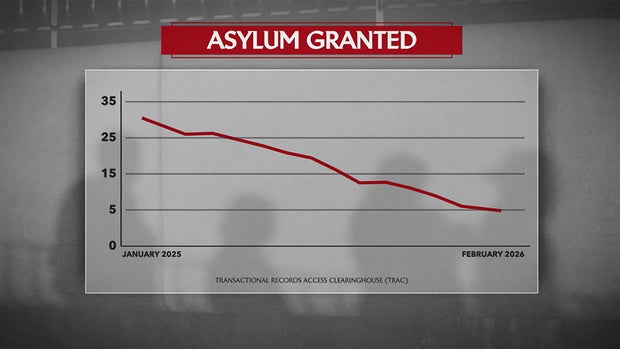
“I’m very concerned that we’re doing a lot of things right now without any changes to the law,” said Wood. “We’re doing it by executive order and executive power alone, whether it’s firing of immigration judges, or deportation orders. That’s not the way a democracy is supposed to be run.”
WEB EXTRA: Daniel Caudillo on immigration judges and due process (Video)
Professor Daniel Caudillo, director of the Jim and Leah Finley Immigration Law Clinic at Texas Tech University School of Law, also served as an immigration judge in Laredo, Texas. He talks with Ted Koppel about impacts on immigration judges today, and the importance of protecting due process for all.
For more info:
Story produced by Deirdre Cohen. Editor: Ed Givnish.