


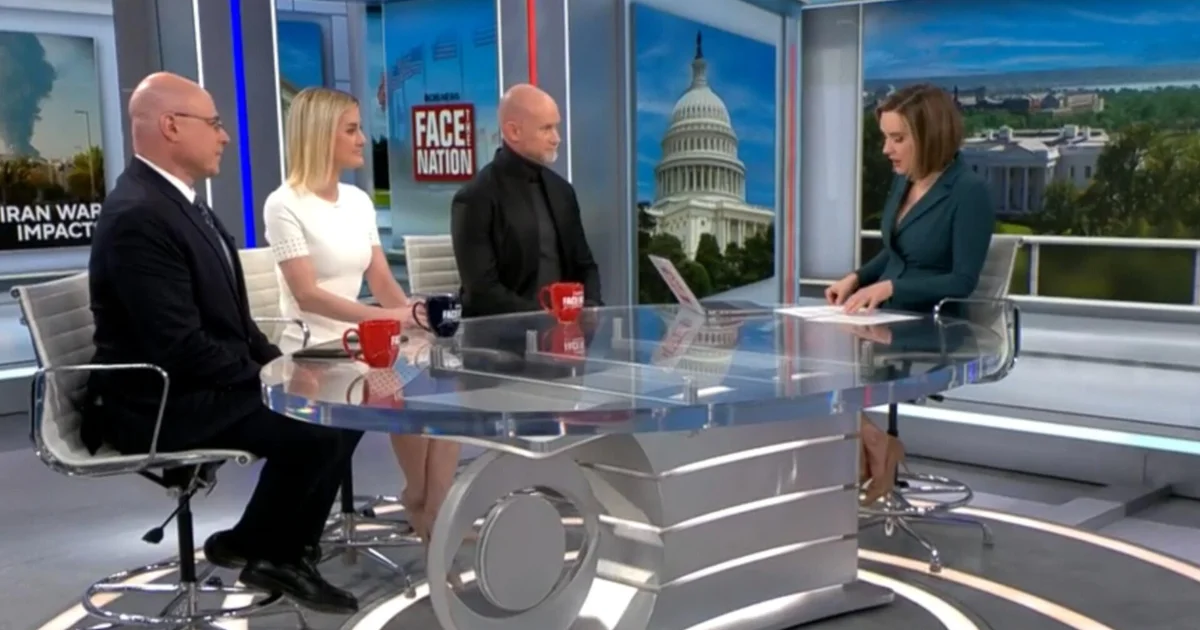
On this “Face the Nation with Margaret Brennan” broadcast, moderated by Margaret Brennan:
- Iranian foreign minister Abbas Araghchi
- Sen. Mark Warner, Democrat of Virginia
- National Economic Council Director Kevin Hassett
- Rep. Dan Crenshaw, Republican of Texas
- Former CIA executive and operative Jonathan Gannon, CBS News national security contributor and Biden administration top counterterrorism official Sam Vinograd and energy policy expert and analyst Kevin Book
Click here to browse full transcripts from 2026 of “Face the Nation with Margaret Brennan.”
MARGARET BRENNAN: I’m Margaret Brennan in Washington.
And this week on Face the Nation: The consequences of the war in Iran are increasingly reverberating across the globe. The world’s oil supply is under intensifying pressure, as Iran threatens to blow up tankers in the Strait of Hormuz, and the U.S. strikes back at the heart of Iran’s critical oil hub.
President Trump is now asking U.S. allies to send warships to the region to help keep the strait open, as Tehran doubles down on its blockade. We will get the latest from Iran’s foreign minister, Abbas Araghchi.
Meanwhile, the pain from the oil supply shock is beginning to hit Americans at the gas pump. We will ask President Trump’s top economic adviser, Kevin Hassett, what the administration can do to lower energy prices.
The top Democrat on the Intelligence Committee, Senator Mark Warner, and Texas Republican Congressman Dan Crenshaw will be here as well.
Then: three violent attacks in the U.S. last week against the backdrop of global conflict. How safe are we in the homeland? We will get analysis from our panel of experts.
It’s all just ahead on Face the Nation.
Good morning, and welcome to Face the Nation.
This morning, the Israel Defense Forces say they have launched a new wave of strikes in Iran, while Iranian state media says Iranian forces have fired back at Israeli and American targets. The number of U.S. casualties is now at 13, with the Department of Defense identifying the six service members killed last week when their military refueling aircraft crashed in Iraq.
Our senior national security correspondent, Charlie D’Agata, has the latest from Tel Aviv.
(Begin VT)
CHARLIE D’AGATA (voice-over): Among the six air crew now identified in the crash of the refueler, Tech Sergeant Tyler Simmons. Sergeant Simmons was a boom operator, this video showing him refueling a fighter jet mid-flight.
Now thousands more U.S. sailors are heading to the region equipped for close combat on sea or land. The increased firepower comes as an Iranian- backed militant group in Iraq struck the U.S. Embassy compound, prompting officials to urge U.S. citizens to leave the country as soon as possible, even as President Trump claimed to have totally decimated Iranian military targets on Kharg Island, a crucial oil hub.
Iran’s grip on the Strait of Hormuz has crippled at least 16 oil tankers and other vessels, to the point where President Trump has even asked China to send warships, while his administration claims U.S. and Israeli forces have neutralized most of Iran’s military.
Yet, in an act of defiance, Iran’s president and other senior officials were seen on the streets taking part in open air rallies earlier this week.
Here on the streets of Israel, there’s been a sharp increase in the amount of rocket and missile attacks from Iran and its proxy Hezbollah in the past 24 hours. They have already begun cleanup of a strike here in Tel Aviv just this morning – Margaret.
(End VT)
MARGARET BRENNAN: That’s Charlie D’Agata in Tel Aviv.
We turn now to the foreign minister of Iran, Abbas Araghchi.
Good evening to you, sir.
ABBAS ARAGHCHI (Iranian Foreign Minister): Well, good evening to you. Thank you for having me for the second time.
MARGARET BRENNAN: Yes, and they are extraordinary times.
Minister, President Trump said this weekend he is not ready to make a deal with Iran because the terms aren’t good enough yet. His administration is saying this war could last another 3.5 weeks or so. Has Iran asked for a cease-fire?
FOREIGN MINISTER ABBAS ARAGHCHI: No, we never asked for a cease-fire, and we have never asked even for negotiation. We are ready to defend ourselves as long as it takes.
And this is what we have done so far, and we continue to do that until President Trump comes to the point that this is an illegal war with no victory. And, you know, there are, you know, people being killed only because President Trump wants to have fun.
This is what he has said.
MARGARET BRENNAN: Have fun?
FOREIGN MINISTER ABBAS ARAGHCHI: So, we are not – yes, this is what he said, that they are sinking, you know, ships and targeting different places because it is fun.
And the secretary of war has said that there is no – no mercy. And this is actually a war crime.
MARGARET BRENNAN: Yes.
FOREIGN MINISTER ABBAS ARAGHCHI: Even saying that is a war crime.
So this is a war – this is a war of choice by President Trump and the United States, and we are going to continue our self-defense.
MARGARET BRENNAN: Well, that may be your position, but, sir, this is a war of survival for your government.
Minister, don’t you have to negotiate and reach out, either directly or through a third party?
FOREIGN MINISTER ABBAS ARAGHCHI: No, it’s not a war of survival. We have – – we are – we are, you know, stable and strong enough.
We are only defending our – our people from the – you know, the – this – – this act of aggression. And we don’t see any reason why we should talk with Americans, because we were talking with them when they – when they decided to attack us. And that was for the second time.
There is no experience, good experience talking with Americans. We were talking. So, why they decided to attack us? So what is good if we go back to talk once again?
MARGARET BRENNAN: Well, I want to come back to that in just a moment.
You’re referring to the diplomacy with President Trump’s son-in-law Jared Kushner and his envoy, Steve Witkoff. But just to continue on this, Iran is sending its drones and its missiles into your neighboring countries, American allies throughout the Gulf.
Before the war, your government traded with them. You had relations with them. If your government survives this conflict, how do you go back to doing business with countries you’re sending drones into and hitting civilian targets?
FOREIGN MINISTER ABBAS ARAGHCHI: Well, obviously, these are the countries who have given their soil to American forces to attack us.
So, what can we do? We just sit and watch that Americans are – American forces are attacking us from their soil and we don’t defend ourselves?
(CROSSTALK)
MARGARET BRENNAN: But your drones are going into civilian areas and hitting plants and hotels and civilians.
FOREIGN MINISTER ABBAS ARAGHCHI: No, no. No, no, not – no, no, this is not the fact.
We are only targeting American assets, American installations, American military bases. Everything belongs to Americans. And this is a fact that they are using their soil. You know, just – there are many, many examples.
Just yesterday, they, you know, attacked our islands using HIMARS artillery rockets, which is – which are low-range, you know, rockets. And they use the territory of UAE to attack us. Some – a week ago, three F-15 jet fighters were shot down apparently by friendly fire in Kuwait, but nobody asked what they were doing in Kuwait.
They were using Kuwait, and, you know, airspace of a neighborly, a friendly country to attack us. So it is obvious we cannot just, you know, remain, you know, silent…
(CROSSTALK)
MARGARET BRENNAN: Right.
Well, so many of these countries are part of CENTCOM. But – but this is – the point is that it’s going to hurt your country in the long term. But when we talk about the Strait of Hormuz, which is such an important transit point for global trade, you have said it is closed to Israel and it’s closed to the United States.
“The Financial Times” is reporting that European diplomats from France and Italy are talking to your government about trying to get safe passage for their ships. Are you open to restarting oil and gas vessels going through there?
FOREIGN MINISTER ABBAS ARAGHCHI: Well, we are open to countries who want to talk to us about the safe passage of their vessels.
It depends on our – on our…
MARGARET BRENNAN: You are negotiating with France and Italy?
FOREIGN MINISTER ABBAS ARAGHCHI: I cannot mention any country in particular, but we have been approached by a number of countries who wants to have a safe passage for their vessels.
And this is up to our military to decide, and they have already decided to let, you know, a group of vessels belongs to different countries to pass in a – safe and secure. So we provide them security to pass, because we have not closed this strait.
They are not coming themselves because of the insecurity which is there because of the aggression by the U.S.
MARGARET BRENNAN: I want to ask you again about the negotiations.
Iran has declared it has 440 kilos or so of nuclear material. Where is that material now? Who has custody of it?
FOREIGN MINISTER ABBAS ARAGHCHI: Well, we have not declared. This is verified and declared by the agency.
MARGARET BRENNAN: That’s right.
FOREIGN MINISTER ABBAS ARAGHCHI: This is not a secret. This is not a secret. You know, the agency have said in his many reports the exact amount of our enriched, you know, nuclear material.
MARGARET BRENNAN: Yes. So where is it now? Who has custody of it?
FOREIGN MINISTER ABBAS ARAGHCHI: So, they are – they are under the rubble.
You know, the – our nuclear facilities were attacked, and everything is under the rubble. Of course, you know there is the possibility to retrieve them, but under the supervision of the agency.
If one day we come to the conclusion to do that, it would be under the supervision of the agency. But, for the time being, we have no program. We have no plan to recover them from under the rubble.
MARGARET BRENNAN: Am I understanding you here? Because I know that you said, 48 hours before the U.S. strikes happened, you had personally offered to President Trump’s negotiators to take that 440 kilo amount of 60 percent enriched material and to dilute it. You said Iran was ready to give that material away.
This was in the deal that was also presented to Vice President Vance by Oman.
FOREIGN MINISTER ABBAS ARAGHCHI: Right.
MARGARET BRENNAN: Today, is Iran still willing to let go of that enriched uranium?
FOREIGN MINISTER ABBAS ARAGHCHI: Well, that was one of the elements of a deal that we were negotiating with our, you know, American interlocutors.
That one – that element were – dealt with the question of Iran’s 60 percent enriched material. And I said – I offered actually that we are ready to dilute those enriched material or down-blend them, as they say, into lower percentage.
So that was a – you know, a big offer, a big concession in order to prove that Iran has never…
MARGARET BRENNAN: Yes.
FOREIGN MINISTER ABBAS ARAGHCHI: … wanted nuclear weapons and would never want them. So…
(CROSSTALK)
MARGARET BRENNAN: Are you willing to give that up now?
FOREIGN MINISTER ABBAS ARAGHCHI: Well – well, there is nothing on the table right now. Everything depends on the future.
If any time in the future we decide to enter into negotiation with U.S. or other interlocutors, you know, we may decide what to put on the table. For the time being, nothing is – nothing is on the table.
MARGARET BRENNAN: There are at least four Americans being held at Evin prison that we know of, including a journalist, Reza Valizadeh, and Kamran Hekmati, a 61-year-old man.
What is the status of those Americans? Are they safe?
FOREIGN MINISTER ABBAS ARAGHCHI: Well, if – if they – if the U.S. and Israel do not attack our prisons, I guess they are safe.
MARGARET BRENNAN: Foreign Minister, we are running out of time, and I can see the Internet is going in and out here.
I just do want to point out you’re speaking to us via Zoom.
FOREIGN MINISTER ABBAS ARAGHCHI: Yes.
MARGARET BRENNAN: The Iranian people don’t have open Internet access, but you do. Why?
FOREIGN MINISTER ABBAS ARAGHCHI: Well, I’m the voice – because I’m the voice of Iranians, and I have to defend their right.
So, this is why I have access to Internet to just, you know, have – have our voice being heard by the international community. But Internet is closed because of the security reasons, because we are under the – under attack, we are under aggression, and we have to do everything to protect our people.
In any country, there are, you know, urgent measures taken for the – for the sake of war.
MARGARET BRENNAN: Minister, I’m glad the uplink worked to talk to you right now. We thank you for your time this morning.
Face the Nation will be back in a minute. Stay with us.
(ANNOUNCEMENTS)
MARGARET BRENNAN: We go now to President Trump’s top economic adviser, Kevin Hassett.
Good morning to you.
KEVIN HASSETT (Director, National Economic Council): Good morning.
MARGARET BRENNAN: The IDF spokesperson said this morning that Israel’s combat operations will go through the beginning of April.
Is that also the U.S. timeline? And, if so, how much will this conflict cost the economy if it goes on another 3.5 weeks?
KEVIN HASSETT: Right.
Well, one of the things that we’ve been briefed on almost every day is what’s going on and what the president is being briefed on with regard to the Iran war. And, as of yesterday, the story was, the message was that people, the Defense – Department of War believed that it would take four to six weeks to complete this mission and that we’re ahead of schedule.
And so we are a couple of weeks in, and I think that should give you some clarity about when we expect that the president will decide that we’ve achieved his objectives.
The other thing I can say is that you can also look at futures markets, which are interesting, because you’ve cited over and over the spot price of gasoline, which, of course, is affected right now by the disruption of the strait. But if you look at the futures prices, they are expecting a rapid, rapid end to the situation and much, much lower prices.
In fact, I don’t think I have seen a sort of future price path with such as steep a decline in all my years watching futures.
MARGARET BRENNAN: Well, we will talk about the oil trade later on in the program, as those markets prepare to open later today.
But the International Energy Agency called this the largest supply disruption in the history of the global oil market. So, I’m not sure how much past charts are a future indicator here.
But the president is calling on other countries now to send ships to help protect the Strait of Hormuz. You just heard Iran’s foreign minister saying Tehran has been approached by other countries about negotiating their way through strait.
If that kind of negotiation happens, are Americans just going to get cut out here?
KEVIN HASSETT: Well, first of all, you have to understand that America is not going to have its economy harmed by what the Iranians are doing.
The bottom line is that, in the ’70s, we didn’t produce much oil, but now we do. And so America is in a very strong position. They think that they’re going to harm the U.S. economy and get President Trump to back down. There couldn’t be anything that was a stupider thing to say, because the bottom line is that our economy has got all this momentum in the world.
And we’ve got lots and lots of oil. We have lots of trading partners that are more on the hook from imported oil from these guys.
MARGARET BRENNAN: Yes.
KEVIN HASSETT: And, as we can see, it’s completely unacceptable that a government that would, you know, murder 40,000 of their people just a few months ago would be blackmailing countries to let stuff through.
President Trump thinks that is unacceptable.
MARGARET BRENNAN: Yes.
KEVIN HASSETT: And for the global economy, we need to fix it, and we are going to fix it fast.
MARGARET BRENNAN: OK. It is a global market, but I take your point there is supply. Of course, there’s refining. There’s other interruptions to the ability to access oil and gas.
But gas prices themselves are up more than 20 percent since this conflict has begun. Jet fuel prices are leading airlines to raise ticket prices quickly. That’s not my opinion. That’s the United Airlines CEO who just said that.
The American Farm Bureau warned of supply chain shocks, when we already have record high input prices. So can you give us some kind of projection here on how this will impact consumer prices and for how long?
KEVIN HASSETT: For – for sure.
And – and I want you to know that this is something that the government has been studying for decades. And even myself, when I first came in as chairman of the Council of Economic Advisers, one of the first assignments I got from General Mattis was to study what happens if there are oil disruptions.
And so we know how to minimize – minimalize the impact of this disruption. Now, you can’t make it completely go away, but you can minimalize it.
And so we are increasing the amount of permits that we’re giving to Venezuela. We’re getting new sources of fertilizer from Morocco and from Venezuela and other places to make sure that our farmers have the fertilizer they need.
And we’re even thinking ahead about the jet fuel problem, which is really mostly a problem for jet fuel coming from Asia. And we have been in discussions to make it easier for foreign ships to go from the Gulf of America over to the West Coast to make sure that we don’t have a disruption from jet fuel as well.
And so we are looking at every scenario, and we’ve got a plan for each scenario.
MARGARET BRENNAN: OK. Are you going to trigger those things and make them operational, or are you just looking at them? And how do you prevent food prices from also going up?
KEVIN HASSETT: Right.
Well, the – the big problem right now would be energy prices. And we’re watching and monitoring closely. We’re looking at things every day and seeing how quickly we progress. The bottom line is, again, that the reason why futures markets for oil are dropping down towards $60 and even below $50 in the long run is that we expect that, if Iran stops being this disruptive terrorist force in the Middle East, that there will be a boom in oil production and industrial production.
But think about the harm, the harm that this evil government has done to their own people.
MARGARET BRENNAN: Yes.
KEVIN HASSETT: Back in the ’70s, before the revolution…
MARGARET BRENNAN: Sure.
KEVIN HASSETT: … Iran was the 17th largest economy in the world. Now it’s something like the 50th.
MARGARET BRENNAN: No one’s going to defend the regime’s human rights record on this program.
KEVIN HASSETT: And so they’ve run – they’ve run their country into the ground.
But the point is that – I wanted to just say that the countries around them, they also suffer from the risk of having them go nuts and attack them. And so we expect that the global economy is going to have a big positive shock as soon as this is over.
And we’re still being briefed that it would be four to six weeks from the beginning and that we are ahead of schedule.
MARGARET BRENNAN: A big positive shock, four to six weeks. So this a April 9 scenario you’re talking about? You are going to see some kind of boost, even – even…
KEVIN HASSETT: Well, the president will decide – the president will decide if they no longer have the capability of blackmailing us and harming our neighbors. And, once he decides that, then he will call an end to the war.
MARGARET BRENNAN: That’s a pretty broad definition.
KEVIN HASSETT: Well, we’ve destroyed their navy. We’ve destroyed their air force and so on. And so I think we are well on the way.
MARGARET BRENNAN: Well, tell me, how much is this war going to cost? Because I know the Pentagon briefed it’s going to be about $11.3 billion. Do you need to ask Congress for more money to pay for what you’re doing?
KEVIN HASSETT: I think, right now, we’ve got what we need.
Whether we have to go back to congress for more is something that I think that Russ Vought and OMB will look into. But the latest number – you said 11.3. The latest number I was briefed on was 12, and so it’s consistent.
So this is something that we’ve got the weapons that we’ve already got in place to do this. And so we are not necessarily going to need any kind of supplemental.
MARGARET BRENNAN: More than that was spent in just the first week of the war. You know that. It was over $5 billion just in munitions. You’re solid on the 12?
KEVIN HASSETT: I said $12 – $12 million – $12 billion was – was…
MARGARET BRENNAN: For six weeks of war?
KEVIN HASSETT: No. I’m sorry. The $12 billion was what I was briefed has been spent so far.
MARGARET BRENNAN: Oh, gotcha.
KEVIN HASSETT: Yes.
MARGARET BRENNAN: Kevin Hassett, thank you very much.
We will be right back with a lot more Face the Nation.
(ANNOUNCEMENTS)
MARGARET BRENNAN: We turn now to the vice chairman of the Intelligence Committee, Democratic Senator Mark Warner. He joins us this morning from Richmond, Virginia.
Senator, a lot to ask you about in regard to Iran, but I want to start first on the homeland.
We had several attacks, two being investigated as terror incidents here at home.
Do we still have the senator? OK. Sorry. Glad he can still hear me.
SENATOR MARK WARNER (D-Virginia): I’m here, yes.
MARGARET BRENNAN: The incidents here at home, including one in Virginia at Old Dominion University, the gunman had served several years in prison for trying to support ISIS. He walked into an Army ROTC class and he shot the instructor dead. He injured two others.
How does a convicted ISIS supporter do this right under the nose of law enforcement? Whose job was it to track him?
SENATOR MARK WARNER: Well, Margaret, I think the job was supposed to be the FBI.
And, unfortunately, under this FBI director, Kash Patel, he has fired many of the top counterterrorism folks, counterespionage folks. And he has taken – and I reported this many times – close to a third of our FBI officers off doing counterterrorism or doing sex crimes and put them on immigration enforcement.
I knew this was going to come back and bite us. And I believe, while there may not be a direct relationship here, we know, in all of the offices, they’ve taken these FBI agents off their critical cases and put them on immigration enforcement.
I think that was a mistake. I want to find out how this guy was able to still be on the loose.
MARGARET BRENNAN: Yes.
SENATOR MARK WARNER: And we’ve got to get an – we’ve got to get an investigation, but we’ve got to get an FBI that is back focused on protecting the homeland and preventing whether it be terrorists or espionage taking place.
MARGARET BRENNAN: At this point, are you aware of any credible threats to the homeland?
SENATOR MARK WARNER: I have not been briefed in the last few days on a additional credible threat.
But this – let’s put it like this. You know, these are the things you have to plan for if you are planning on going to war on a war of choice.
MARGARET BRENNAN: Yes.
SENATOR MARK WARNER: This is a war of choice. And if you just go through quickly, the president said there were going to be four goals.
Regime change. We’ve actually got a worse supreme leader than the previous one. And you heard the foreign minister. It doesn’t sound like they’re ready to move out.
MARGARET BRENNAN: Yes.
SENATOR MARK WARNER: The uranium enrichment, it would take troops on the ground. Getting rid of the missiles, we’ve attrited some of those.
MARGARET BRENNAN: Yes. I get it.
SENATOR MARK WARNER: But the crazy thing was that we didn’t take the Ukrainian offer to go after – to use their drones…
MARGARET BRENNAN: Yes.
SENATOR MARK WARNER: .. which are much cheaper.
MARGARET BRENNAN: I need to talk to you about…
SENATOR MARK WARNER: So – and, finally, we’ve got the Strait of Hormuz closed.
Yes.
MARGARET BRENNAN: I got to go to a break, and I’m coming back to talk to you where I don’t have to cut you off.
Let me just go to this break now.
(ANNOUNCEMENTS)
MARGARET BRENNAN: And, after this break, we will be right back with a lot more Face the Nation, so stay with us.
(ANNOUNCEMENTS)
MARGARET BRENNAN: Welcome back to “FACE THE NATION.”
We return now to our conversation with Senator Mark Warner.
Senator, we were talking about Iran before that break. It was a year ago that the country’s intelligence leaders sat before your committee and provided testimony at the worldwide threats briefing. And at that point the testimony was, quote, “we continue to assess Iran is not building a nuclear weapon and that Khamenei has not reauthorized the nuclear weapons program he suspended in 2003.” Clearly Israel disagreed with that U.S. assessment and they persuaded President Trump. Were those U.S. intelligence leaders wrong?
SENATOR MARK WARNER (D-VA): No, they were not. There was no imminent threat to the United States, and I don’t believe there was even an imminent threat to Israel from Iran. Over a period of time, particularly with the ballistic missile capability, Israel would be more under threat.
The decision to go to war in this case was a choice by President Trump. And as I was racing through – I won’t go through the whole list again, but it was regime change, get rid of the enriched uranium, get rid of their missiles, sink the navy. I’m not sure we have reached successful conclusion on any of those four, particularly on the last point, the navy. They’re still, you know, have hundreds and hundreds of these speed boats that they can plant mines in the Strait of Hormuz, which they’ve already partially mined. And now we’re in this circumstance where, you know, he’s going to decide, I guess when he feels it in his bones I think was the quote the president used.
MARGARET BRENNAN: Yes.
SENATOR MARK WARNER: And is that the criteria when we’ve got literally 13 service members killed. And I got a lot of those sailors on the Ford that are home ported in Norfolk, Virginia. And waiting for him to feel right in the bones, that doesn’t seem to be the right criteria.
MARGARET BRENNAN: Well, we will get an update from those intelligence leaders before your committee later this week. We’ll be watching that closely.
I want to specifically ask you, though, about what happened with this deadly strike on an elementary school in Minab, Iran. Our CBS reporting is that nearly 200 people were killed, likely the result of outdated intelligence that was used for the target coordinates, according to the preliminary assessment. Secretary Hegseth said he has appointed an investigator from outside central command to do a full probe. From what you have been told, did the fatal error originate from within the intelligence community, or was this an issue with the military not vetting the intelligence they were given?
SENATOR MARK WARNER: Margaret, we’ve only got preliminary assessments. And I want a thorough investigation. But what I don’t want to do is jump to the conclusion, whether it was CENTCOM, or whether it was a defense intelligence agency. Let’s – that’s what thorough investigations are supposed to be for. Clearly it was an American strike. I, again, feel a little disappointed that the president tried to deny that at first or say it was even the Iranians. This is where – you know, what we’ve got – you know, the words of the president of the United States are terribly important in moments like this. And unfortunately, President Trump has – uses loose language all the time. Didn’t ever come to the American people on this war of choice and say what our goals are. And we still don’t know, other than the four goals he outlined. I’m not sure what we’re going to accomplish.
MARGARET BRENNAN: Yes.
SENATOR MARK WARNER: But he’s going to then – whenever he decides. And we – where I disagree with my friend Kevin Hassett is, this is having a huge economic effect. In Virginia, two weeks ago, gas prices were $2.81.
MARGARET BRENNAN: Yes.
SENATOR MARK WARNER: Today they’re about $3.45.
MARGARET BRENNAN: I just –
SENATOR MARK WARNER: I saw a farmer yesterday. His fertilizer costs have went up 40 percent.
MARGARET BRENNAN: No. And we’ll continue to track that.
Just to put a fine point on this though, because this was a – this was a school full of children. If a mistake like this happens, are you confident in the rest of U.S. intelligence that is continuing to be used for targeting and to inform what is happening on the ground now and the more than 50,000 service people we have committed here?
SENATOR MARK WARNER: This is why we want the investigation. This school, though, was absolutely adjacent to an Iranian military base. That does not excuse what happened, but that’s why, before I cast blame on whether it was the military or DIA –
MARGARET BRENNAN: Yes.
SENATOR MARK WARNER: I want to get the facts. I think we’d all do a better job if we actually argued from facts rather than from suppositions.
MARGARET BRENNAN: Yes. Well, on the facts, the Senate failed to advance that Homeland Security funding for the fourth time yesterday. We have airline CEOs faulting Congress for not paying TSA agents. I’ve got video of TSA workers on food lines because they just missed their second paycheck, half paycheck last time, full paycheck this Friday. Why can’t you leaders break in deadlock?
SENATOR MARK WARNER: Margaret, I think we should. And what we have offered is, let’s pay TSA. Let’s pay FEMA. Let’s pay the National Guard – or, I’m sorry, the Coast Guard. Let’s pay CISA. I’d even say let’s pay Customs and Border Patrol. If we can’t agree on ICE reforms, let’s pay everybody else with the budget that the Republicans laid out. Why won’t they just take yes for an answer.
MARGARET BRENNAN: Well, they say it’s wholesale funding not piecemeal.
SENATOR MARK WARNER: Well, if you’re going to fund 95 percent, as we did the balance of the government –
MARGARET BRENNAN: Yes. Yes.
SENATOR MARK WARNER: Why not do the balance of DHS.
MARGARET BRENNAN: OK.
SENATOR MARK WARNER: With the exception of ICE?
MARGARET BRENNAN: Well, we will be watching that.
Senator Warner, thank you for your time this morning.
We’ll be right back.
(ANNOUNCEMENTS)
MARGARET BRENNAN: We go now to Texas Republican Congressman Dan Crenshaw, who joins us from Houston.
Welcome back to “FACE THE NATION.”
You, in a previous life, were a Navy SEAL. So, just to tap into your expertise a little bit here, when you see that President Trump is deploying a few thousand more Marines and an expeditionary unit to join the 50,000 forces we have there, what does that signal to you?
REPRESENTATIVE DAN CRENSHAW (R-TX): I think it signals that there’s a seriousness of supporting whatever contingency operations might be needed. I don’t think people should take that as a boots on the ground deployment, especially with only 5,000 troops. These type of units are, you know, they could be for evacuating American citizens out of gulf allied countries. They could be for a number of things.
So, I take it as a seriousness of committing to the situation, which is exactly what is needed. If you’re going to do this, which we have done, you need to see it through. That’s what I would be advising the president. I’d be advising the president to take it very seriously the Straits of Hormuz. This is something we practice on a yearly basis. This is why he’s asked allies to come to our aid to protect it because we practice this as an exercise yearly with 30 plus nations. So, I think he’s doing what’s needed.
MARGARET BRENNAN: So, Secretary Hegseth said earlier this month Operation Epic Fury would have, quote, “no stupid rules of engagement.” Two days later he said, “we are punching them while they’re down, which is exactly how it should be.” This Friday he said, “no quarter (ph), no mercy for our enemies.”
You’ve served in uniform. Do you have any concern that this kind of language is sending the wrong message to our troops who are bound by standards of proportionality or that it could backfire on our troops?
REPRESENTATIVE DAN CRENSHAW: No. If you fought in these wars in Iraq and Afghanistan, you would be well-acquainted with bad rules of engagement. You know, the kind of thing that says, look, you can’t shoot unless you’re shot at. What he’s saying is that, we are targeting Iranian military without quarter. That’s what he’s saying. He’s making it very clear for our military, which is – which is a clarity that our military has lacked in many of these conflicts of the past.
MARGARET BRENNAN: So, even though there are no ground troops at this point, you think that this is –
REPRESENTATIVE DAN CRENSHAW: I can’t –
MARGARET BRENNAN: Can you hear me?
REPRESENTATIVE DAN CRENSHAW: I can.
MARGARET BRENNAN: Oh, OK. So, you don’t take that as sending the wrong signal to our troops whatsoever or that it could enflame enemies who – if there are ever ground troops or a downed air pilot, for example, that they would be mistreated?
REPRESENTATIVE DAN CRENSHAW: No. No. Absolutely not. The rules of engagement will be very clear and in place and in writing for our troops. He is saying that to the American people. And so there’s – there’s military language that our troops abide by, which will be very clear. I don’t think it sends any wrong message. I think it’s – I think it sends exactly the right message. Again, it – my experience in the military, I know what that means.
MARGARET BRENNAN: Yes. OK. The last time you were with us we spoke about, you felt the need for moral clarity. That was a phrase you used for some within your own party, specifically around anti-Semitism in this country. I want to read for you a few things that some Republican lawmakers said this week.
Andy Ogles of Tennessee said “America is a product of English Christian culture. Muslims don’t belong in American society.” Florida’s Randy Fine said, “we need more Islamophobia, not less. Fear of Islam is rational.” And Senator Tommy Tuberville of Alabama posted a picture of the 9/11 attack next to the New York City mayor at dinner breaking his fast at Ramadan with the phrase, “the enemy is inside the gates.”
What do you think of this language, and should Republican leaders speak up about it?
REPRESENTATIVE DAN CRENSHAW: I still think it’s fairly fringe. I mean, look, the truth of the matter is, radical Islamism is bad, right? We’ve always known that. That should not be – that should not be a controversial statement at all. There are plenty of peaceful Muslims who live among us.
MARGARET BRENNAN: But that’s not what they said.
REPRESENTATIVE DAN CRENSHAW: I realize that. But, you know, that’s not a mainstream – that’s not a mainstream narrative by any stretch.
I think trying to fight it internally, what probably gives it more – a lot more air than is necessary. We’ve seen that to be the case as, you know, there’s a Republican conflict ongoing right now over Israel and the anti- Semitism issues. And so, you know, one could make the argument that speaking out against it has only inflamed it.
So, look, I still think that’s very fringe. I don’t think that’s – that’s certainly not the administration’s position. And look, if we’re going to go after radical Islamists, why we need to fund agencies like DHS, and that’s what we’re going to do.
MARGARET BRENNAN: You spoke about this culture of misinformation we’re living in and you pointed to that as one of the factors in your recent primary loss. What lessons should other Republicans take from that? What do you mean?
REPRESENTATIVE DAN CRENSHAW: Well, I mean, I’m a unique Republican. You know, I’ve been the target of online smears and conspiracies for a long time. My election was basically a product of that. You know, first of all, you have about 20 percent of Republican voters bothering to even vote at a primary. And then you have dozens of online smears and conspiracies that people were going into the voting booth actually believing. I mean believing I was worth millions of dollars from insider trading. Doesn’t matter how many times we thought we had debunked that, or that – or that – – or that other people and influencers and what have not have debunked it –
MARGARET BRENNAN: Yes.
REPRESENTATIVE DAN CRENSHAW: All of these things, people still went in believing it. And so the lesson to be learned is, look, you’ve got to get the truth out. You’ve got to try. But ultimately this is a question for the American people. Are you going to believe everything you read online or that’s sent to you in your mail? I mean Democrats spend almost a million dollars also pushing these smears on television. So, Republican voters are going to the voting booth believing what a Democrat told them on TV based on a smear headline written by a liberal reporter in D.C.
MARGARET BRENNAN: Yes.
REPRESENTATIVE DAN CRENSHAW: So, that’s the lesson – and it’s not just for Republican politicians. It’s a lesson for Republican vote.
MARGARET BRENNAN: Misinformation.
Congressman, we appreciate your time today.
We’ll be right back.
(ANNOUNCEMENTS)
MARGARET BRENNAN: And we’re joined now by a panel of experts. Jonny Gannon is a former CIA operative with extensive Iran experience, Sam Vinograd is a CBS News national security contributor and was a top counterterrorism official under the Biden administration, and Kevin Book is an energy policy expert and analyst.
There is a lot for you to break down for me.
But, Jonny, I want to start with you.
You just came back from the UAE. They have taken a lot of incoming, in particular drones.
JONNY GANNON (Former CIA Executive and Operative): More than anybody else.
MARGARET BRENNAN: And that seems to really have been underestimated by the United States. We’ve seen embassies, CIA stations, U.S. posts hit. What was it like to be in the midst of that kind of warfare?
JONNY GANNON: Well, look, there’s a discipline to Abu Dhabi and Dubai right now. Commerce is continuing, people are still going to work. You’ve probably seen video of Sheikh Mohammed, the president of the UAE, in the mall, talking with civilians, greeting children. But there is no doubt that people are beginning to feel these attacks.
I was on the ground in both Abu Dhabi and Dubai. After 26 years at CIA, it’s my first war zone observed from a luxury hotel. But I noticed that as the week went on I was getting edgy. There is the interceptors overhead, there’s the loud booms, hotel windows shaking and alerts going off on your phone at all hours of the day and night. So, for the time being, it looks like the majority of ex-pats are staying put.
MARGARET BRENNAN: Yes.
JONNY GANNON: But there is an exodus and there is impact on the economies, therefore (ph) our partners.
MARGARET BRENNAN: Pain for our partners economically. And those partners, many of them, oil producers, natural gas producers. But those mines and those drones, they’re cheap, but apparently they’re effective at shutting down the Strait of Hormuz, Kevin. Do you anticipate that oil prices are going to be in this 100 range? I know Iran is saying $200 barrel.
KEVIN BOOK (Managing Director, Clearview Energy Partners): Well, look, if the strait reopened today, it could still take weeks to bring production back on. And damaged facilities, maybe months. So, there’s room for the prices to rise as long as the strait stays closed. And then, if we look at the strategic reserve draw, the good news is that we’ve drawn 400 million barrels out of the oil savings account for the industrialized world. The bad news is that we’ve drawn 400 million barrels out of the oil savings account for the industrialized world.
MARGARET BRENNAN: Long term the White House says, oh, we’ll buy it back when it’s cheaper, right?
KEVIN BOOK: Well, that’s the right way to do it, you buy insurance when you don’t need it.
MARGARET BRENNAN: Right.
KEVIN BOOK: But right now we need it.
MARGARET BRENNAN: Sam, on the homeland, we had all these horrific incidents, including that 41-year-old man who drove a car with explosives into Michigan’s largest synagogue. He was a naturalized U.S. citizen. Brothers were members of Hezbollah, who had recently been killed in Lebanon, along with their children. We don’t know yet if the attacker was involved with Hezbollah, but what do you understand about the threat picture at home?
SAMANTHA VINOGRAD: Margaret, the diversity and volume of terrorist threats to this country has never been higher. We have a broad range of threat actors at play, individuals inspired and directed by countries like Iran, by foreign terrorist organizations like Hezbollah and ISIS, and individuals motivated by domestic political grievances and racial anonymous and more. At the same time, the internet has been a force multiplier for terrorism. Individuals have such easy access to content online that can radicalize them and important such easy access to information on tactics, techniques and targets, which means that they can plot their attacks more quickly and make their attacks more effective. What that really means is, we need a whole new model for counterterrorism in this country that includes law enforcement, but also includes members of the public.
MARGARET BRENNAN: We’ll be listening if there are any answers at this worldwide threats briefing later this week that Senator Warner will help oversee.
Jonny, on what is happening. We already had the Gaza situation having raised the global threat picture. Now, around the world, Americans are being warned to be very careful. How do you understand what Sam is talking about here at home? I mean what about Americans overseas?
JONNY GANNON: Well, there’s no doubt that the – that the threats are increasing. I’m a little bit dubious that the Iranian regime right now can reach out and touch us in the homeland. Certainly people who are still in the gulf are vulnerable.
And I think that, on the back end of this, the intelligence community and our federal law enforcement are going to have to be very focused and well- resourced given what we saw after the Soleimani strike, which was that the Iranians engaged in lethal operations around the world trying to kill American officials, or former officials. So, we can expect that, I think, on the back end of this.
MARGARET BRENNAN: So, I mean, it’s still making people really nervous, Sam. I mean even just in New York, you had the two Pennsylvania men, two U.S. citizens who were arrested, they were going to protest the anti-Muslim protest in New York, but they claim that they had ties to ISIS. It’s not clearly directed by a state. It’s not clearly directed by anyone. How do you –
JONNY GANNON: Inspired.
MARGARET BRENNAN: Inspired. How do you protect yourself?
SAMANTHA VINOGRAD: Well, what we have to think about today is not just how to enhance physical security protections at targets. Certainly the government has a role to play in helping synagogues, churches, mosques, schools and others in putting up security barriers, training security officers and those physical security enhancements.
We also really have to double down on information and intelligence sharing. That’s a government function, but it also has to include the public. And what I mean by that is, the threat landscape is so disperse. There’s so many tentacles of this. That when individuals and communities see an individual that may be exhibiting signs of violence, they have to ask for help from law enforcement, from a social worker, from a mental health worker, because the pathway and the path to radicalization and mobilization is just so rapid.
And I do think, Jonny, that the Iranian regime has demonstrated an incredible capacity to be flexible and adaptive. They’ve played a long game here. They have invested in propaganda and tools in this country, as well as just hiring people to do their dirty work for them, to such an extent that I am concerned that they have the intent and the capability to, if not direct attacks here in the homeland, to inspire them.
JONNY GANNON: I’m with you 100 percent on that, Sam. While I’m not a spokesman for the U.S. government, I would add though that our intelligence community has been very focused on that threat in recent years –
SAMANTHA VINOGRAD: I agree.
JONNY GANNON: As well as federal law enforcement.
MARGARET BRENNAN: So, Kevin, we heard from one of the president’s advisers. He’s got a broad array of them. David Sacks. He’s not a national security guy. He’s the tech guy. But he had an opinion and he went public with it. And he said, “the U.S. is a much more powerful country than Iran but they have a dead man switch over the economic fate of the gulf states and beyond that.” There seems to be pressure to end this sooner rather than later. Is there a time frame on these projections you’re looking at in terms of the pain threshold for oil and gas for Americans?
KEVIN BOOK: Yes, Margaret, Iran’s asymmetric control over the strait is a pretty powerful tool. And we’re seeing that right now for all these producers who require that sea borne access to their markets. They’re shedding in supply right now so that they don’t overflow their own storage. What that means is, that the inventories that are forward positioned in the world are going to be exhausted. The strategic reserves that are coming to the rescue will be used. But we’re looking at weeks before things start to get very tight.
Already in Asian economies you’re seeing refiners cutting their runs. You’re seeing export controls so that products that are refined in those economies aren’t going to global markets. We’re very insulated here in the United States. We’re a net exporter. The world itself uses 36 percent less oil per dollar of real GDP than it did 25 years ago. But we’re talking about three to four percent of the energy that supplies global consumption going offline. We’re going to feel that.
MARGARET BRENNAN: Was there any justification to make up for the fact that America is helping put money in Vladimir Putin’s pocket by lifting these Russia sanctions? Is that going to make a dent in the oil price?
KEVIN BOOK: I think one way to think about it, Margaret, is that both the strategic reserve draw and the Russian sanctions relief are tools that are available to the U.S. government right now. The price might be higher without them.
MARGARET BRENNAN: But we can’t quantify it really?
KEVIN BOOK: It’s hard to prove a negative.
MARGARET BRENNAN: But it – it’s – is it just to show they’re doing something?
KEVIN BOOK: Well, there is a certain – every person in public office tries to show responsiveness in crisis like this.
MARGARET BRENNAN: Well, OK. Fair. Fair.
KEVIN BOOK: The problem is that as the price rises, interventions become more significant. Sometimes the best thing is to do nothing and let the market work it out but no one gets elected to office on that basis.
MARGARET BRENNAN: Fair point.
Jonny, the U.S. intel assessments say Iran’s government is not at risk of collapsing. You’ve been thinking about Iran for a while. What do you think of this new supreme leader, who we haven’t seen out in public?
JONNY GANNON: Well, Mojtaba Khamenei is clearly not a charming public face. What he is, is a systems operator. So, he was a gatekeeper for the supreme leader’s office in the past. He has strong ties to the IRGC and the Basij. He knows how power actually operates. And he is effectively a symbol of continuity right now. And I think that’s more important than being an actual – in an actual managerial role. He is the message from the regime and that they are still in control.
MARGARET BRENNAN: And the stability of that regime?
(CROSS TALK)
SAMANTHA VINOGRAD: It’s funny the regime and the command and control over the asymmetric capabilities that Iran has to include, for example, proxies that may seek to do Americans harm, sleeper cells in the United States and more. So, as we do think about the new supreme leader, I’m thinking about, from a homeland perspective, whether that individual has a command and control over the tools that could, in fact, harm Americans, Margaret.
MARGARET BRENNAN: And we’ll – these are open questions we’re going to try to get answers to.
Thank you to all of you.
JONNY GANNON: Thank you.
MARGARET BRENNAN: That’s it for us today. Thank you for watching. Until next week. For “FACE THE NATION,” I’m Margaret Brennan.
(ANNOUNCEMENTS)