


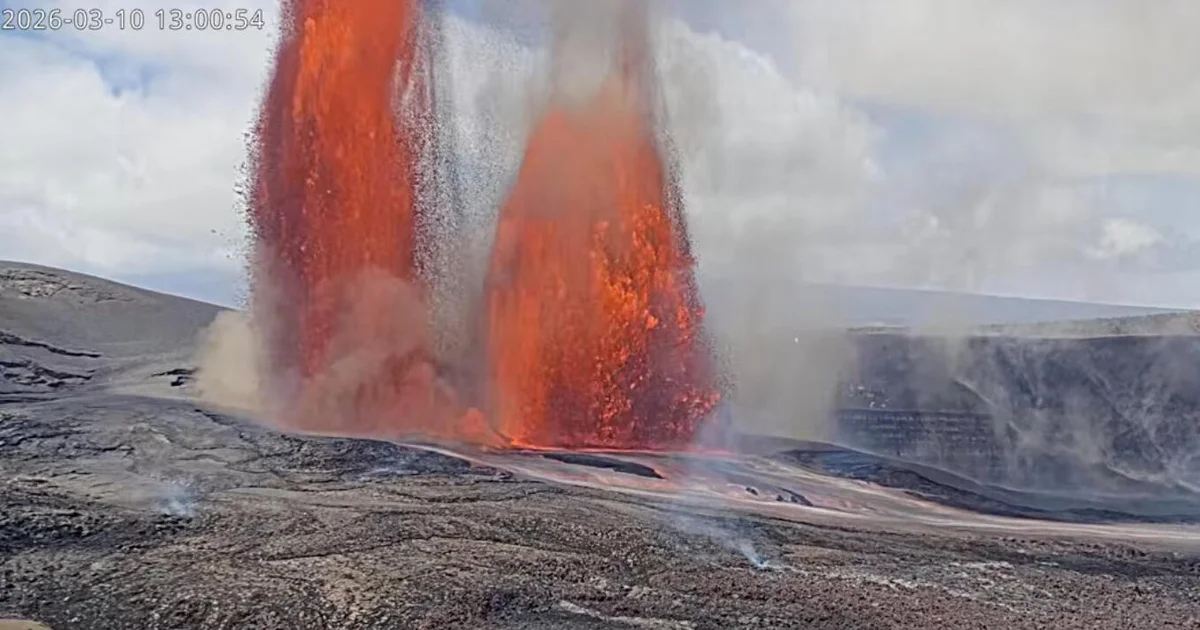
The latest lava fountaining episode of an erupting Hawaii volcano reached 1,000 feet high Tuesday, prompting temporary closures at a national park and part of an important highway because of falling glassy volcanic fragments, including ash.
Kilaueaon Hawaii’s Big Island, has been dazzling residents and visitors for more than year with an on-and-off eruption that periodically sends fountains of lava soaring into the sky.
The fountaining that began Tuesday morning marked the eruption’s 43rd episode since it began in December 2024. A livestream showed two fountains of bright-red lava and smoke. It’s unclear how long the fountaining will last. Some episodes have lasted a few days and others a few hours.
AP 

One eruption in November dispensed just under 11 million cubic yards of lava from inside the volcano — enough lava to fill an Olympic-sized swimming pool every 5 1/2 seconds.
Like other times, the molten rock was confined within Kilauea’s summit crater inside Hawaii Volcanoes National Park and hasn’t threatened homes or buildings.
But the lava fountains were creating trouble for neighboring communities and a highway where the volcanic fragments and ash, known as tephra, was falling. The tephra prompted temporary closures at the national park around the summit and a partial closure of Highway 11, an important route around the island, on either side of the park.
Hawaii County officials also opened a shelter at a district gymnasium for residents and tourists impacted by the road closure or falling tephra. There were no people using the shelter soon after it opened, said Tom Callis, a county spokesperson.
The National Weather Service issued an ashfall warning.
“More than 1/4 inch accumulation of ash is expected over Hawaii Volcanoes Nat’l Park extending to southeast and southwest,” the service wrote alongside a map showing affected locations.
Volcanic tephra can irritate eyes, skin and the respiratory system, according to county officials. Tephra also can clog and cause other problems with water catchment collection systems, which are common in some parts of the Big Island, officials said.
Ash fell so heavily during a previous fountaining episode that some communities needed help from county civil defense workers to clean up ash that coated their homes, Callis said.
Kilauea is one of the world’s most active volcanoes