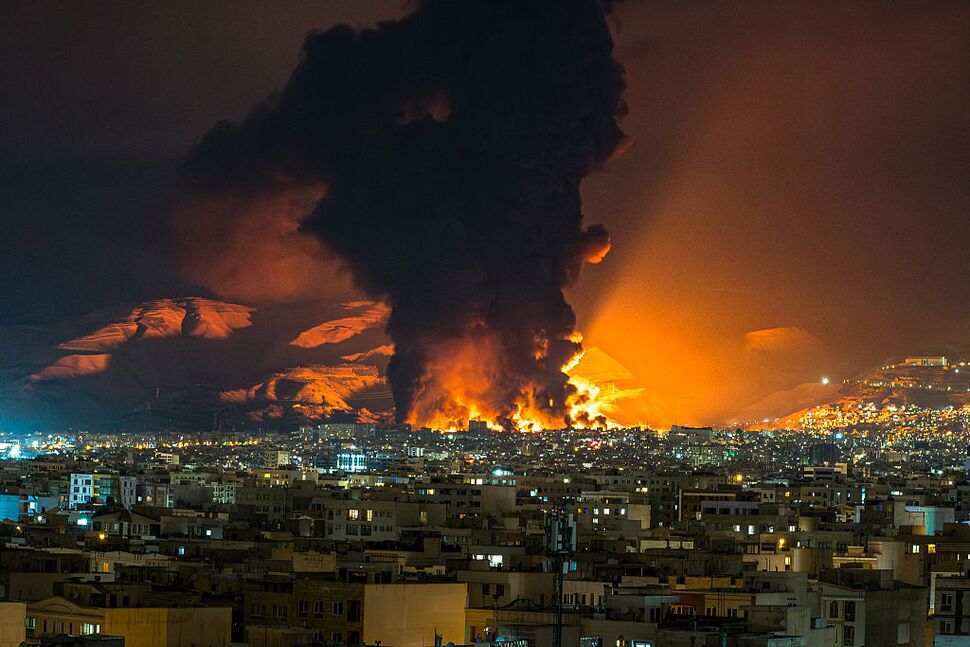
News coverage of the U.S. war against Iran can feel overwhelming – a tidal wave of information and analysis so vast it’s tempting to just abandon the effort to stay up to date.
But don’t give up on understanding what may be President Donald Trump’s most consequential second-term decision.
Here at Decision Points, we’re watching the news closely and have some must-read recommendations that go beyond the basic “Yep, still bombing” developments. We found these recent pieces interesting and thought-provoking:

Sign Up for U.S. News Decision Points
Your trusted source for breaking down the latest news from Washington and beyond, delivered weekdays.
By clicking “Sign Up”, you will receive the latest updates, including emails, from U.S. News & World Report and our trusted partners and sponsors, and you agree to our Terms and Conditions & Privacy Policy.
Iran Conflict Draws a Surprising Parallel – It’s Not Iraq
There are superficial similarities between the Iran and Iraq conflicts, like the invocation of weapons of mass destruction as a reason to attack. But to point out just the most obvious difference, the United States has not poured hundreds of thousands of soldiers into Iran.
The New York Times made the case on Sunday that the conflict in Iran today might most resemble Russia’s expanded invasion of Ukraine in 2022 – at least from the standpoint of the official rhetoric.
For instance: Trump adherents (though not the president himself) refusing to say the United States is at “war,” much like Russian President Vladimir Putin insisting that he had ordered a “special military operation” in Ukraine, not a war.
The AI War
From The Wall Street Journal, we got a great look over the weekend at how the U.S. and Israel have harnessed artificial intelligence to manage nearly every aspect of the conflict, from gathering intelligence to picking targets and the weapons to hit them.
The piece does a nice job of connecting AI to one of the most interesting tidbits about the planning for the war, namely intelligence gathered from hacked traffic cameras in Tehran.
“Before Israeli jet fighters launched ballistic missiles that killed Iran’s Supreme Leader Ali Khamenei at his residence a week ago, launching the current regional war, Israeli intelligence services had for years been monitoring hacked Tehran traffic cameras and eavesdropping on senior officials’ communications – increasingly relying on AI to sift through a flood of intercepts,” the Journal reported.
The Uneven Costs of War
A number of pieces have detailed an asymmetry that is defining the war: The relatively low costs of Tehran’s Shahed drones vs. the much, much higher price tag on the weapons being used to shoot them down or target Iran.
CNBC reports that public estimates put an individual Shahed drone at somewhere between $20,000 and $50,000. The ballistic and cruise missiles raining down on Iran, in contrast, can run in the millions of dollars each.
Air defense systems used to shoot down Shahed drones can run between $3 million and $12 million per interceptor, U.S. Department of Defense budget documents show. Nations have also experimented with cheaper defense options like mass-produced interceptors, fighter jet fire and electronic weapons targeting the drone’s GPS.
It raises the question of how sustainable a sustained war is.
The one-way attack drones, also used by Russia in the war against Ukraine, have a relatively light payload but can be used to exhaust air defense systems ahead of more damaging future attacks. They have a range of up to 1,200 miles.
While the U.S. and its allies have shot down most Shaheds, the CNBC piece flags a United Arab Emirates Ministry of Defense statistic: “Out of 941 Iranian drones detected since the start of the Iran war, 65 fell within its territory, damaging ports, airports, hotels and data centers.”
The Ground Forces Question
Trump and senior aides have refused to rule out sending American ground troops into Iran. That’s not especially notable: Commanders in chief generally balk at publicly ruling out options on the battlefield.
But what would that look like in practice? The U.S. does not have large ground forces in the Middle East. As a result, we can fairly safely rule out a massive invasion like Iraq in 2003 or the sizable deployment to Afghanistan in 2001.
NBC News reported late last week that Trump “has privately expressed serious interest in deploying U.S. troops on the ground inside of Iran.”
His private comments “have not focused on a large-scale ground invasion of Iran, but rather on the idea of a small contingent of U.S. troops that would be used for specific strategic purposes.” He has not made a decision, NBC said.
One possible goal: Securing Iran’s nuclear program, notably its stockpiles of enriched uranium.
NBC quoted Behnam Ben Taleblu, the Iran program senior director at the Washington, D.C.-based think tank Foundation for Defense of Democracies, as saying that might be imperative in case the regime in Tehran collapses.
“You don’t want (Iran) to become a failed state nuclear bazaar,” Taleblu told NBC.