


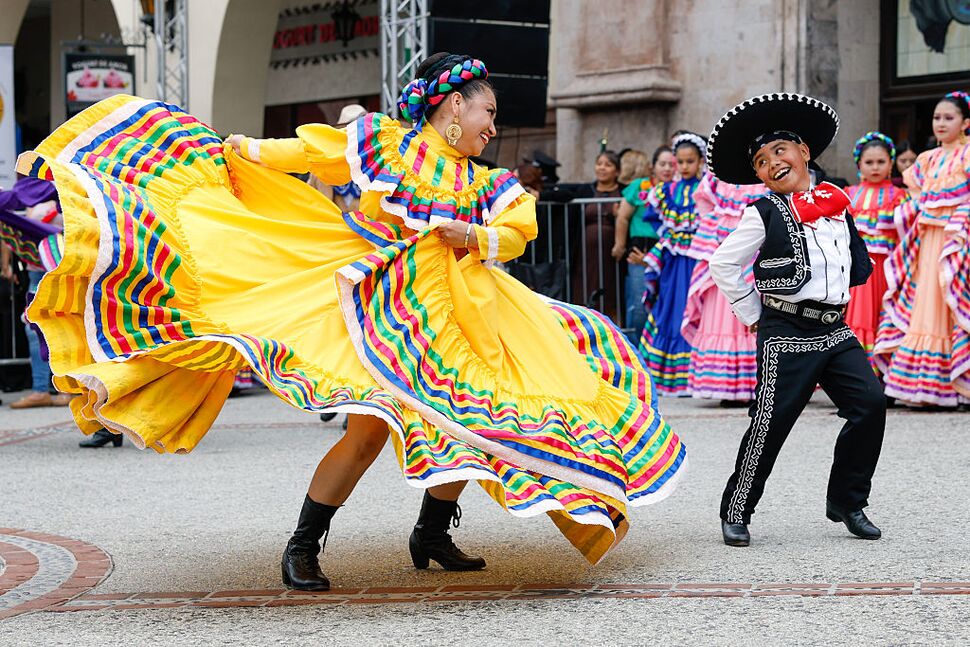
For many Americans, Cinco de Mayo is the one day each year to openly celebrate Mexican culture.
Restaurants in Chicago are offering specialslike discounts on margaritas and duck mole tacos.
But Cinco de Mayo’s origin and significance is more nuanced than tacos and tequila, and its meaning has evolved over time. Translated from Spanish, Cinco de Mayo, of course, literally means the “fifth of May.” And, perhaps counterintuitively, the holiday is more widely observed in the United States, than it is in Mexico.


Sign Up for U.S. News Decision Points
Your trusted source for breaking down the latest news from Washington and beyond, delivered weekdays.
By clicking “Sign Up”, you will receive the latest updates, including emails, from U.S. News & World Report and our trusted partners and sponsors, and you agree to our Terms and Conditions & Privacy Policy.
Here’s a brief look at some of its history:
What Is Cinco de Mayo?
The holiday marks Mexico’s victory in the Battle of Puebla on May 5, 1862. The unexpected win came when troops repelled better-armed French forces, who invaded Mexico after the country’s leaders – fresh from their own civil war – declared that they were suspending payments of all foreign debts. Since the 1860s, the people of Puebla have celebrated the anniversary of the triumph.
Contrary to popular belief, Cinco de Mayo is different from Mexican Independence Day. That holiday, on Sept. 16, commemorates the start of Mexico’s fight for independence from Spain a half century earlier in 1810.
“It was an unexpected and meaningful victory, especially as a moment of resistance, but it did not define the nation in the same way independence did,” Sehila Mota Casper, executive director and co-founder of Latinos in Heritage Conservation was quoted by History.com as saying.
So Why Is Cinco de Mayo Celebrated?
Although the day began as a remembrance of a Mexican military victory, the celebrations quickly spread to America, where the underdog story resonated with the immigrant community. Just a year after the battle and as the Civil War was still raging, the fledgling city of Los Angeles and the better-established port of San Francisco held Cinco de Mayo parades to encourage democracy. It has been celebrated annually in California.
The holiday became more prevalent and its significance shifted as Mexican Americans migrated to America. During the Civil Rights Era in the 1960s, activists invoked it to elevate the contributions of Mexican Americans across the country.
In the 1980s, U.S. corporate interests commercialized Cinco de Mayo, promoting businesses and products culturally – or, more frequently, stereotypically – associated with Mexico. Paradoxically, that has led to a greater observance of the day in the U.S. than in Mexico, though Cinco de Mayo is not recognized as a federal holiday in either country.
Today, many in the U.S. honor the day with parades, parties, music and dancing. Celebrations in Mexico are usually contained to Puebla, where the original battle was fought, and the day is used to educate people on the notable national historical event.