


In September of 2024, Hurricane Helene pummeled the mountains of North Carolina, causing massive floods that uprooted trees and swept away entire homes. Remote communities were cut off from relief efforts after the storm damaged bridges and roads.
But an unanticipated element caused chaos and confusion in the disaster’s aftermath: the arrival of white nationalists, militias, conspiracy theorists and far-right groups. Some of them were armed, straining local law enforcement.
These outside groups often don’t coordinate with local authorities first, adding to the chaos. White nationalists from a group called Patriot Front came to deliver food and supplies and clear debris. They then posted videos and photos on social media of themselves helping out.
But as 60 Minutes reported, a big part of why they are there is to use these disasters as an opportunity to gain followers on the ground and online.
“Their purpose really was to take videos of themselves doing these good works so that they could present themselves online as do-gooders — clean-cut people who are just trying to help,” Stahl said.
“They’re looking for eyeballs… you would think just what they want you to think, which is that the main purpose they are there is to help, when in fact they’re white supremacists. And they’re there to proselytize.”
60 Minutes found that this is a common strategy for white nationalists and other far-right groups in the wake of natural disasters.
John Kelly is the head of the data analytics firm Graphika, which studies how content spreads online.
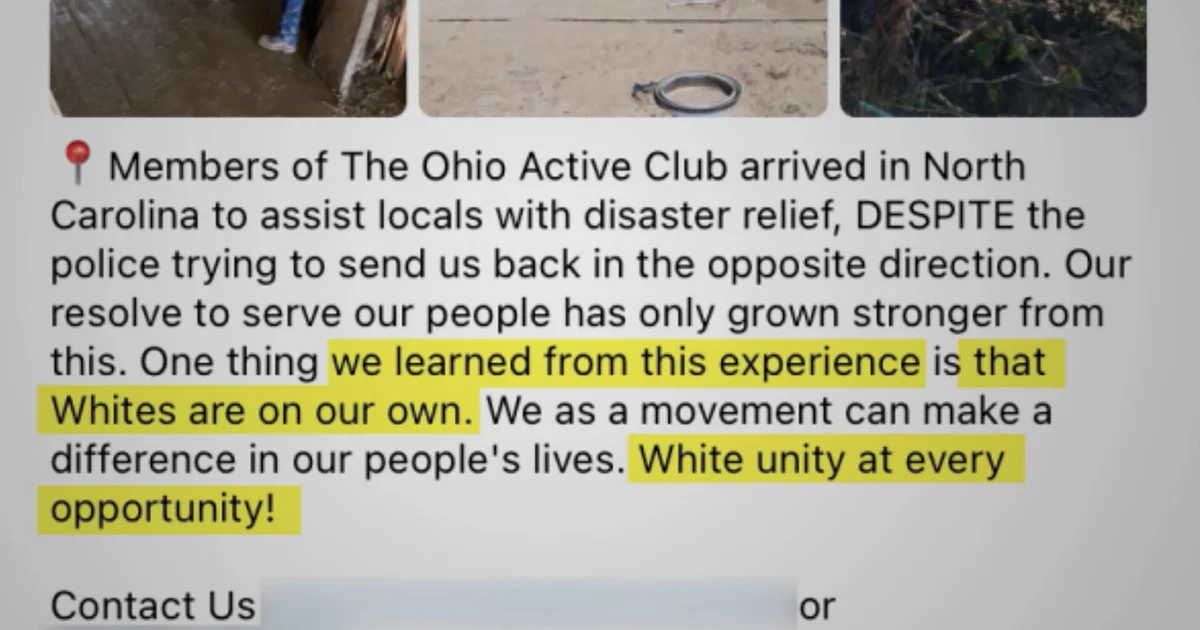
Kelly showed Stahl a post by a chapter of the self-described white nationalist group Active Club. In the post, men, with their faces blurred to hide their identity, are hacking and clearing tree branches in the aftermath of Hurricane Helene in North Carolina.
“But at the bottom [of the post]you see their message,” Stahl said.
“‘We have learned from this experience that whites are on our own,” the caption stated. “White unity at every opportunity.”
“There are very few things that bring the public’s attention to focus on one thing in unison. And natural disasters is one of those,” Kelly told Stahl in an interview.
“They’ve kind of decided to leave the more triggering iconography in the closet and try to appeal to a more mainstream audience…. not to do things that turn people off, the way that marching around with swastikas would turn people off.”
Many of these posts are accompanied by misinformation or disinformation, often saying the government didn’t do a good job in the rescue.
Kelly told Stahl that conspiracy theories can be a powerful tool for far-right and hate groups to find new audiences.
“Conspiracy theories are very, very popular,” Kelly said. “And so they can pick this stuff up… that may resonate with a larger audience, to help build their following.”
But it’s not just white nationalist groups that are exploiting social media feeds in times of crisis. China, Russia, and Iran have also spread messages that align with their propaganda goals to influence Americans on social media during these disasters.
Graphika’s Kelly told Stahl that China has invested billions to build networks of accounts that can create content or amplify existing content posted by others that suit their agenda.
“You have thousands of fake accounts, personas, that seed or generate or post content… and then there’s a second wave of fake accounts that come along and amplify that content, try and boost it,” Kelly said.
“Some of that content is then later engaged with… by the official, you know, ambassadors and state media and things like that. It’s a very sophisticated operation.”
China doesn’t need to create its own content in some cases: it can amplify divisive, anti-government messages created by Americans.
“They sometimes take an existing message from an American… and they blow it up and disseminate it as widely as they can as an example of how our system doesn’t work. That’s always their main message,” Stahl told 60 Minutes Overtime.
Kelly said that right wing-groups, white nationalists, Russia and China are often pushing the same narrative: “None of the parties… are in favor of a strong and highly functional federal government in the United States, right? They all benefit from having that in bad shape and getting worse.”
Kelly showed 60 Minutes an example of a post made by a user understood to be American that was later amplified by an account linked to China’s influence operations.
In the X post, the influencer shows video from two different locations placed side-by-side: destruction after Hurricane Helene in Asheville, North Carolina, and then an idyllic street scene in Kyiv, Ukraine.
The caption reads: “Hurricane Helene victims received a one-time payment of $750, while our tax dollars continue to fund Ukrainian pensions. Remember this when you vote in November.”
“The implication being that we don’t have enough money to fix what’s going on in North Carolina because we’ve sent it all to Ukraine,” Kelly told Stahl.
Kelly then showed Stahl a nearly identical post on X by an account he said was linked to the Chinese government’s influence operation.
“They don’t have to create from whole cloth a new message, a new image. What they can do is look at what we’re doing in our own discourse and simply pick the part that helps them advance their agenda and boost it,” Kelly explained.
Another form of manipulation in the wake of natural disasters is generative AI images and videos created by online influencers.
Kelly showed Stahl an image that went viral during Hurricane Helene: a girl in a boat that appears to be crying, holding a puppy, surrounded by floodwater in what is supposed to be North Carolina. It’s a completely fake, AI-generated image.
Other AI images and videos will exaggerate the devastation of a natural disaster, making them look far worse than they actually were.
Another viral AI image came out of the Los Angeles wildfires last year that shows the famous Hollywood sign consumed by flames.
“You might think it’s real at first. But it almost doesn’t matter whether you think it’s real. Once you’ve encountered it, it’s had its emotional impact, it’s gotten your attention,” Kelly told Stahl.
“Whether or not you think it’s real or not, it serves the purpose.”
The video above was produced by Will Croxton. It was edited by Nelson Ryland.