


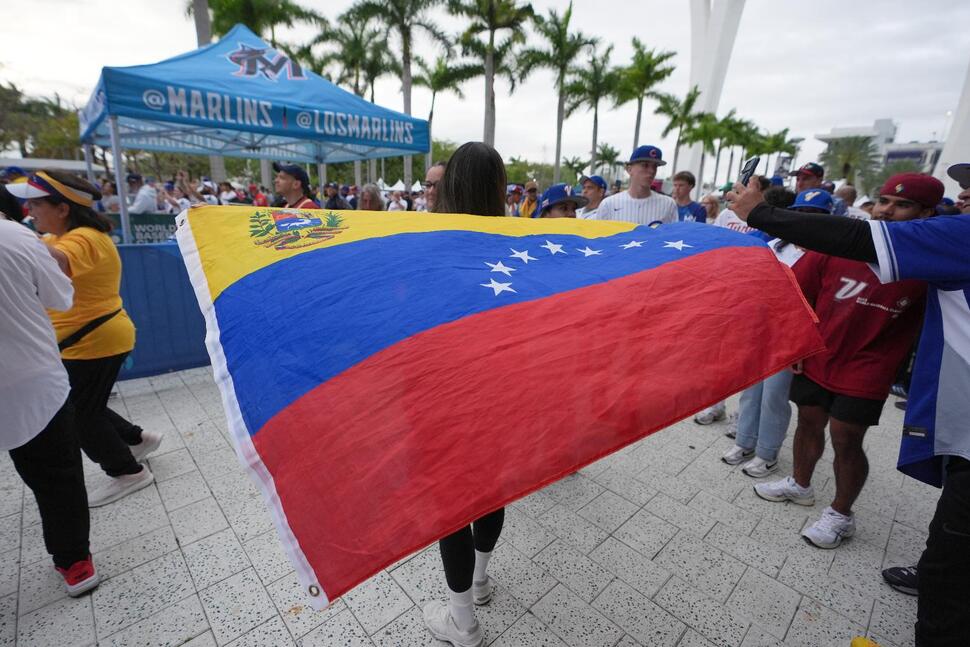
MIAMI (AP) — Pablo Cuerta was watching batting practice before the U.S.-Venezuela championship game at the World Baseball Classic, when the realization hit him.
There were thousands of Venezuelans at the game in Miami on Tuesday night. There were thousands of Americans at the game as well. And some — like Cuerta, a Venezuelan-American — got to basically cheer for both sides. His shirt: a Venezuela jersey. His hat: the Venezuelan team cap. And draped over his shoulders, tied across his chest: the U.S. flag.
“I was born in Venezuela, and this country gave me the opportunity to come, to be a citizen,” said Cuerta, who drove from his home near Orlando for the final days of the tournament in Miami. “I appreciate both countries, you know. One, I was born in Venezuela. And two, this one gave me everything I’ve got. So, I’m proud to have both countries.”
As they have throughout the tournament, Venezuelan fans showed up in a big way to see their team in Miami; all seven of their team’s games at the WBC were played inside the Miami Marlins’ ballpark. From the outset, these unusual political times — Venezuela’s deposed leader Nicolás Maduro is currently jailed in New York and facing drug trafficking charges, after American forces executed a military operation in Venezuela earlier this year to capture him — have not had much of an effect on the joy Venezuelans have for this event, even with it being played on U.S. soil.
When both flags were brought to home plate as part of the pregame ceremony, the building simply roared.
“Super emotional with Venezuela and being here for the championship game. This is beyond sport. It is well deserved,” said Argenis Masiaf, a Miami resident who had the Venezuelan flag painted on his face for the game. “We have lived through many difficult things inside our country. This is the moment for Venezuela to accomplish something so special and memorable.”
Venezuela’s players and coaches have tried to avoid all political talk. They’ve said in many ways that they’re at the WBC to play baseball, and manager Omar López reiterated that sentiment before the final.
López did, however, acknowledge how much getting to the title game — and getting to play the U.S. — means to Venezuela, a baseball-mad South American country of about 32 million people. He said he expected “the whole country” to be watching.
“Tonight, everyone is going to be together,” López said. “The whole country is going to be paralyzed to watch the game, and together we are going to have better generations for our country, united with no color, political colors or ideology. We have people with double citizenship. This is the only way.
“We have sports. Baseball is one of the best tools or ways to educate a country. Discipline, dedication, determination. If you don’t believe in that, you should start believing. You have to believe in that. Thirty human beings today are going to unite Venezuela through a baseball game.”
Josh Rojas, a student from Utah, was outside the stadium three hours before first pitch Tuesday, soaking up the atmosphere. He had a “V” for Venezuela painted on both sides of his face, proudly carrying a flag as well.
“Me and my family knew Venezuela would make a good run, so we came,” Rojas said. “Man, it’s meant everything. I’m a Latino American, and it’s just making me more proud of my Latin heritage. It’s just awesome to see a whole country, a whole community come together to support this country through baseball.”
Jaci Douglas said she “hates” baseball. The medical student from Pennsylvania viewed Tuesday’s game as something well beyond sport.
“My mother is Venezuelan. I have in-laws who are Venezuelans,” Douglas said. “They’re all here tonight and they told me that if I miss this, I’d regret it. … It’s an event.”
Cuerta said he heard everyone in Venezuela — the country he left eight years ago — was watching.
“It’s going to be a lot of parties, everywhere,” Cuerta said. “Every space, every restaurant, every street, everywhere. Everybody’s watching. When we’re born, that’s the first thing your parents do. Before they send you to school, they send you to the field. That’s what they mean when they say it’s in our blood.”
Copyright 2026 The Associated Press. All rights reserved. This material may not be published, broadcast, rewritten or redistributed.
Photos You Should See – March 2026

