


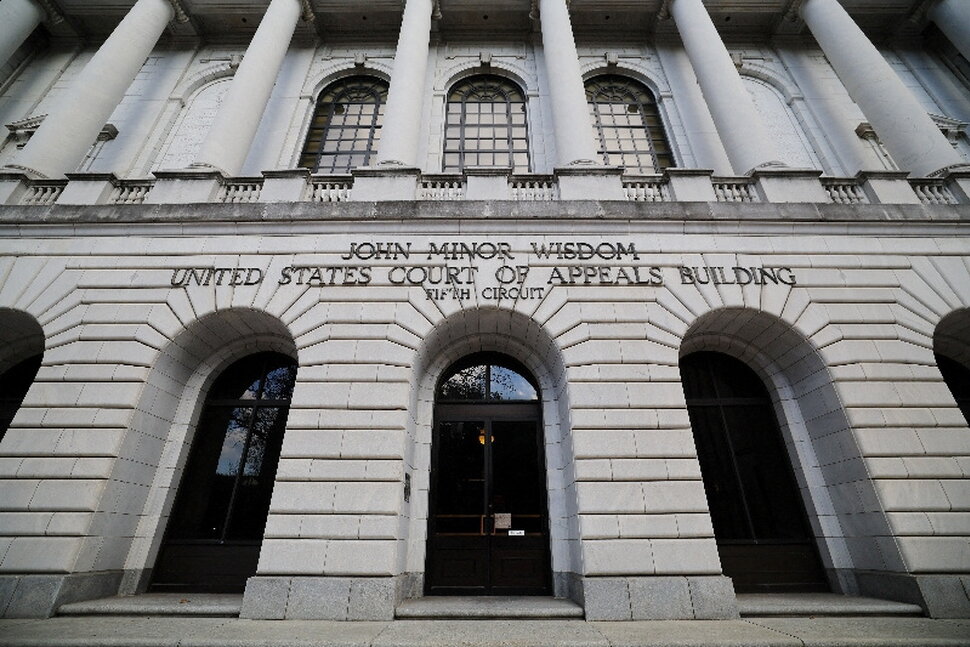
May 17 (Reuters) – The U.S. Supreme Court’s decision to preserve mail access to the abortion pill mifepristone marked the latest time that the nation’s top judicial body has reined in an even more right-leaning appeals court, one nestled in the American South.
The Supreme Court on Thursday put on hold a May 1 ruling by the New Orleans-based 5th U.S. Circuit Court of Appeals that had blocked – albeit briefly – mifepristone from being prescribed through telemedicine and dispensed by mail. Access to mifepristone has been a flashpoint in the U.S. culture wars since the Supreme Court in 2022 allowed states to ban abortion.
The Supreme Court, with its 6-3 conservative majority, has moved U.S. law dramatically rightward in recent years. But the 5th Circuit’s rulings in several key cases have gone beyond what even this conservative Supreme Court will permit, including twice on the abortion pill.
‘PUSH THE JURISPRUDENTIAL ENVELOPE’
“The 5th Circuit has been willing in the past decade to push the jurisprudential envelope on social issues pretty heavily towards the political conservative side,” said law professor Sally Brown Richardson of Tulane University Law School in New Orleans.
That trend, Richardson said, has been reflected in the sheer number of appeals of 5th Circuit rulings that the Supreme Court has elected to hear.
The 5th Circuit is one of the 12 regional U.S. appeals courts, all one step below the Supreme Court. It hears cases from Louisiana, Texas and Mississippi, three deeply conservative Southern states. Twelve of its 17 judges were appointed by Republican presidents, including six by Donald Trump.
The 5th Circuit has become a favored destination for conservatives, including activists and Republican politicians, seeking to advance their agenda. It has issued major decisions on issues such as abortion, gun rights and religious liberty, while handing policy setbacks to Trump’s Democratic predecessor Joe Biden including on immigration policies.
In its Thursday action halting the 5th Circuit’s ruling on the abortion pill while a lawsuit by Republican-led Louisiana seeking to curtail access to the medication proceeds, the Supreme Court issued a brief and unsigned order that did not explain its reasoning. Just two of its six conservative justices, Clarence Thomas and Samuel Alito, publicly dissented.
The 5th Circuit’s rulings often are appealed to the Supreme Court by liberal interests. Appeals of 5th Circuit rulings have made up a disproportionate number of cases heard by the Supreme Court in recent years.
During its current nine-month 2025-2026 term, the Supreme Court has heard 10 cases arising from the 5th Circuit, more than from any of the other federal appeals courts.
The same was true of its 2024-2025 term, with 13 cases from the 5th Circuit. The Supreme Court reversed the 5th Circuit in 10 of those cases, according to data collected by the SCOTUSblog website.
“You have several examples of cases where the Supreme Court uses the 5th Circuit to pass itself off as maybe more balanced or moderate,” University of Oklahoma law professor Michael Smith said.
In four cases decided so far this term, the Supreme Court has upheld 5th Circuit rulings in only one of them. Two important cases from the 5th Circuit that are expected to be decided by the Supreme Court by the end of next month include appeals of its decisions that declared unconstitutional a federal ban on users of illegal drugs including marijuana from owning guns and that placed limits on mail-in ballots.
In the current abortion-pill case, the 5th Circuit had blocked a 2023 Biden-era U.S. Food and Drug Administration regulation that has allowed the drug to be prescribed through telemedicine and dispensed by mail.
Trump-appointed U.S. Circuit Judge Kyle Duncan wrote in that decision that the FDA’s policy likely lacked a scientific basis and undermined Louisiana’s abortion ban implemented after the Supreme Court overturned its 1973 Roe v. Wade precedent that had legalized the procedure nationwide.
“Once lost, that sovereign prerogative of protecting unborn life cannot be regained by legal remedy,” Duncan wrote.
Manufacturers of mifepristone appealed to the Supreme Court on an emergency basis, and it swiftly paused the 5th Circuit ruling.
In 2024, the Supreme Court also overturned, in a unanimous decision, a 5th Circuit ruling that had curtailed access to mifepristone, finding that the anti-abortion groups and doctors who brought a legal challenge to the pill lacked the necessary legal standing to pursue the case.
In 2023, the 5th Circuit declared unconstitutional a federal law that criminalizes firearm ownership for people under domestic violence restraining orders. The following year, the Supreme Court reversed that decision, which had been written by Trump-appointed U.S. Circuit Judge Cory Wilson.
The Supreme Court in 2024 reversed another 5th Circuit ruling that Wilson authored that had declared the U.S. Consumer Financial Protection Bureau’s funding mechanism unconstitutional.
‘DISPARAGED AND DESTROYED’
More major cases arising from the 5th Circuit appear headed to the Supreme Court.
The American Civil Liberties Union has vowed to appeal the 5th Circuit’s April ruling that upheld a Texas law requiring public schools to display the biblical Ten Commandments in classrooms in a case testing the principle of separation of church and state.
That 9-7 decision was also written by Duncan and joined by all of his fellow Trump appointees on the 5th Circuit, including U.S. Circuit Judges James Ho and Andrew Oldham. All three are considered possible Supreme Court nominees if Trump gets to make another appointment.
In a speech in April, Ho defended judges who embrace originalism, a legal philosophy favored by conservatives that seeks to interpret the U.S. Constitution based on how its text was understood at the time of its drafting.
Ho said originalist judges are “disparaged and destroyed” when they issue rulings disfavored by “cultural elites.” Ho also said “that it is too often, for too many of us, easier to do what is popular than to do what is right.”
“Judges must not be afraid of being booed,” Ho said.
(Reporting by Nate Raymond in Boston; Editing by David Bario, Amy Stevens and Will Dunham)
Copyright 2026 Thomson Reuters.