


By Ananda Teresia and Bernadette Christina
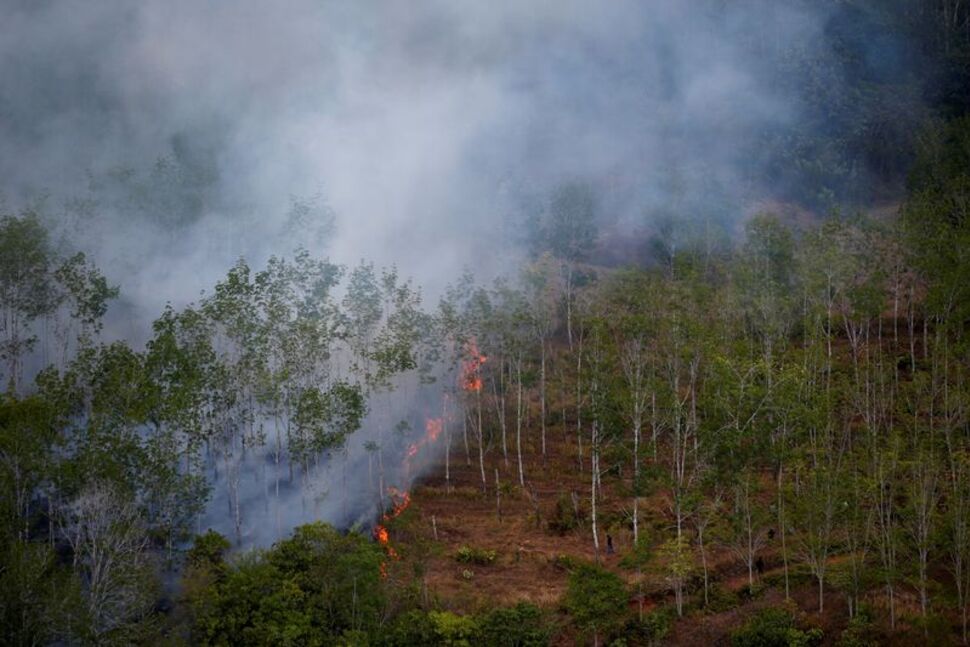
JAKARTA, March 31 (Reuters) – Forest loss in Indonesia surged by 66% in 2025, hitting its highest rate in eight years as a result of weak environmental protections and an ambitious food and energy self-sufficiency drive, an environmental group said on Tuesday.
The archipelago, made up of thousands of islands, has some of the world’s thickest forests and most biodiverse regions, but it leans heavily on mining and palm plantations to support its $1.4 trillion economy, which is the biggest in Southeast Asia.
Auriga Nusantara, a think tank focusing on forestry and biodiversity in Indonesia, used high-quality satellite images combined with on-the-ground visits to 49,000 hectares of forest across sixteen provinces.
It found that a total of 433,751 hectares (4,338 square kilometres) of forest was cleared last year, a dramatic jump from 261,575 hectares in 2024, said Timer Manurung, Auriga’s chairman.
“The surge in deforestation in 2025 is truly distressing, taking Indonesia back to a time when… (it) was at its highest,” he said, noting that the highest rate of deforestation prior to 2025 was in 2016, when more than a million hectares were cleared.
FOOD AND ENERGY SECURITY GOALS DRIVING FOREST LOSS
Manurung identified President Prabowo Subianto’s food security programme as one of the main contributing factors. The programme aims to boost domestic output of key agricultural products like rice and reduce Indonesia’s dependence on imports.
The government allocated 20.6 million hectares of forest areas for food-, energy- and water-related programmes in 2025, 43% of which was natural forest. More than 78,000 hectares of the “food reserve forest” were cleared last year, an area the size of New York City, according to Auriga calculations.
As it cleared parts of the island of Borneo to make room for rice fields, Indonesia said last year that it had achieved self-sufficiency in rice production.
“They are gambling, they are speculating… it’s peat land and not suitable for rice,” Manurung said.
Prabowo’s bioenergy push also had a heavy impact, with areas converted to industrial forest to produce biomass and another 37,910 hectares cleared inside Indonesia’s sprawling oil palm concessions.
An additional 41,162 hectares of forest were converted into coal, gold, and nickel concessions, Manurung said.
“The current presidency is continuing the pattern of former president Joko Widodo, which uses the so-called national strategic projects and Omnibus Law (Job Creation law) that weaken environmental protection,” he said.
Indonesia’s Forestry Ministry and a spokesperson for the president did not immediately respond to Reuters requests for comment.
BORNEO, SUMATRA AND PAPUA HIT THE HARDEST
Among Indonesia’s islands, Borneo saw forests shrink the fastest last year, with Sumatra and Papua ranking second and third. East Kalimantan, the location of Indonesia’s planned new capital, was the hardest-hit province.
Three Sumatran provinces affected by floods and landslides last year showed “dramatic increases in deforestation” with Aceh rising by 426%, North Sumatra by 281% and West Sumatra by 1,034% compared to 2024.
The government must improve regulation to ensure that natural forest is better protected, and should also expand conservation areas outside forest estates, Manurung said.
“This serves as a warning that must prompt corrective action, particularly as the upcoming dry season brought on by El Nino is likely to result in a high risk of forest and land fires,” he said.
(Reporting by Ananda Teresia and Bernadette Christina; Editing by David Stanway)
Copyright 2026 Thomson Reuters.