


LOS ANGELES (AP) — After thousands of Iranian demonstrators were killed in a January crackdown, Shima Razavi Gacek wanted to keep alive her family’s favorite springtime holiday traditions but didn’t feel like throwing her annual house party with a roaring bonfire ahead of Nowruz — the Persian New Year.
Instead, the 46-year-old Los Angeles resident organized a vigil Tuesday night at a local park, where the photos of slain protesters were displayed and dozens of Iranian Americans lit candles and took turns hopping over tea lights in a version of a fire-jumping tradition known as Chaharshanbe Suri.
“It is such a beautiful and joyous time of year,” said Razavi Gacek, who has lived in the United States since she was 5. “This year, it’s not, but we need our community more than ever.”
Iranian Americans are marking Nowruz this year with a mix of somber celebrations and the traditional flowers, music and dancing. Many communities canceled festivities following the crackdown on protesters in January, while others have organized smaller, quieter versions of the usually joyous celebration.
Nowruz means “new day” in Farsi, the language typically spoken in Iran. The holiday that coincides with the spring equinox is rooted in Zoroastrian tradition dating back millennia and is celebrated from Afghanistan to Turkey. Iranians of diverse religious faiths mark Nowruz even though the hard-line Iranian regime has at times discouraged festivities.
It is also celebrated in the United States, including in Los Angeles, which is home to nearly a third of the country’s 750,000 Iranian Americans, and in Nashville, Tennessee, with the largest Kurdish community in the nation.
Many communities have canceled planned Nowruz parties and events since Iran’s deadly crackdown on demonstrations.
In New York, a group of elderly Iranian American women called off their celebration, which they host at a suburban shopping mall 25 miles (40 kilometers) outside Manhattan.
“People are not in the mood to celebrate the New Year,” said Marjan Khalili, president of the Long Island Ladies Association. “That’s what Nowruz is — we welcome the New Year, and now we really don’t have much to welcome, you know?”
Shani Moslehi, chief executive of the Orange County Iranian American Chamber of Commerce in Southern California, said her group scratched plans for an annual party and is teaming up with a mental health clinic to provide support to community members dealing with the stress of the war and inability to communicate with family in Iran.
“Everyone I hear from is not doing well,” Moslehi said. “The dancing and singing lasted a day, and people realized just killing that one guy is not going to solve the problem.”
Some community organizations felt compelled to carry on with Nowruz traditions but have tempered them to meet the moment.
At New York University, the student-run Persian Cultural Society held a vigil with speeches and poems in place of its annual Nowruz celebration and asked attendees to dress in black rather than the festive colors normally favored during the holiday.
In Los Angeles, organizers called off an outdoor festival that typically draws thousands and instead held a concert titled “Light Always Prevails.” It featured an Iranian female vocalist who was barred from singing after the 1979 Islamic Revolution and an Iranian-American performing in Persian for the first time, said Shahab Paranj, artistic director of the Iranshahr Orchestra.
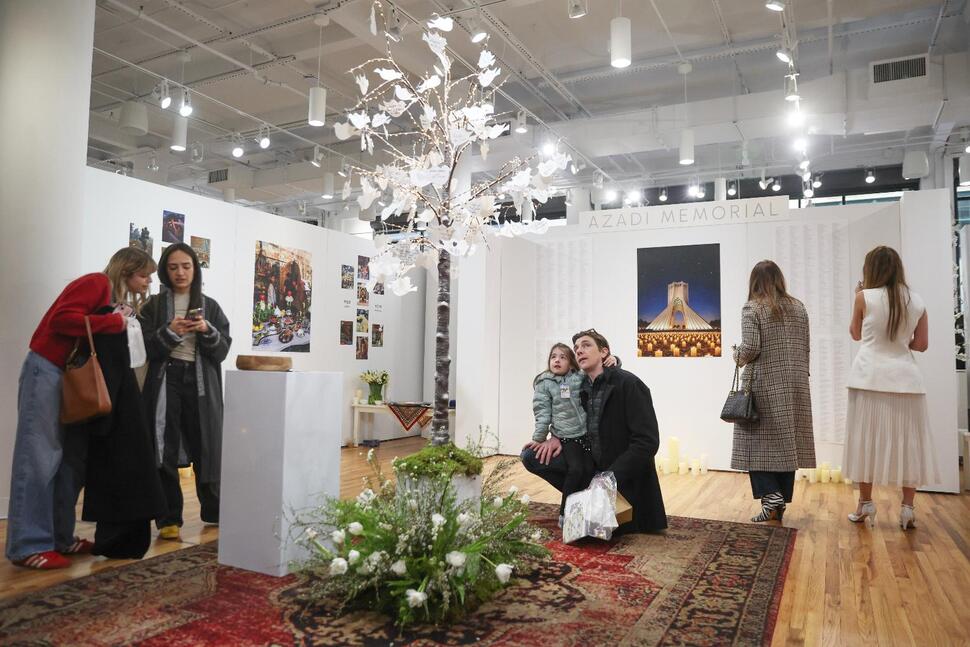
It is now more vital than ever to celebrate Nowruz in defiance of the Islamic regime, said Hedi Yousefi, who organized a Norooz Bazaar in Manhattan that showcased vendors and artists, and displayed a memorial wall listing the names of some 3,000 people killed in January.
“They want us to be quiet. They want us to shut up and don’t talk and celebrate,” she said. “But we have to talk about our culture, we have to keep our tradition alive.”
In the Nashville area, where the local Kurdish community hails from Iran, Iraq, Syria and Turkey, organizers are planning an event meant to show solidarity with people across the war-torn region.
“It’s not going to be a grief celebration or a sad celebration,” said Tabeer Taabur, president of the Tennessee Kurdish Community Council.
At the park in Los Angeles, scores of people shared dinner at picnic tables covered with white tablecloths and a display of sprouts, fruit and flowers. They took turns jumping over small fires burning in tins to mark the changing of the year.
Mojan Gabbay, 50, lit a candle at the table honoring Iranian demonstrators, then walked across the patio to hop over an aluminum pan filled with burning tree bark, and smiled. She said she doesn’t always celebrate Chaharshanbe Suri but felt moved this year to keep up the tradition for her two children.
“I wanted my kids to know where their roots are from and everything that’s going on has really touched our hearts,” Gabbay said, holding back tears. “These are your people and when you hear their pain and when you see their suffering, you feel it.”
Marcelo reported from New York. Associated Press writer Adam Geller in New York contributed.
Copyright 2026 The Associated Press. All rights reserved. This material may not be published, broadcast, rewritten or redistributed.
Photos You Should See – March 2026

