


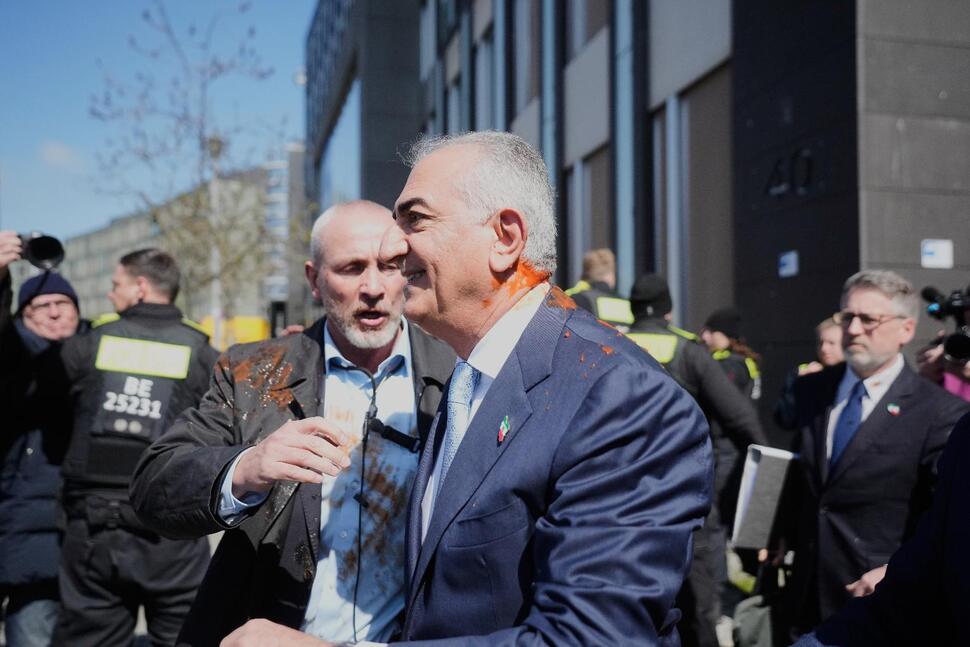
He then waved to his supporters and got into a car that drove away. The alleged perpetrator was immediately detained by police.
Pahlav, 65, is the son of Iran’s former shah, who was so widely hated that millions took to the streets in 1979 to force him from power. Nevertheless, Pahlavi is trying to position himself as a player in his country’s future, though it’s unclear how much support he has in Iran after he has been in exile for nearly 50 years.
Pahlavi, who was not invited to meet with any government representatives during his visit to Berlin, argued Thursday that the ceasefire agreement assumes the Iranian government’s behavior will change and “you’re going to deal with people who all of a sudden have become pragmatists.”
“I don’t see that happening,” he said. “I’m not saying that diplomacy should not be given a chance, but I think diplomacy has been given enough chance.”
Pahlavi is jockeying for a return to power should the Shiite theocracy fall and has supported the U.S.-Israeli military intervention in the Middle East.
Pahlavi in Berlin called on Europeans to do more to support Iranian people fighting for democracy. He claimed 19 political prisoners were executed by Iranian authorities in the past two weeks and another 20 people have been sentenced to death.
“Will the free world do something, or watch the slaughter in silence?” Pahlavi said.
Ciobanu reported from Warsaw, Poland.
Copyright 2026 The Associated Press. All rights reserved. This material may not be published, broadcast, rewritten or redistributed.
Photos You Should See – April 2026

