


Some San Francisco residents in the Outer Sunset district woke up to flashing lights and officers early Thursday morning.
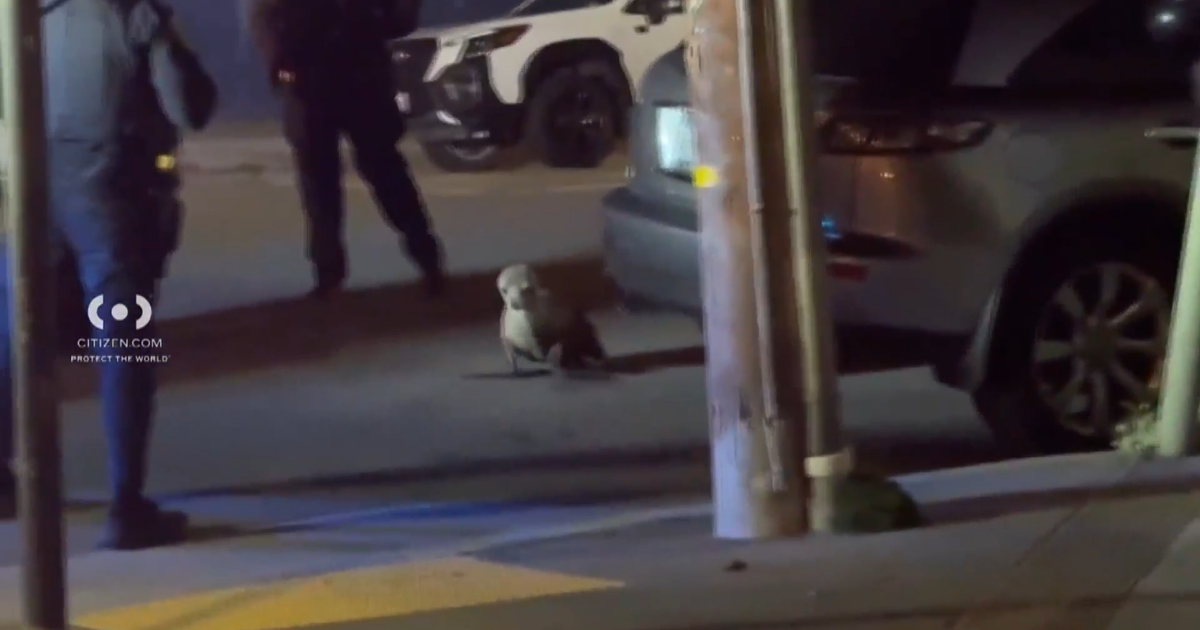
A sea lion was caught on camera, just hanging out with a bunch of officers in the area of 48th Avenue and Irving Street. It was quite a scene at the street corner as they tried to corral it.
“Wasn’t an arrest, exactly, but the police officers were trying to get a California sea lion in custody,” said Tamara Barak Aparton, a San Francisco Parks & Recreation spokesperson. “It had wandered out of the ocean and onto the city street.”
Officers and park rangers found a dog crate large enough to fit the sea lion pup into and took it to the bike storage area at a nearby ranger station until the Marine Mammal Center picked it up.
“We are all rooting for him,” Barak Aparton said.
The sea lion’s new name is Irving. The Marine Mammal Center says it doesn’t know its sex yet and whether or not Irving is sick.
Daniel Costa, a professor of ecology at UC Santa Cruz, says at first glance, it looks like a healthy seal pup.
“Sea lions are probably losing a little bit of their fear of people as they get more accustomed to us,” Costa said. “So, my first thought is that sea lion you guys saw was just a curious sea lion.”
Professor Costa has traveled the world to study sea lions. He says the California sea lion population has exploded since the Marine Mammal Protection Act was enacted in 1972. Some of them have become so friendly that he refers to them as sea dogs.
“They’re kind of like a Husky or an Irish Setter,” Costa said. “They’re very energetic. They’ll do anything for food.”
But he warns, it’s never a good idea to get too close to Irving or any other sea lion.
“They’re most likely going to run from you,” he said. “They’re more afraid of us than we are of them. However, if they’re cornered, it’s just like a dog and I’m calling them sea dogs. They will bite and they have really sharp teeth.”
Professor Costa is not ruling out domoic acid poisoning, but he says this could be a sign that sea lions have maxed out of their habitat and are exploring. The hope is that Irving will be released back into the Pacific soon.