



Western Europe saw its hottest June on record this year as temperatures skyrocketed around the world last month, with blistering heat stoking wildfires and, at times, turning deadly across the continent and the United States, according to a new report by the Copernicus Climate Change Service.
The C3S report also found that June 2026 was the second-hottest June ever recorded globally.
Much of Western Europe experienced a historic heat wave during the second half of the month, breaking both monthly and all-time temperature records in several countries, the report said.
C3S/ECMWF 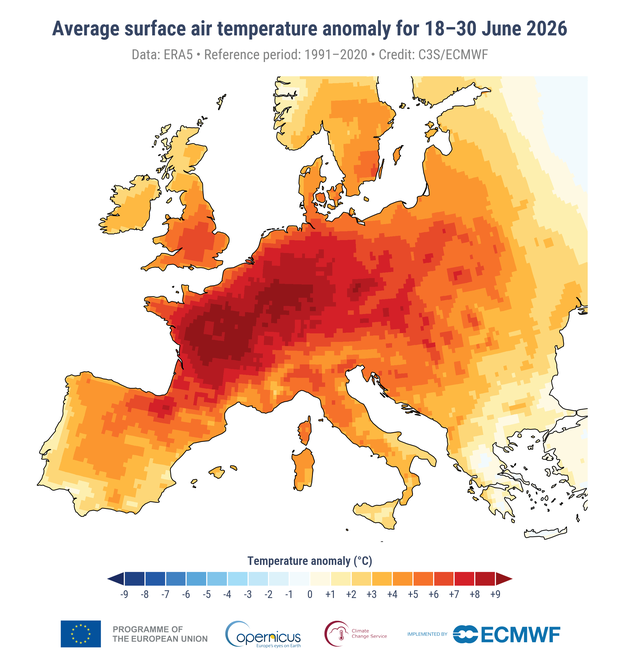

Last month’s heat emerged between an initial spell of extreme warmth that rolled through the region in May and another beginning to form in July.
“The succession of heatwaves illustrates the growing challenge posed by increasingly frequent and intense heat extremes across Europe and the globe,” the report said.
Samantha Burgess, a climate expert at the European Center for Medium-Range Weather Forecasts, said in a statement that June’s conditions “underscored how profoundly the climate is changing” and acknowledged that record temperatures on land coincided with marine heat waves spread across sections of the Mediterranean and Atlantic coasts.
“Together, these records reflect a climate system continuing to accumulate heat,” Burgess said. “The result is increasingly intense heatwaves, a persistently warm ocean, and growing risks for people, ecosystems and infrastructure across Europe and beyond.”
Drought accompanied the June heat, fueling massive wildfires in southern France that had burned through more than 11,000 acres and forced roughly 10,000 evacuations as of Monday, according to French Interior Minister Laurent Nuñez.
French Prime Minister Sébastien Lecornu previously said dozens of people had died from drowning in France over the course of a single week in June, after desperately seeking reprieve from scorching triple-digit temperatures by swimming.
ARNAUD FINISTRE /AFP via Getty Images 

As the month neared its end, the World Health Organization chief announced that Europe had reported more than 1,300 heat-related deaths since June 21. Many of them happened in France, where officials told CBS News they recorded about 1,000 excess deaths, mainly in elderly residents, due to heat exposure.
France repeatedly broke its own temperature records throughout June, its national weather service said, while the United Kingdom’s Met Office confirmed the same for the United Kingdom.
Aligned with the broader global trend, continental Europe experienced its second-highest June on record this year, according to the C3S report released early Thursday local time. Researchers found that temperatures were about 3.2 degrees Fahrenheit higher than the 1991-2020 average.
The difference was even starker in Western Europe, with the report finding that June temperatures there were nearly 5.5 degrees above average.
Sea surface temperatures remained at “exceptionally high” levels across a section of the tropical Pacific Ocean, where El Niño originates, according to the report. Known as the warmer phase of the El Niño Southern Oscillation cycle, or ENSO, El Niño is characterized by unusually warm waters that, in turn, influence weather conditions worldwide in various ways.
Forecasters have said the current El Niño could be notably intensepotentially increasing global temperatures and the risk of extreme weather in the coming months, according to the World Meteorological Organization.
The weather pattern could bring frequent and widespread flooding along both the West and East Coasts of the United States, even without the presence of storms, according to the National Oceanic and Atmospheric Administration.
In Europe, El Niño could cause warmer-than-normal autumn temperatures, with that warmth building towards spring 2027, according to the European Union’s Joint Research Centre.
People across Europe have been exposed to severe heat exceedingly often in recent years — illustrating what the scientific community generally recognizes as a consequence of human-caused climate change.
“Globally, extreme temperature events are observed to be increasing in their frequency, duration, and magnitude,” the World Health Organization said in a page on its website dedicated to heat waves.
Estimating that the number of people exposed to heat waves increased by about 125 million between 2000 and 2016, the agency said such extreme conditions can imperil health infrastructure, strain water, energy and transportation systems, and threaten food or economic stability depending on where they happen.