


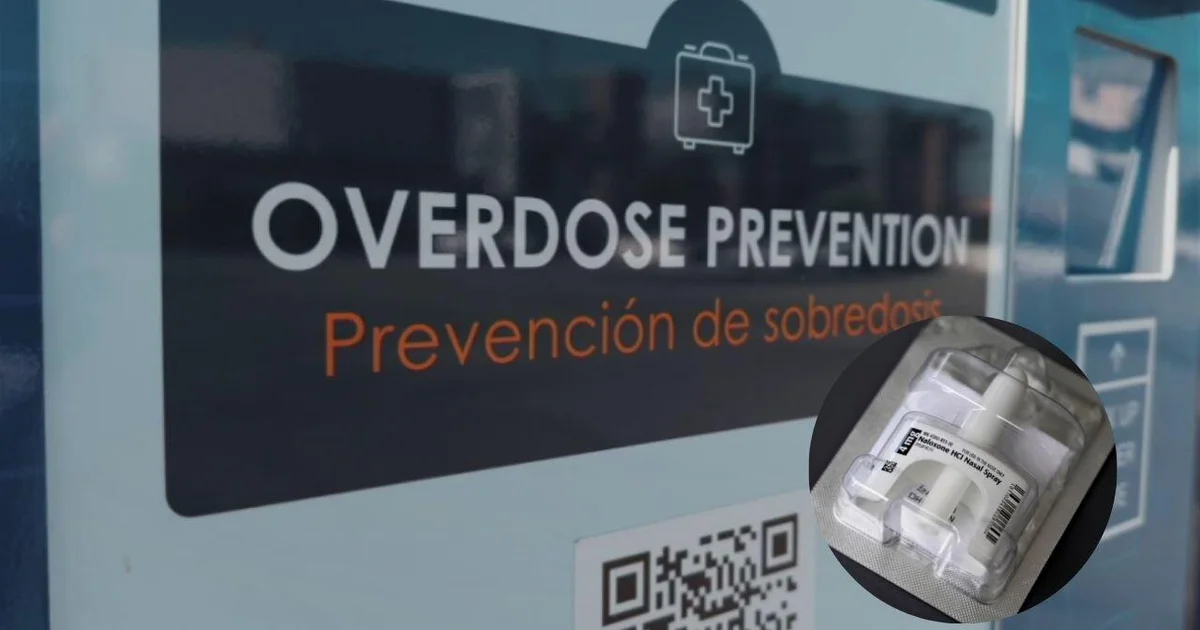
Los Angeles County spends millions of dollars each year on overdose prevention, providing free access to life-saving drugs that reverse the effects of opioids. While critics of the program say it enables addiction, proponents point to L.A. City Fire Department data, which show that naloxone has a high success rate of preventing deaths from overdose.
CBS News California Investigates obtained data from the LAFD that show 24,503 of the 25,461 patients who received naloxone doses since 2022 survived their overdose, about 96%. The L.A. County Department of Public Health says 2024 saw the most significant drop in overdose deaths, including a 37% decrease in fentanyl-related cases since 2014, when county officials began tracking the homeless mortality rate.
Naloxone is the generic name for the fast-acting medication that is used to reverse opioid overdoses, including those of heroin, fentanyl and other prescription drugs, according to the LACDPH. Narcan is one of the most commonly used brands of naloxone.
The LACDPH attributed this change to multiple factors, including an increase in overdose prevention, harm reduction and mental health and substance use treatment services. The decline was also largely driven by a 21% decrease in drug overdose mortality among people experiencing homelessness, officials said.
“Narcan reverses an overdose almost instantaneously, and it has been shown over and over and over again,” said Dr. Barbara Ferrer, director of the LACDPH.
California Department of Health Care Services data show that the entities with the most reported naloxone reversals are harm reduction programs, county health agencies and law enforcement.
California Department of Health Care Services 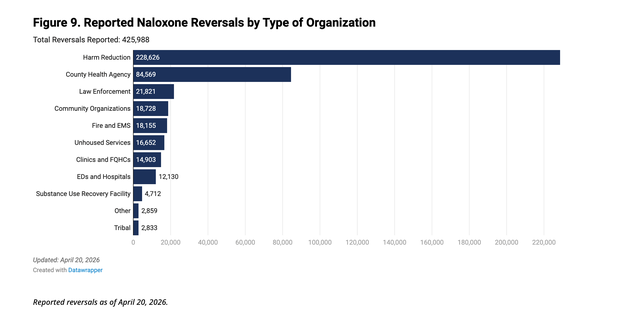

Since 2022, the state has allocated more than $130 million to the Naloxone Distribution Project, which aims to reduce overdose deaths by offering the nasal spray for free. The NDP receives general funds from the state and opioid settlement funds from the Janssen and Distributors (J&D) Settlement Agreements, according to DHCS.
In L.A. County, the Department of Public Health also offers free naloxone and fentanyl test strips through several initiatives. Select library branches across the county host clinics and officials have deployed over 50 self-service machines that distribute naloxone.
John Alle, co-founder of Safe Cities, an initiative that helps combat homelessness across L.A., is among the critics of free naloxone distribution. He owns commercial properties across L.A. County, including the building that houses the iconic Langer’s Deli across the street from MacArthur Park.
Alle believes the free distribution of Narcan enables and encourages “people to come to this specific park and other parks and have naloxone but also continue to stay here day and night using meth and fentanyl.”
Alle says the distribution of Narcan and other drug paraphernalia in harm reduction programs contributes to crime at the park. He adds that he would rather see increases in homeless shelters, drug and alcohol and mental health treatment centers away from the parks.
On Wednesday, federal agents flooded the MacArthur Park area in what First Assistant U.S. Attorney Bill Essayli called “Operation Free MacArthur Park,” a two-month-long operation.
During the operation, agents executed 25 arrest warrants and eight search warrants targeting fentanyl and methamphetamine dealers. Officials seized approximately 19 kilograms of fentanyl and arrested 18 people.
The LACDPH confirms Narcan, and other generic brands of naloxone are distributed as part of a harm reduction program in the same area as Alle’s building in MacArthur Park.
According to the LAFD, since the start of the year, there have been more than 30 incidents involving the administration of naloxone in the MacArthur Park area. In 2025, there were 135 incidents.
Ferrer disagrees, noting that “people don’t actually look forward to overdosing and being revived with Narcan. It’s not a pleasant experience.” She doesn’t believe that free access to the life-saving drug is a driving force of addiction.
“I think what it is we have to meet people where they’re at,” Ferrer said. “We have to offer them support. We have to offer them all of the tools in the toolkit.”
In January, body cam video captured an up-close look at overdose prevention in action, when L.A. Police Department Officer Jonathan Melendez and his partner were captured saving the life of a man who was lying in the middle of the road in Hollywood.
Melendez remembers the man’s nails and lips were blue, his skin was gray, and his eyes were rolled back. He quickly checked the man’s pulse and recognized the situation to be either a fentanyl or a heroin overdose.
Melendez immediately started CPR while a second police unit was on the way with naloxone. Once the drug arrived, he administered three rounds of Narcan and continued with CPR compressions until the medication took effect.
“Seeing him breathe on his own was a big relief,” Melendez said.
Michael Williams says seeing a video of Melendez saving the man’s life brings up a lot of emotions about his own past. The most impactful part of the recording is when Melendez said to the man, “Welcome back,” Williams said.
In November 2024, Williams was in the back of an ambulance when he also heard someone say, “Welcome back.” He had overdosed on a combination of crack and fentanyl.
He says he got a second chance at life, thanks to a combination of naloxone and CPR, just like the man in the video.
“He was given another life,” Williams said. “I was given another life.”
Capt. Robert Peters, from the LAPD’s Hollywood Division, commends his officers’ actions but adds that Narcan isn’t always enough, especially when a patient doesn’t have a pulse.
“The Narcan was one thing, but he provided CPR for an extended period of time and if you watch the video, you can see him, he’s giving sternum rubs, trying to keep the guy conscious,” Peters said about Melendez’s life-saving measures. “You can hear him saying, ‘Stay with me, stay with me,’ it was very impressive.”
Melendez says he’s used Narcan about three times as an officer. He had extensive CPR training during his military service. Even then, he periodically turns to a YouTube video from the American Heart Association to keep his skills fresh.
The instructional clip uses a portion of the song “Staying Alive” by the Bee Gees while showing how to administer CPR. Melendez said the song helps keep a good tempo and rhythm when giving chest compressions.
Williams got to see the effects of naloxone coupled with CPR a few weeks after he was admitted into the L.A. Mission’s recovery program. A man overdosed in the dorms, where naloxone is taped to the bunk beds, and his life was saved.
Nearly a year and a half after Williams’ overdose, he now volunteers at the L.A. Mission, working to give others a second chance in life.
“I had a purpose before, but I didn’t really understand what that purpose was until I was given a second chance or a second opportunity to really see what that’s like,” Williams said.
Melendez said you don’t have to be a first responder to be able to make a difference.
“I think that being calm in the situations, being comfortable knowing that you know what’s going on, can lead to a better success rate,” Melendez said.
Los Angeles County annual harm reduction spending
- FY 20-21: $500,000
- FY 21-22: $975, 628
- FY 22-23: $3,855,162
- FY 23-24: $4,982,153
- FY 24-25: $6,931,879
- FY 25-26 Q1-2: $3,394,079
- FY 25-26 Q3-4 Allocated: $4,745,000
Source: Los Angeles County Department of Public Health
Naloxone administration incidents in the MacArthur Park area by month for 2025-2026
- January 2025: 7
- February 2025: 2
- March 2025: 11
- April 2025: 15
- May 2025: 15
- June 2025: 10
- July 2025: 9
- August 2025: 9
- September 2025: 11
- October 2025: 16
- November 2025: 12
- December 2025: 18
- January 2026: 14
- February 2026: 7
- March 2026: 12
Source: Los Angeles City Fire Department