


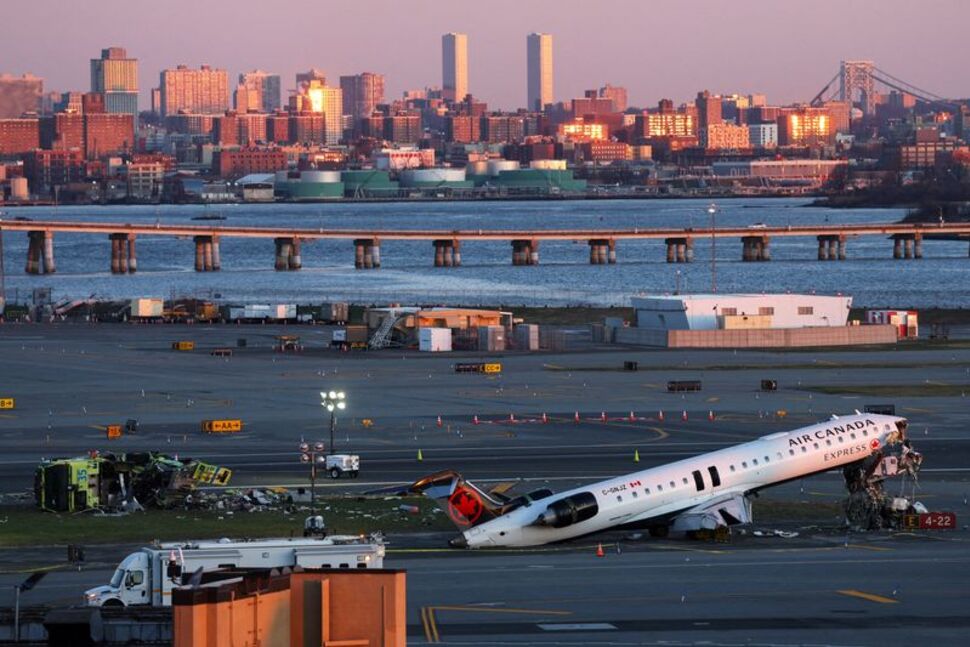
NEW YORK, March 31 (Reuters) – Air traffic controller staffing at LaGuardia airport on the night an Air Canada jet collided with a fire truck may have violated the facility’s procedures by combining roles before midnight, according to a document seen by Reuters.
The crash at the New York airport at about 11:37 p.m. ET on March 22, which killed both pilots, has revived concerns over U.S. air traffic control staffing shortages and the workload of controllers across the country.
Staffing shortages, including at the supervisor level, are placing controllers into combined roles handling local air and ground traffic more often, according to several air traffic controllers across the country.
The National Transportation Safety Board said last week that as part of its crash investigation, it was seeking information on the duties being performed by each controller.
If the controller involved in the crash was performing both air and ground duties, that would be inconsistent with the LaGuardia tower’s standard operating procedures.
An NTSB final report on a 1997 collision at LaGuardia between a private jet and a vehicle referenced new procedures being put in place afterward to ensure “local and ground positions shall not be combined prior to” midnight at the New York airport.
As of 2023, the rule remained in place, according to a LaGuardia Tower Standard Operating Procedures document seen by Reuters.
“Positions at LaGuardia Tower are not to be consolidated to one position prior to midnight local time or 90 minutes after the start of the shift, whichever is later,” said the 2023 document, which people familiar with the matter said remained current in 2026.
The Federal Aviation Administration, which runs U.S. air traffic control, did not respond to a request for comment.
CONTROLLER DUTIES NOT CLEAR
NTSB Chair Jennifer Homendy told reporters last week that two controllers were working in a glass-enclosed section of the airport’s control tower at the time of the accident.
There was a local controller managing the active runways and the immediate airspace and a controller-in-charge who was also providing pilots with departure clearance, she said.
“It is not clear who was conducting the duties of the ground controller. We have conflicting information,” she said, referring to the position that manages all aircraft and vehicle movements on the taxiways, generally excluding active runways.
Multiple current and retired controllers said they believed the local controller who was managing the active runways was also handling traffic on the ground, based on audio posted by LiveATC.net.
The NTSB did not return a request for comment.
Air crash investigations typically find accidents result from multiple contributing factors, rather than a single cause.
The controller-in-charge, who is responsible for safety of operations, signed in at 10:30 p.m. while the local controller signed on at 10:45 p.m., the NTSB’s Homendy said.
According to the LaGuardia standard operating procedures document, the local and ground positions should not have been combined until midnight at the earliest.
The document also states positions will only be consolidated as traffic warrants. If positions are consolidated, as traffic volume increases, the positions will be de-combined, the document stated.
On the night of the Air Canada crash, weather-related delays resulted in 70 commercial flights taking off or landing at the airport between 10 p.m. and 11:37 p.m., compared with an average of 53 in the same time frame since 2022, according to Cirium data.
Several controllers interviewed by Reuters described the workload that night as busy and said other controllers would typically be brought in or stay on past their normal shift end time to manage the heavier-than-scheduled number of flights.
The local and ground positions should have stayed uncombined until at least midnight, said a current New York-area controller on condition of anonymity as he was not authorized to speak with media.
“And that is not even talking about the traffic, volume and complexity that night,” he said.
(Reporting by Doyinsola Oladipo in New York; additional reporting by David Shepardson in Washington and Allison Lampert in Montreal; Editing by Jamie Freed)
Copyright 2026 Thomson Reuters.