


By Alexander Dziadosz, Aaron McNicholas and Vinaya K
CAIRO, April 2 (Reuters) – Eastern Libya’s military leader, Khalifa Haftar, has acquired what appear to be Chinese and Turkish combat drones, Reuters reporting has found, despite a long-standing U.N. embargo on supplying weapons to the divided North African country.
Commercial satellite images show at least three drones at Al Khadim airbase, located in the desert about 100 kilometres (62 miles) east of the city of Benghazi, between late April and December. Their arrival has not previously been reported.
What appeared to be ground control equipment for the aircraft was still visible this year, according to three weapons experts who reviewed the images.
Unmanned aerial vehicles (UAVs) played a significant role during a 2014-2020 civil war in Libya, when Haftar’s Libyan National Army (LNA) tried to overthrow the U.N.-recognised government in Tripoli on the grounds it was harbouring armed gangs and “terrorists”, which it denied. Countries including the United Arab Emirates (UAE), Egypt and Russia provided key backing to Haftar, according to U.N. investigators, while Turkey supported the Tripoli-based administration. China avoided taking sides.
Libya’s warring factions agreed a ceasefire in 2020, but the country remains divided between Haftar’s administration in the east and the Tripoli-based government led by Prime Minister Abdulhamid Dbeibah in the west.
The arrival of new combat drones at Al Khadim “would be a huge symbolic win” for Haftar, reinforcing his hold over the east and much of the south, including major oilfields, and strengthening his hand in negotiations to form a unified Libyan government, said Anas El Gomati, head of the Sadeq Institute, a Libyan think tank.
Gomati said the weapons could also be used to defend supply lines to the Rapid Support Forces paramilitary group in neighbouring Sudan. Haftar has denied supporting the RSF.
Haftar’s LNA is not known to have the technical expertise to pilot these kinds of drones, Gomati told Reuters.
“The question remains: who’s operating them?”
The experts who reviewed the satellite images said one was most likely a Chinese-made Feilong-1 (FL-1), an advanced surveillance and attack drone. The others appear to be less powerful, Turkish-made Bayraktar TB2 drones, all three agreed, though they could not rule out other models.
Reuters could not determine who supplied the drones or when. The LNA, the governments of China and Turkey, and the drones’ manufacturers, Xi’an-based defence company Zhongtian Feilong and Istanbul-based Baykar, did not respond to detailed questions for this article. The Tripoli-based government also did not comment.
The news agency could not establish whether China, Turkey or any other U.N. member states applied for exemptions to the embargo to send drones to eastern Libya. The Security Council committee that handles these requests did not answer questions about the drones.
The U.N. department of peace-building affairs referred Reuters to a Security Council resolution last year expressing “grave concern” over continued violations of the embargo, which requires approval from the United Nations for weapons transfers to Libya.
LIBYA’S RIVAL AUTHORITIES IN RACE TO REARM
The embargo has been in place since 2011, when a NATO-backed uprising toppled longtime ruler Muammar Gaddafi. But high-tech weaponry flowed into the country during the war that followed, according to a U.N. panel of experts monitoring the embargo, turning Libya into Africa’s first major theatre for drone combat.
Tensions have now cooled, but there is evidence both sides are attempting to bolster their air power, according to five Libya analysts, the weapons experts and the U.N. investigators.
In December, the LNA reached a deal to purchase $4 billion-worth of military equipment from Pakistan, including JF-17 fighter jets developed with China, Reuters reported.
Pakistani officials told the news agency at the time that the deal did not break the embargo. U.N. sanctions officials and Pakistan’s foreign and defence ministries did not answer questions about these assertions.
The acquisition of Chinese and Turkish drones would mark a significant boost in the LNA’s capabilities after the 2020 departure of a fleet of Chinese-made Wing Loong II drones based at Al Khadim, documented by the U.N. panel.
The UAE, which saw Haftar as a bulwark against Islamist groups, helped the LNA build up air power, including supplying and “most probably” operating the Wing Loongs, the panel said in a 2017 annual report.
Abu Dhabi has repeatedly denied providing military support to the LNA. The UAE foreign ministry did not respond to questions about the new drones.
Turkey supplied the U.N.-recognised government with TB2 drones and air defence systems that helped turn back Haftar’s assault on Tripoli in 2020, producing a stalemate that has mostly endured since.
The balance of air power tipped further in Tripoli’s favour in October 2022, when the government there signed an agreement with Turkey to procure more advanced Bayraktar Akinci drones, which can carry nearly three times the payload and reach higher altitudes than the Wing Loong II.
However, relations between Turkey and Haftar have improved recently, as Ankara has sought to safeguard economic and energy interests in Libya and ratification by the eastern-based parliament of a controversial deal on maritime boundaries struck with western authorities in 2019.
Ibrahim Kalin, head of Turkey’s National Intelligence Organisation, met with Haftar and his son, Saddam, in Benghazi in August to discuss ways to “enhance cooperation” on intelligence and security matters, the LNA said in a statement at the time.
Saddam, who is the LNA’s deputy commander, visited Ankara three times last year, meeting with senior officials including Defence Minister Yasar Guler. Turkey’s defence ministry described its engagement with the LNA in a statement as a step toward a “unified Libya”.
Reuters could not establish whether the discussions included the provision of drones.
NEW DRONE SPOTTED AT EASTERN AIRBASE
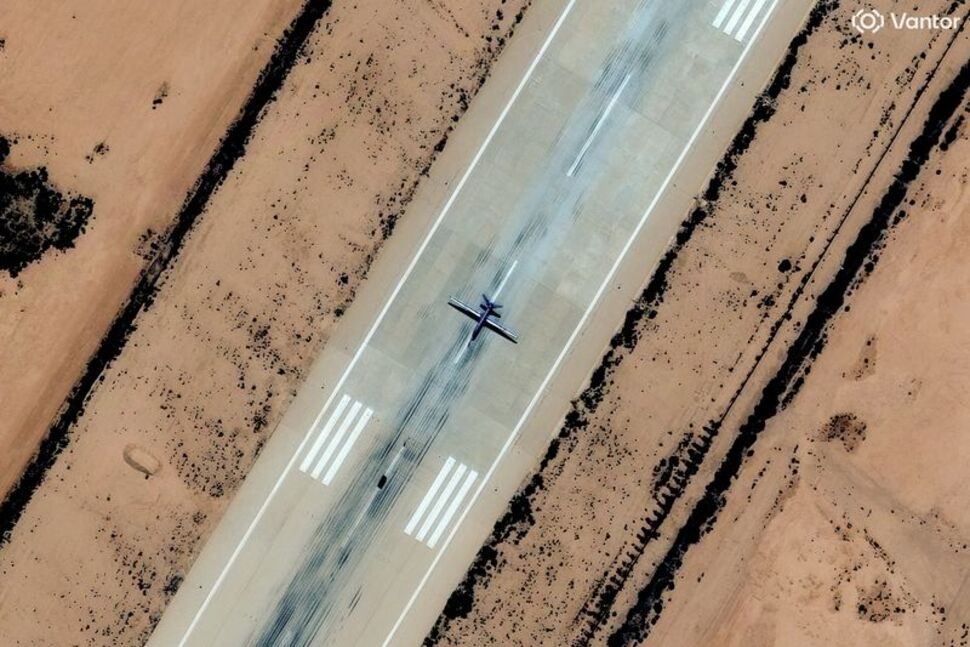
Between late April and July last year, a type of drone not previously seen in Libya was parked outside a hangar on the northern apron at Al Khadim, satellite imagery reviewed by Reuters shows. The same type of drone also appeared on Al Khadim’s runway in a May 3 image from U.S. satellite imaging company Vantor, which suggests it was being used, according to Wim Zwijnenburg, a military technology expert at Dutch peace organisation PAX.
The dimensions and body shape are similar to a Wing Loong II, but the wing design makes it more likely to be a Feilong-1, Zwijnenburg said. Jeremy Binnie, a Middle East specialist at defence intelligence company Janes, and Joseph Dempsey, a military analyst with London’s International Institute for Strategic Studies think tank, concurred with that assessment.
Few photographs have been released of the model, and Reuters could not find any previous satellite imagery, making it difficult to identify with certainty.
A new shelter was completed in November over the spot where the drone had been parked, which Binnie said might explain why it wasn’t visible in subsequent imagery. A truck carrying satellite equipment, which he said was likely used to pilot the aircraft, was standing near the apron as recently as January 12.
Haftar appears to have been trying for years to acquire military drones from China, said Justyna Gudzowska, executive director of the watchdog group The Sentry, citing international law enforcement operations targeting sanctions violations.
Chinese drones were involved in two alleged attempts to smuggle unauthorised military equipment into eastern Libya since 2019, according to investigators in the U.S., Canada and Italy.
In June 2024, Italian authorities acting on U.S. intelligence seized a shipment of drone parts en route from China to Benghazi. U.N. experts who inspected the components found they were consistent with parts from two Feilong-1 drones, a model they concluded was covered by the embargo, according to a draft of the panel’s 2025 report seen by Reuters.
China has disputed the parts were military equipment, previously telling the U.N. panel they appeared to be from a scrapped model used for emergency rescues and disaster relief.
Two smaller drones appeared on the same apron at Al Khadim in a Dec. 17 Vantor image. Their length, wingspan and twin-boom tail design are consistent with Turkish TB2 drones, said Dempsey, who alerted Reuters to the image.
The model gained renown when Ukraine deployed them against invading Russian forces and has been exported widely, including to the UAE.
Armsmakers in countries including China, the UAE and Belarus have also produced similar-looking models. However, two ground control units with distinctive double-antennae set-ups, which appeared in satellite imagery between July and March, strongly suggest that TB2s were operating in the area, all three experts agreed.
Satellite images from California-based firm Planet Labs show Al Khadim has undergone extensive renovations since early last year. They include the addition of at least three new hangars on the apron where the drones were spotted.
Another structure under construction in the images analysed by Reuters is likely intended for “stationing and launching of Turkish Bayraktar UAVs”, the U.N. panel said in the draft report.
Russian forces, which use Libya as a springboard for their own operations in West and Central Africa, are present at Al Khadim. But the experts who spoke to Reuters did not think they were operating the drones in the imagery.
Baykar’s chief executive, Haluk Bayraktar, told CNN in a 2022 interview his company would never supply drones to Russia because “we support Ukraine, support its sovereignty”.
While Moscow has been known to use some Chinese-made surveillance drones and components, there is no record of it deploying a fully assembled Chinese combat drone, military expert Zwijnenburg said.
Russia’s defence and foreign ministries did not respond to requests for comment.
(Alexander Dziadosz reported from Cairo, Aaron McNicholas from London and Vinaya K from Bengaluru; Additional reporting by Milan Pavicic and Reade Levinson in London, Giulia Paravicini in Nairobi, Tuvan Gumrukcu in Ankara, Can Sezer in Istanbul and Luc Cohen in New York; Writing by Alexander Dziadosz; Editing by Alexandra Zavis)
Copyright 2026 Thomson Reuters.
Photos You Should See – March 2026

