


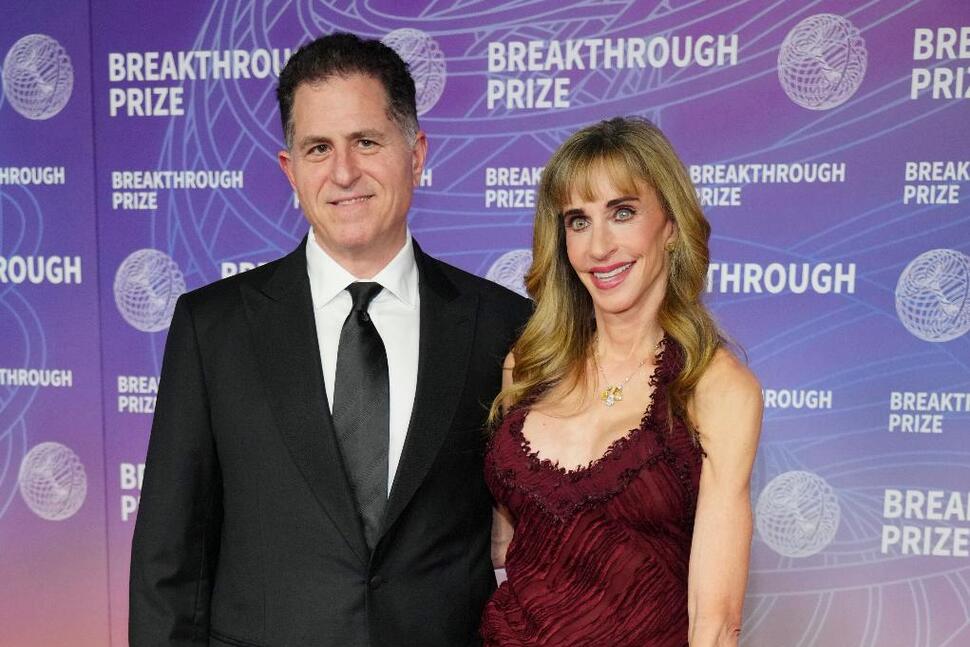
NEW YORK (AP) — Billionaires Michael and Susan Dell are fueling the University of Texas at Austin’s medical research ambitions with a $750 million gift that promises to improve patient care through artificial intelligence and increase health care options for the booming state capital.
The UT Dell Medical Center, announced Tuesday, is projected to open in 2030 as the crown jewel of a new 300-plus-acre advanced research campus. The university expects to break ground this fall on what school leaders are calling the country’s first “AI-native” hospital.
The donation makes the couple the first University of Texas donors to give more than $1 billion, according to system officials, building on two decades of support for computer science education, the medical school and scholarships for students with the most significant financial need.
For Michael Dell, the founder and CEO of Dell Technologies whose net worth is estimated by Forbes at about $170 billion, the next step was to further expand his and his wife’s investments in Central Texas. The computer magnate founded the company in 1984 as a UT-Austin pre-med student selling customized supercomputers from his freshman dorm room. Health infrastructure needs became clear, he said, as the area’s population about doubled in size.
“I was born in Texas. My wife was born in Texas. This is our home,” Dell told the Associated Press, adding that “building a stronger health system here, more innovation and helping to support the growth and stability of the region” is important.
A ‘rare’ opportunity to integrate technology into a new medical center
With the launch of UT Dell Medical Center, however, Dr. Claudia Lucchinetti sees a rare opportunity: instead of retroactively applying new technologies to old hospital infrastructure, she said they can integrate them from the start. They will also collaborate with the University of Texas MD Anderson Cancer Center in Houston to offer top specialists for those with complex conditions.
Lucchinetti, the dean of Dell Medical School and senior vice president for medical affairs, said their model will use technology to support the patient-doctor relationship and make care “feel simpler and more human.” “Ambient” AI will make the hospital itself an “intelligent member of the care team,” she said, taking notes so that clinicians can treat patients more directly. She touted AI’s ability to identify biometric patterns and early signs of cancer before they’re obvious to the naked eye.
The goal, she said, is to move from a reactive and fragmented health system to one that is predictive and more seamless.
“We have the technology, the science and the understanding to do better. And what we’ve been missing is the ability to design a system around those capabilities from the start,” she said. “That’s the opportunity that Susan and Michael Dell have catalyzed.”
The gift will also support undergraduate scholarships, student housing and UT’s Texas Advanced Computing Center, where officials are building the nation’s largest academic supercomputer with Dell’s AI infrastructure.
In a convocation address two years ago, Michael Dell encouraged medical school graduates to ensure AI models understand human ethics and make health care more equitable. He believes the technology will augment caregiving, create more precise treatments, accelerate scientific discoveries and apply those findings to real-world practices sooner.
“We have to figure out how to do this in a way that is responsible, reflects our values and beliefs, and ultimately enables humans to reach their full potential,” he told AP. “That’s what we’re all working on.”
Landscape for higher education giving
The major contribution comes at a time when private support for higher education is falling to a dwindling pool of supporters.
Rutgers University Associate Dean for Research Marybeth Gasman said she’s excited to see such strong support for a public institution at a time when public funding is declining amid politicized attacks on higher education. She hopes the megagift inspires other donations, as she said decades-long patterns suggest that more giving occurs after high-profile individual contributions.
“Higher education, quite frankly, could really use it right now,” she said.
UT-Austin officials are certainly hoping so. The Dells’ gift kicks off a broader 10-year campaign to raise $10 billion for the university.
The donation comes on the heels of the Dells’ $6.25 billion pledge to provide an incentive to claim new investment accounts under President Donald Trump’s tax law for 25 million American children ages 10 and under. The “Trump Accounts” give $1,000 to every newborn, so long as their parents open one, and invests those funds in the stock market. The couple believes it is the largest single private commitment made to U.S. children.
Michael Dell said even a small sum makes a child more likely to enter college — “perhaps at the University of Texas or some other great school” — and eventually start a family or business. He welcomed the creativity he’s seeing from other “Trump Accounts” funders. He’s seen cities offer additional investments for community service and good grades. He noted that hedge fund managers Brad Gerstner and Ray Dalio have seeded accounts in Indiana and Connecticut, respectively.
“I think you’ll see many more gifts at the local community level and some other big ones at the national level,” he said.
But he dismissed the suggestion that, between the “Trump Accounts” and this University of Texas gift, there’s been a shift in his and his wife’s philanthropy toward more selective, bigger bets.
“Certainly, we’ve been very blessed and we have a lot of resources,” he said. “So, we’re looking for things that have significant impact.”
Associated Press coverage of philanthropy and nonprofits receives support through the AP’s collaboration with The Conversation US, with funding from Lilly Endowment Inc. The AP is solely responsible for this content. For all of AP’s philanthropy coverage, visit https://apnews.com/hub/philanthropy.
Copyright 2026 The Associated Press. All rights reserved. This material may not be published, broadcast, rewritten or redistributed.
Photos You Should See – April 2026

