


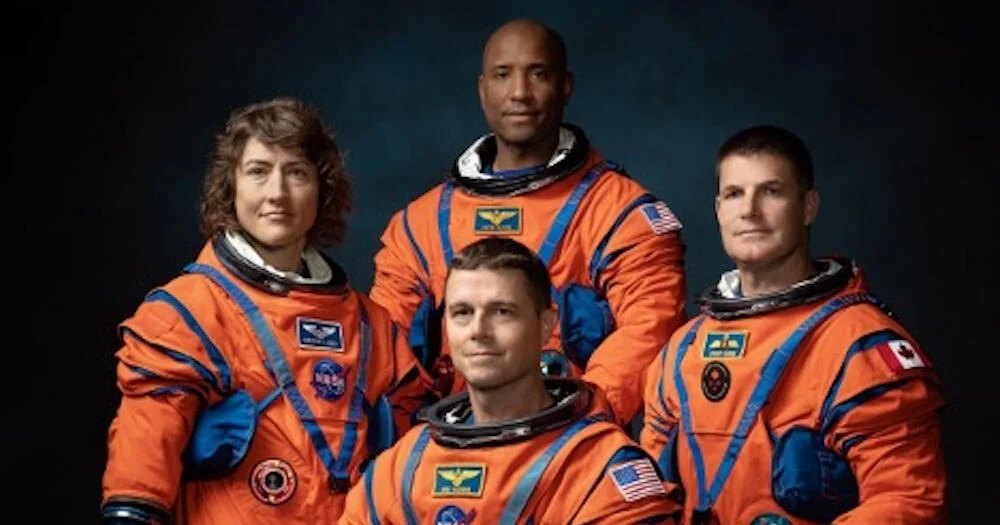
The four Artemis II astronauts scheduled to launch on a trip around the moon this week stand out even in a NASA astronaut corps full of super achievers.
They include three space station veterans and a Canadian rookie — a commander who is a single parent to two children; an experienced Navy pilot; a veteran spacewalker who will become the first woman to fly to the moon; and the first Canadian who will fly beyond low-Earth orbit.
NASA 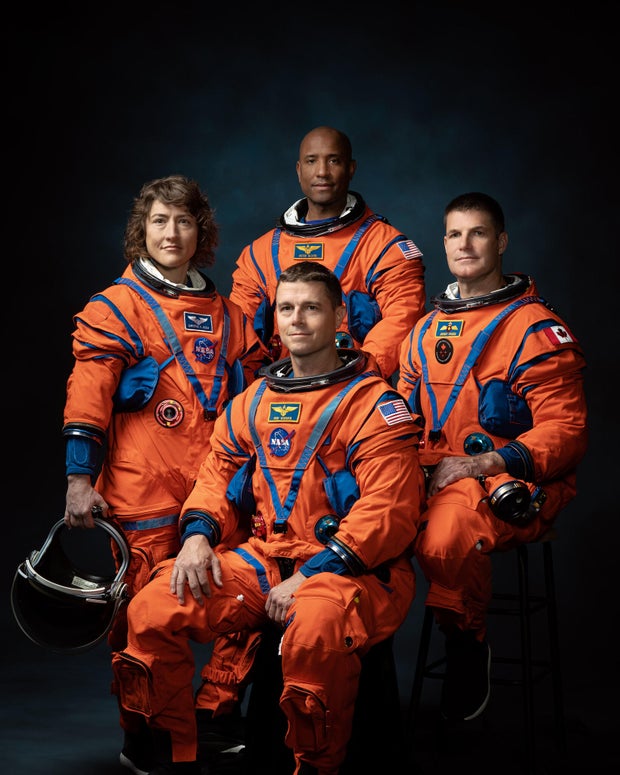

“It’s extraordinary as a human being to go to the far side of the moon and look back and see the Earth from the perspective of the moon,” Canadian astronaut Jeremy Hansen said in an interview with CBS News. “Whatever that looks like, and whatever that feels like, that is an extraordinary opportunity that I’m very grateful for.”
Said astronaut Christina Koch: “How do we feel as the people that can call the moon (a) destination, not just something we’re looking at? It is our strong hope that this mission is the start of an era where everyone, every person on Earth, can look at the moon and think of it as also a destination.”
Koch, Hansen, pilot Victor Glover and commander Reid Wiseman were selected with great fanfare in April 2023. They have spent the past three years training for a relatively short nine-day mission to loop around the moon, a trailblazing flight that sets the stage for planned moon landings in 2028 and the construction of a lunar base near the moon’s south pole.
The crew brings a wealth of experience to NASA’s most challenging mission in decades — scheduled for liftoff Wednesday evening. Here’s a brief look at the astronauts.
Reid Wiseman, Artemis II commander
Mission commander Reid Wiseman, 50, was born in Baltimore, earned a degree in computer and science engineering from the Rensselaer Polytechnic Institute and a master’s degree in systems engineering from Johns Hopkins University.
Miguel J. Rodriguez Carrillo /AFP via Getty Images 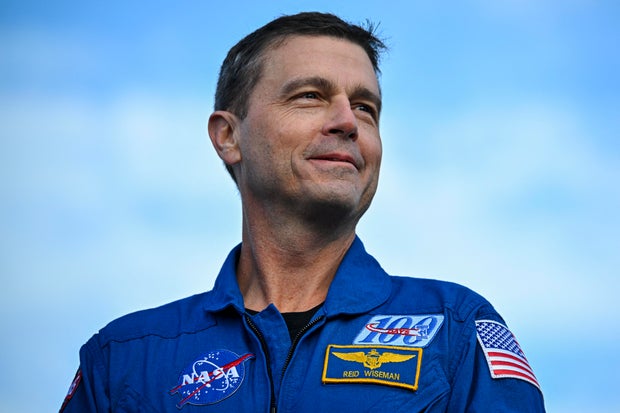

He became a naval aviator in 1999, completed multiple aircraft carrier deployments, put in a stint at the U.S. Naval Test Pilot School flying F-35 and F-18 fighter jets before another carrier deployment. He was at sea when he was selected to join NASA’s astronaut corps in 2009.
Wiseman first flew in space in 2014, launching aboard a Russian Soyuz spacecraft, logging 165 days in orbit aboard the International Space Station and completing two spacewalks totaling 12 hours and 47 minutes.
His wife Carroll, a registered nurse, died in 2020 after a long battle with cancer.
“When she really started getting sick, I wanted to move us back towards where her family was from,” Wiseman said. “And she’s like, ‘No, this is where you work. This is the job you love. This is where you work, and this is where our kids are growing up, and we are going to stay right here.’ To me, that was marching orders … to continue down this path.”
He protects the family’s privacy, but has said raising their daughters as a single dad has been the greatest challenge of his life.
“They would rather I not go,” he said in an interview. “They would definitely rather I be a stay-at-home dad and hang out. But they also know that this is a unique opportunity. You know, the parents have to live their dreams just like the kids have to live their dreams.”
U.S. Navy Captain Victor Glover, Artemis II pilot
Born in Pomona, California, Glover, 49, is married and the father of four children. He earned an engineering degree from California Polytechnic State University and three master’s degrees in military aviation, systems engineering and management.
Miguel J. Rodriguez Carrillo /AFP via Getty Images 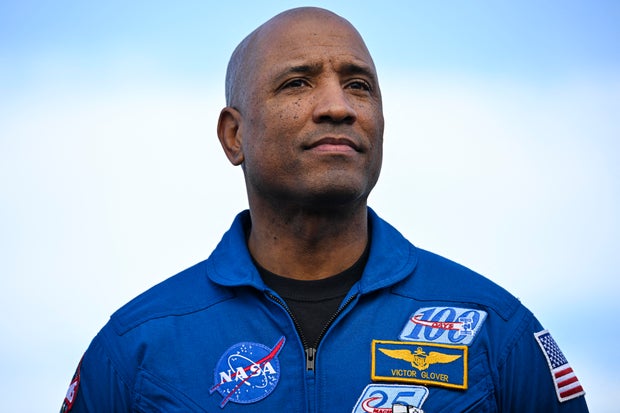
An F/A-18 pilot, Glover logged a deployment aboard USS John F. Kennedy aircraft carrier, spent a year as a Navy exchange pilot at the Air Force Test Pilot School and went on to fly with several fighter squadrons before being selected for a Legislative Fellowship assigned to the office of a U.S. senator. He was a Legislative Fellow in the Senate when selected as an astronaut in 2013.
A father of four, Glover has logged more than 3,500 hours flying time in more than 40 aircraft, completing more than 400 carrier flights and 24 combat missions. He served as pilot of the first operational SpaceX Crew Dragon flight to the International Space Station in 2020-21, logging 168 days in orbit and completing four spacewalks.
“I was going through a lot when I got assigned to this mission,” he said. “I had some real challenges going on in my life, and I was trying to do some things professionally as well as personally. And when this assignment came up, it was a tough time to shift gears for me.
“So I took some time to tell my wife, and then we told the kids when we could all be together. … When I told them, they erupted, let’s go! I’m about to start crying right now. Like I needed that. I didn’t even know I needed it.”
Christina Koch, mission specialist
Christina Koch (pronounced “Cook”), 47, was born in Grand Rapids, Michigan, but grew up in Jacksonville, North Carolina. A surfer and rock climber who enjoys backpacking, photography and travel, Koch holds a bachelor’s degree in engineering from North Carolina State University and studied abroad in Ghana.
Miguel J Rodriguez Carrillo /AFP via Getty Images 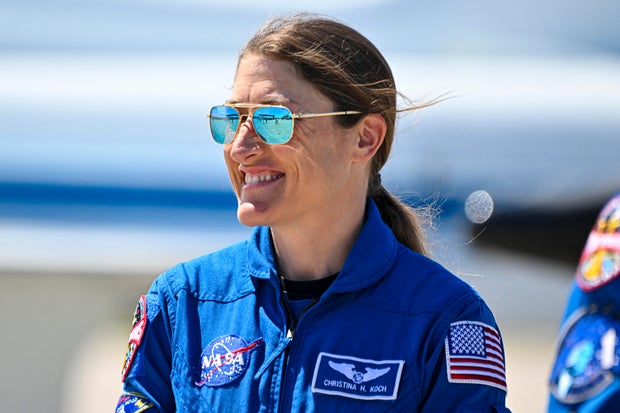
She worked as an electrical engineer at NASA’s Goddard Space Flight Center before working as a research associate in Antarctica and wintering over at the Admunsen-Scott South Pole Station. She then worked at Johns Hopkins University, helping develop science instruments for NASA’s Juno probenow orbiting Jupiter, and two spacecraft designed to study the Van Allen radiation belts.
As if that wasn’t enough, Koch then resumed field work in Antarctica and Greenland before work with the National Oceanic and Atmospheric Administration in Alaska and Samoa.
She met her husband before becoming an astronaut, “and I remember telling him that I was applying when we started dating and but that, don’t worry, that would never happen.”
But it did. Her application was approved and she joined the astronaut corps in 2013. She logged 328 days in space aboard the International Space Station in 2019-20, conducting six spacewalks, including the first three all-female outings.
The Artemis II mission is a natural step for a woman who has devoted her life to exploration, both on and off the planet.
“To me, what it all comes down to is … answering some of the biggest philosophical questions of our time,” she said. “Are we alone? Could there be life out there? We have to know how our solar system formed, how other solar systems around other stars might have formed.
“And secondly, I think we go to learn about ourselves when we are behind the moon and we’re separated from the rest of humanity. Hopefully that’s a poignant moment where we can think to ourselves, what is important when you send other humans off of the planet? What do we care about? What unites us, what makes us the same?
“Those questions are answered when we take these big journeys, and they inform how we live our everyday lives.”
Jeremy Hansen, Canadian mission specialist
Born in London, Ontario, Hansen, 50, grew up on a farm until his high school years in Ingersoll, Ontario. A rock climber and mountain biker who enjoys sailing, he is married and the father of three children.
Miguel J. Rodriguez CARRILLO /AFP via Getty Images 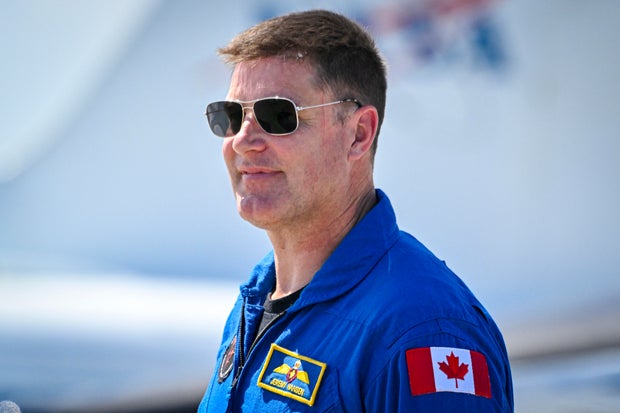
At age 12, Hansen began what turned into a lifelong career in aviation, joining the Royal Canadian Air Cadet Squadron and earning his glider pilot wings at 16 and a private pilot’s license a year later.
He earned a bachelor’s degree, with honors, in space science from the Royal Military College and starting in 2004, served as a CF-18 fighter pilot and combat operations officer, working with NORAD and Arctic flying operations. The Canadian Space Agency selected him for astronaut training in 2009.
In 2017 he became the first Canadian to lead a NASA astronaut class and was named to the Artemis II crew six years later. Fifteen Canadians have flown in space, but none have flown farther than low-Earth orbit. Hansen will be the first to venture into deep space and the first to fly around the moon.
The Artemis II mission will be the first piloted flight of NASA’s giant Space Launch System rocket and the first flight of an Orion crew capsule with astronauts on board.
“It’s a test flight, and we have to be willing to take that risk,” Hansen said. “And that’s the one that I talk to my family about. I’m very optimistic. I truly believe the most likely outcome is we’ll all be totally fine when we hit the Pacific Ocean.
“But I want everyone to understand that you can lose a crew, and if we do that, it shouldn’t shock us. And the most important thing we do next is we stack the next rocket, and let the next four volunteers get on top of it and go.”
He said asking his wife and children to accept that risk is “a lot to ask of a family. My kids are all young adults now, but still a lot to ask of them. But they’re really showing up. They’re really supportive.”